
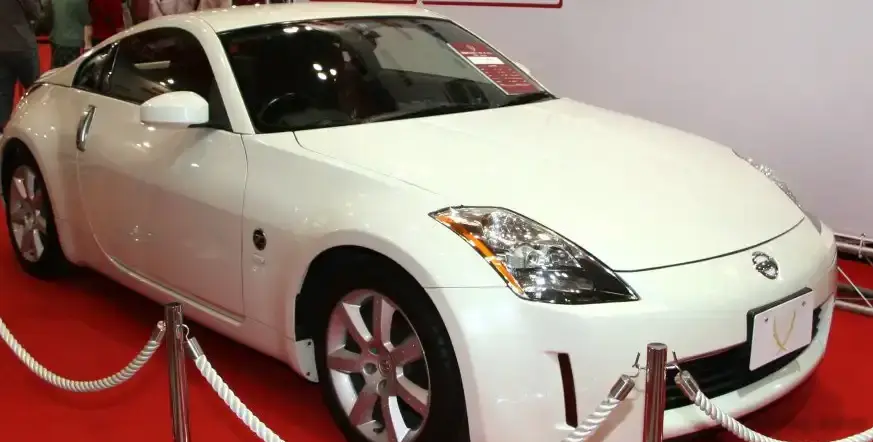
The Nissan Fairlady 3.5i, produced between 2002 and 2004, represented a significant iteration of Nissan’s long-running Z-car lineage. This variant, powered by the VQ35DE engine, was positioned as the performance flagship of the 350Z (known as the Fairlady Z in Japan) range during its initial release. It aimed to recapture the spirit of the original Fairlady Z cars, offering a blend of modern technology, sporty handling, and accessible performance. The 3.5i was a key model in re-establishing Nissan’s presence in the sports car market, particularly in North America where the Z-car had a strong following.
Technical Specifications
| Brand | Nissan |
| Model | Fairlady |
| Generation | Fairlady |
| Type (Engine) | 3.5 i (283 Hp) |
| Start of production | 2002 |
| End of production | 2004 |
| Powertrain Architecture | Internal Combustion engine |
| Body type | Coupe |
| Fuel Type | Petrol (Gasoline) |
| Power | 283 Hp @ 6200 rpm |
| Power per litre | 80.9 Hp/l |
| Torque | 352 Nm @ 4800 rpm |
| Torque (lb-ft) | 259.62 lb.-ft. @ 4800 rpm |
| Engine layout | Front, Longitudinal |
| Engine Model/Code | VQ35DE |
| Engine displacement | 3498 cm3 |
| Engine displacement (cu. in.) | 213.46 cu. in. |
| Number of cylinders | 6 |
| Engine configuration | V-engine |
| Cylinder Bore | 95.5 mm |
| Cylinder Bore (in.) | 3.76 in. |
| Piston Stroke | 81.4 mm |
| Piston Stroke (in.) | 3.2 in. |
| Compression ratio | 10.3:1 |
| Number of valves per cylinder | 4 |
| Fuel injection system | Multi-port manifold injection |
| Engine aspiration | Naturally aspirated engine |
| Valvetrain | DOHC |
| Engine oil capacity | 4.7 l |
| Engine oil capacity (US qt) | 4.97 US qt |
| Engine oil capacity (UK qt) | 4.14 UK qt |
Powertrain & Engine Architecture
The heart of the Fairlady 3.5i is the VQ35DE 3.5-liter V6 engine. This engine is a member of Nissan’s highly regarded VQ engine family, known for its smooth operation, reliability, and strong performance. The VQ35DE features a 60-degree V-angle, aluminum alloy block and cylinder heads, and dual overhead camshafts (DOHC) with variable valve timing (VVT) on both intake and exhaust valves. This VVT system optimizes engine performance across the rev range, enhancing both low-end torque and high-end horsepower. The engine utilizes a multi-port fuel injection system, delivering precise fuel metering for efficient combustion. The engine’s design prioritized a relatively compact size and low weight, contributing to the car’s balanced handling. The 3.5i was exclusively offered with a 6-speed manual transmission, providing drivers with direct control over the engine’s power.
Driving Characteristics
The Fairlady 3.5i delivered a distinctly sporty driving experience. The 283 horsepower and 259 lb-ft of torque provided brisk acceleration, with 0-60 mph times typically falling in the low-to-mid 5-second range. The engine’s powerband was broad and usable, making it enjoyable to drive both on the street and on the track. The 6-speed manual transmission featured well-defined shift gates and a relatively short throw, encouraging spirited driving. The car’s chassis was well-tuned, offering a good balance between ride comfort and handling precision. Steering was responsive and well-weighted, providing good feedback to the driver. While not as raw or visceral as some European sports cars, the Fairlady 3.5i offered a refined and accessible performance experience.
Equipment & Trim Levels
The Fairlady 3.5i was generally well-equipped, reflecting its position as the top-of-the-line model. Standard features included leather upholstery, air conditioning, power windows and locks, a premium sound system, and alloy wheels. Optional extras included a Bose audio system, navigation system, and various cosmetic enhancements. Interior trim was focused on a sporty aesthetic, with metallic accents and supportive bucket seats. The dashboard layout was driver-focused, with clearly legible gauges and intuitive controls. The 3.5i also featured a limited-slip differential, enhancing traction and cornering performance.
Chassis & Braking
The Fairlady 3.5i utilized a MacPherson strut front suspension and a multi-link rear suspension. This suspension setup provided a good balance of ride comfort and handling performance. The car’s chassis was relatively stiff, contributing to its responsive handling. Braking duties were handled by ventilated disc brakes on all four wheels, providing ample stopping power. Anti-lock brakes (ABS) were standard, enhancing safety and control during hard braking. The car’s wheel and tire combination was optimized for both grip and handling, with wider tires typically fitted to the rear wheels.
Market Reception & Comparison
The Fairlady 3.5i was generally well-received by automotive critics. It was praised for its strong performance, refined handling, and attractive styling. Some critics noted that the car’s interior, while well-equipped, lacked the premium feel of some European competitors. Compared to the base 3.0-liter Fairlady Z, the 3.5i offered a significant performance upgrade, justifying its higher price tag. It competed directly with sports cars such as the Porsche Cayman, BMW Z4, and Audi TT. The Fairlady 3.5i offered a compelling value proposition, providing comparable performance to its European rivals at a lower price point.
Legacy
The VQ35DE engine has proven to be remarkably durable and reliable, and the Fairlady 3.5i is generally considered a well-built and dependable sports car. Used examples are still relatively common on the market today, and well-maintained cars can provide years of enjoyable driving. The 3.5i’s strong performance and attractive styling have made it a popular choice among enthusiasts. The car’s relatively simple mechanical design makes it relatively easy to maintain and repair. The Fairlady 3.5i played a significant role in re-establishing Nissan as a major player in the sports car market, and it remains a fondly remembered model among Z-car enthusiasts.
