
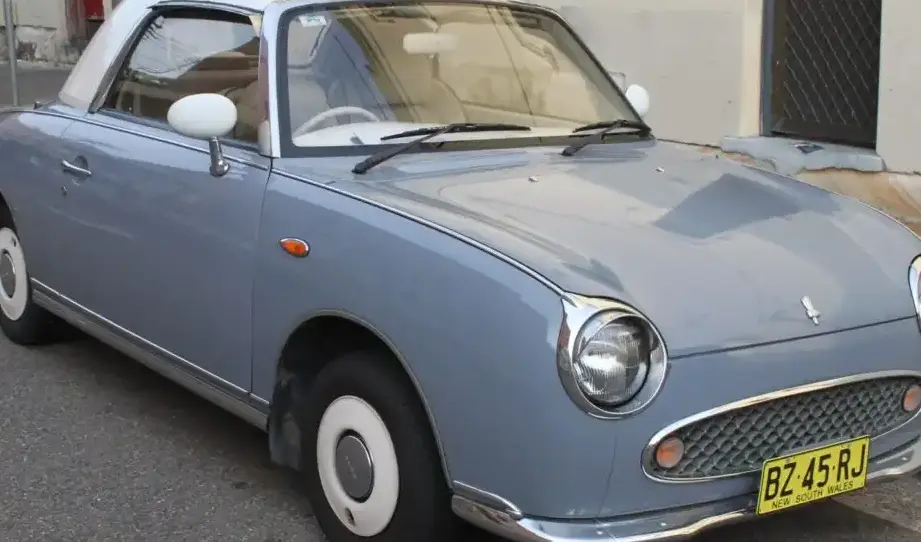
The Nissan Figaro, a retro-styled convertible, was a limited-production vehicle released by Nissan in 1991. Part of Nissan’s “Pike Factory” series – which also included the Be-1 and Pao – the Figaro aimed to evoke the spirit of 1960s roadsters, specifically the Datsun Fairlady. Production was intentionally limited to around 20,000 units, creating an instant collector’s item. The 1.0 T variant, powered by a supercharged 1.0-liter engine and paired with a 3-speed automatic transmission, represented a unique entry point into the Figaro lineup, prioritizing ease of use and a distinctive driving experience over outright performance. It was only available for one year, adding to its exclusivity.
Technical Specifications
| Brand | Nissan |
| Model | Figaro |
| Generation | Figaro |
| Type (Engine) | 1.0 T (76 Hp) |
| Start of production | 1991 |
| End of production | 1991 |
| Powertrain Architecture | Internal Combustion engine |
| Body type | Cabriolet |
| Seats | 4 |
| Doors | 2 |
| Fuel Type | Petrol (Gasoline) |
| Weight-to-power ratio | 16.3 kg/Hp, 61.5 Hp/tonne |
| Weight-to-torque ratio | 11.7 kg/Nm, 85.8 Nm/tonne |
| Power | 76 Hp @ 6000 rpm |
| Power per litre | 77 Hp/l |
| Torque | 106 Nm @ 4400 rpm (78.18 lb.-ft. @ 4400 rpm) |
| Engine layout | Front, Transverse |
| Engine displacement | 987 cm3 (60.23 cu. in.) |
| Number of cylinders | 4 |
| Engine configuration | Inline |
| Cylinder Bore | 68 mm (2.68 in.) |
| Piston Stroke | 68 mm (2.68 in.) |
| Engine aspiration | Supercharger |
| Valvetrain | SOHC |
| Kerb Weight | 1235 kg (2722.71 lbs.) |
| Max. weight | 1835 kg (4045.48 lbs.) |
| Max load | 600 kg (1322.77 lbs.) |
| Fuel tank capacity | 40 l (10.57 US gal | 8.8 UK gal) |
| Length | 3740 mm (147.24 in.) |
| Width | 1630 mm (64.17 in.) |
| Height | 1365 mm (53.74 in.) |
| Wheelbase | 2300 mm (90.55 in.) |
| Front track | 1350 mm (53.15 in.) |
| Rear (Back) track | 1335 mm (52.56 in.) |
| Minimum turning circle | 9.4 m (30.84 ft.) |
| Drivetrain Architecture | The Internal combustion engine (ICE) drives the front wheels of the vehicle. |
| Drive wheel | Front wheel drive |
| Number of gears and type of gearbox | 3 gears, automatic transmission |
| Front suspension | Independent type McPherson |
| Rear suspension | Semi-independent, coil spring |
| Front brakes | Ventilated discs |
| Rear brakes | Drum |
| Tires size | 165/70R12 |
Powertrain & Engine Architecture
The heart of the Figaro 1.0 T is the EA15 engine, a 987cc inline-four cylinder engine. What sets this engine apart is its use of a Roots-type supercharger, a relatively uncommon feature for a vehicle of this size and era. The supercharger, driven directly off the crankshaft, provides a boost in low-end torque, compensating for the engine’s small displacement. The engine utilizes a single overhead camshaft (SOHC) valvetrain and multi-point fuel injection. The engine code is typically identified as VG10 or VG10E. The 3-speed automatic transmission, while providing convenient operation, is a relatively simple unit designed for smooth, rather than sporty, shifts. It’s a traditional hydraulic automatic, lacking the electronic controls found in more modern transmissions.
Driving Characteristics
The Figaro 1.0 T’s driving experience is best described as relaxed and charming. The supercharger provides adequate acceleration for city driving, but it’s not a particularly quick car. The 3-speed automatic transmission has relatively wide gear ratios, meaning the engine can feel strained at higher speeds. Compared to the manual transmission versions, the automatic Figaro sacrifices some responsiveness. The automatic is geared more towards fuel efficiency and ease of use, appealing to drivers who prioritize comfort over performance. The power delivery is linear, with the supercharger providing a noticeable boost off the line. However, the overall power output of 76 horsepower limits its highway cruising ability.
Equipment & Trim Levels
The Figaro was remarkably well-equipped for its price point and target market. Standard features included power windows, power steering, and a retro-styled interior with comfortable cloth seats. The interior design was a key element of the Figaro’s appeal, featuring a wood-grain dashboard and chrome accents. The 1.0 T trim generally came with a fixed rear spoiler and a unique color palette, often featuring pastel shades. Optional extras included air conditioning, a premium sound system, and upgraded interior trim materials. The Figaro’s interior was designed to evoke the feeling of a classic British roadster, with a focus on style and comfort.
Chassis & Braking
The Figaro utilizes a front-wheel-drive layout with an independent McPherson strut suspension in the front and a semi-independent coil spring suspension in the rear. The front brakes are ventilated discs, providing adequate stopping power, while the rear brakes are drums. The suspension setup is tuned for comfort, providing a relatively soft ride. The chassis is a monocoque construction, providing a good level of rigidity for a small convertible. The relatively light weight of the vehicle – around 2723 lbs – helps to offset the limited power output. Stabilizer bars were fitted to both the front and rear axles to reduce body roll during cornering.
Market Reception & Comparison
The Nissan Figaro was a critical and commercial success in Japan. Its unique styling and limited production run made it an instant collector’s item. Critics praised its retro design, comfortable interior, and ease of use. However, the 1.0 T variant was sometimes criticized for its lack of performance compared to other vehicles in its class. Compared to other Pike Factory models like the Be-1 and Pao, the Figaro offered a more refined and comfortable driving experience. The automatic transmission appealed to a wider range of buyers, while the supercharged engine provided a unique selling point. Fuel economy was reasonable for the time, averaging around 35-40 mpg.
Legacy
Today, the Nissan Figaro 1.0 T is a highly sought-after classic car, particularly in Japan and increasingly in Europe and the United States. Its unique styling and limited production run have made it a collector’s favorite. The supercharged engine and automatic transmission combination is relatively rare, adding to its desirability. While the powertrain is generally reliable, age-related issues such as corrosion and worn rubber components are common. Parts availability can be a challenge, but a growing aftermarket support network is emerging. The Figaro represents a unique chapter in Nissan’s history, showcasing the company’s willingness to experiment with retro styling and limited-production vehicles. It remains a charming and distinctive example of 1990s automotive design.
