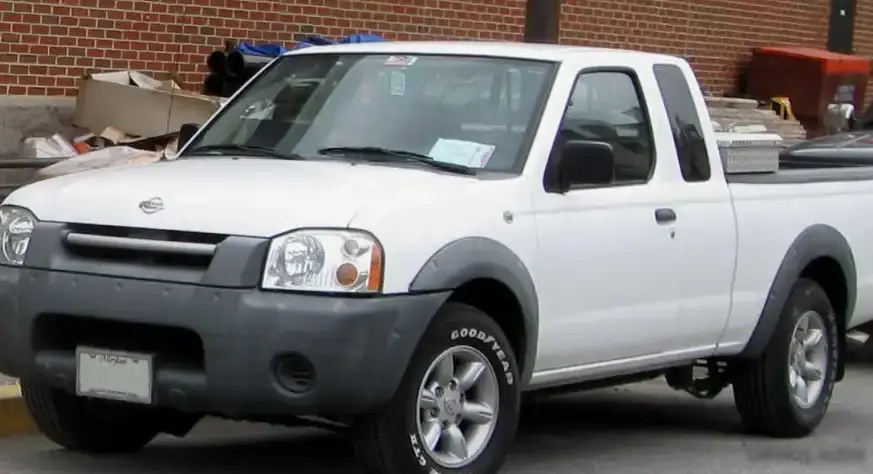
The Nissan Frontier I King Cab Long (D22), specifically the facelifted version produced from 2002 to 2004, represented Nissan’s entry into the mid-size pickup truck market in North America and other global regions. This generation, launched in 1998 and receiving a significant refresh in 2000, aimed to provide a more compact and fuel-efficient alternative to full-size trucks like the Ford F-150 and Chevrolet Silverado. The 3.3-liter V6 4×4 variant occupied a middle ground within the Frontier lineup, offering a balance between capability, affordability, and everyday usability. It was positioned as a step up from the base 2.4-liter four-cylinder models, appealing to buyers needing more power for towing and hauling, while remaining more accessible than the supercharged V6 options.
Technical Specifications
| Brand | Nissan |
| Model | Frontier |
| Generation | Frontier I King Cab Long (D22, facelift 2000) |
| Type (Engine) | 3.3 V6 (170 Hp) 4×4 |
| Start of production | 2002 |
| End of production | 2004 |
| Powertrain Architecture | Internal Combustion engine |
| Body type | Pick-up |
| Seats | 4 |
| Doors | 2 |
| Fuel Type | Petrol (Gasoline) |
| Acceleration 0 – 100 km/h | 9.3 sec |
| Acceleration 0 – 62 mph | 9.3 sec |
| Acceleration 0 – 60 mph | 8.8 sec |
| Power | 170 Hp @ 4800 rpm |
| Power per litre | 51.9 Hp/l |
| Torque | 271 Nm @ 2800 rpm / 199.88 lb.-ft. @ 2800 rpm |
| Engine Model/Code | VG33E |
| Engine displacement | 3275 cm3 / 199.85 cu. in. |
| Number of cylinders | 6 |
| Engine configuration | V-engine |
| Cylinder Bore | 91.5 mm / 3.6 in. |
| Piston Stroke | 83 mm / 3.27 in. |
| Number of valves per cylinder | 2 |
| Engine aspiration | Naturally aspirated engine |
| Engine oil capacity | 3.3 l / 3.49 US qt | 2.9 UK qt |
| Coolant | 11 l / 11.62 US qt | 9.68 UK qt |
| Fuel tank capacity | 73.4 l / 19.39 US gal | 16.15 UK gal |
| Length | 5153 mm / 202.87 in. |
| Width | 1808 mm / 71.18 in. |
| Height | 1694 mm / 66.69 in. |
| Wheelbase | 2950 mm / 116.14 in. |
| Front track | 1525 mm / 60.04 in. |
| Rear (Back) track | 1507 mm / 59.33 in. |
| Drive wheel | All wheel drive (4×4) |
| Number of gears and type of gearbox | 5 gears, manual transmission |
| Front suspension | Double wishbone |
| Rear suspension | Leaf spring |
| Front brakes | Ventilated discs |
| Rear brakes | Drum |
| Assisting systems | ABS (Anti-lock braking system) |
| Tires size | 265/70 R15; 255/65 R16; 265/55 R17 |
| Wheel rims size | 7.0J x 15; 7.0J x 16; 7.0J x 17 |
Powertrain & Engine Architecture
The heart of this Frontier variant is the VG33E 3.3-liter V6 engine. This engine, part of Nissan’s VG series, is a naturally aspirated, iron-block, aluminum-head design. It features a single overhead camshaft (SOHC) valvetrain with two valves per cylinder. Fuel delivery is managed by a multi-point fuel injection system. The VG33E is known for its relative simplicity and durability, though it lacks the sophistication of more modern engines. The engine produces 170 horsepower at 4800 rpm and 271 Nm (199.88 lb-ft) of torque at 2800 rpm. This power is delivered through a five-speed manual transmission to the four-wheel-drive system. The 4×4 system typically features a shift-on-the-fly transfer case, allowing the driver to easily switch between 2WD, 4HI, and 4LO modes.
Driving Characteristics
The 3.3L V6 with the five-speed manual transmission provides a reasonably responsive driving experience. Acceleration from 0-60 mph takes around 8.8 seconds, which was competitive for a mid-size pickup of its time. While not a performance-oriented truck, the VG33E offers sufficient power for everyday driving and moderate towing. The manual transmission allows for greater driver control, especially when navigating challenging terrain or hauling loads. The gear ratios are tuned for a balance of acceleration and fuel economy. Compared to the base 2.4-liter engine, the 3.3L provides a noticeable improvement in both power and torque, making it more suitable for tasks like hauling materials or towing a small trailer. However, it doesn’t offer the same level of performance as the optional supercharged V6.
Equipment & Trim Levels
The 2002-2004 Frontier King Cab Long 3.3 V6 4×4 typically came standard with features like air conditioning, power steering, and an AM/FM radio. The King Cab configuration offered a small rear seat, providing limited passenger space. Interior upholstery was typically cloth, with options for upgraded materials available. Common optional extras included a CD player, power windows and locks, and a sliding rear window. The trim level often dictated the availability of these options, with higher trims offering more standard features. The exterior typically featured black plastic bumpers and side moldings, with chrome accents available on higher trim levels.
Chassis & Braking
The Frontier I utilized a body-on-frame construction, providing a robust and durable platform. The front suspension consists of a double wishbone setup, while the rear suspension employs leaf springs. This configuration is typical for pickup trucks, prioritizing load-carrying capacity and durability over ride comfort. Braking duties are handled by ventilated discs in the front and drum brakes in the rear. Anti-lock brakes (ABS) were standard, enhancing safety during emergency braking situations. The tires, typically sized 265/70 R15, 255/65 R16, or 265/55 R17, provide adequate grip for both on-road and off-road driving.
Market Reception & Comparison
The Nissan Frontier I King Cab Long 3.3 V6 4×4 was generally well-received by critics as a capable and affordable mid-size pickup. It was praised for its reliability and durability, as well as its comfortable ride quality. However, some critics noted that the interior was somewhat basic compared to competitors like the Toyota Tacoma. Fuel economy was considered average for its class. Compared to the 2.4-liter Frontier, the 3.3L offered a significant performance boost, making it a more appealing option for buyers needing more power. Compared to the supercharged V6, the 3.3L was more affordable and offered better fuel economy, but lacked the same level of performance.
Legacy
The VG33E engine, while not known for being particularly high-tech, has proven to be a relatively reliable powertrain. Many examples of the 2002-2004 Frontier 3.3 V6 4×4 are still on the road today, a testament to its durability. In the used car market, these Frontiers are often sought after by buyers looking for an affordable and dependable pickup truck. Maintenance is generally straightforward, and parts are readily available. However, like any older vehicle, potential buyers should be aware of common issues such as rust and wear on suspension components. The Frontier I laid the groundwork for the subsequent generations of Frontier, establishing Nissan as a serious contender in the mid-size pickup truck segment.