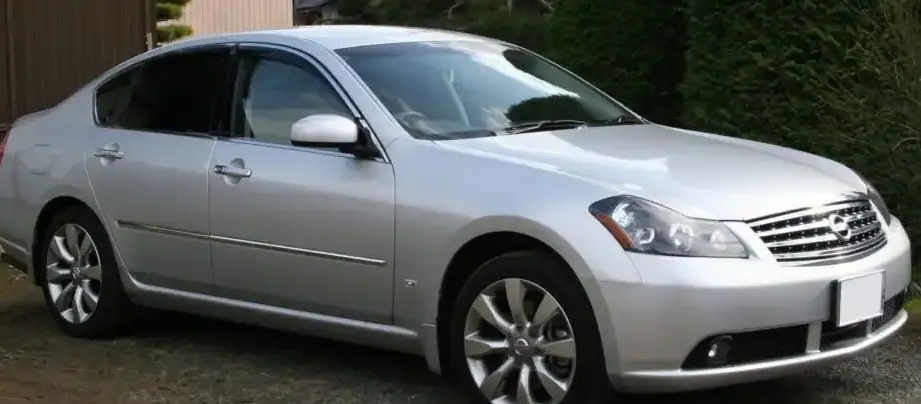
The Nissan Fuga, known as the Infiniti M in North American markets, represented Nissan’s attempt to recapture a share of the luxury sedan segment. The first generation, designated the Y50, was produced from 2004 to 2006 and aimed to offer a blend of performance, comfort, and technology. This article focuses specifically on the 3.5L V6 variant, equipped with the 5-speed automatic transmission, which served as a core offering within the Y50 Fuga lineup. It was positioned as the premium engine choice, offering a significant step up in performance compared to the later introduced 2.5L models.
Technical Specifications
| Brand | Nissan |
| Model | Fuga |
| Generation | Fuga I (Y50) |
| Type (Engine) | 3.5L V6 (283 Hp) |
| Start of production | 2004 |
| End of production | 2006 |
| Powertrain Architecture | Internal Combustion engine |
| Body type | Sedan |
| Seats | 5 |
| Doors | 4 |
| Fuel Type | Petrol (Gasoline) |
| Weight-to-power ratio | 5.8 kg/Hp, 171.5 Hp/tonne |
| Weight-to-torque ratio | 4.7 kg/Nm, 213.3 Nm/tonne |
| Power | 283 Hp @ 6200 rpm |
| Power per litre | 80.9 Hp/l |
| Torque | 352 Nm @ 4800 rpm, 259.62 lb.-ft. @ 4800 rpm |
| Engine layout | Front, Longitudinal |
| Engine Model/Code | VQ35DE |
| Engine displacement | 3498 cm3, 213.46 cu. in. |
| Number of cylinders | 6 |
| Engine configuration | V-engine |
| Cylinder Bore | 95.5 mm, 3.76 in. |
| Piston Stroke | 81.4 mm, 3.2 in. |
| Compression ratio | 10.3:1 |
| Number of valves per cylinder | 4 |
| Fuel injection system | Multi-port manifold injection |
| Engine aspiration | Naturally aspirated engine |
| Valvetrain | DOHC |
| Engine oil capacity | 4.7 l, 4.97 US qt | 4.14 UK qt |
| Kerb Weight | 1650 kg, 3637.63 lbs |
| Fuel tank capacity | 80 l, 21.13 US gal | 17.6 UK gal |
| Length | 4840 mm, 190.55 in |
| Width | 1795 mm, 70.67 in |
| Height | 1510 mm, 59.45 in |
| Wheelbase | 2900 mm, 114.17 in |
| Front track | 1530 mm, 60.24 in |
| Rear (Back) track | 1545 mm, 60.83 in |
| Drivetrain Architecture | The Internal combustion engine (ICE) drives the rear wheels of the vehicle. |
| Drive wheel | Rear wheel drive |
| Number of gears and type of gearbox | 5 gears, automatic transmission |
| Front brakes | Ventilated discs |
| Rear brakes | Ventilated discs |
| Assisting systems | ABS (Anti-lock braking system) |
| Tires size | 225/55 R17 |
Introduction
The Y50 Nissan Fuga was launched in Japan in October 2004, representing a significant departure from the preceding Cefiro. It was built on the Nissan D platform, shared with other Nissan vehicles like the Skyline. The 3.5L V6 model was the flagship offering at launch, intended to compete with established luxury sedans from Toyota, Honda, and European manufacturers. The Fuga aimed to provide a more driver-focused experience than some of its competitors, while still delivering the expected levels of comfort and refinement. The North American market received a rebadged version as the Infiniti M35, further expanding its reach.
Powertrain & Engine Architecture
The heart of the Fuga 3.5L is the VQ35DE engine, a 3.5-liter naturally aspirated V6. This engine is a member of Nissan’s highly regarded VQ engine family, known for its smooth operation, reliability, and strong performance. The VQ35DE features a 60-degree V-angle, dual overhead camshafts (DOHC), and four valves per cylinder. It utilizes a multi-port fuel injection system, delivering fuel directly into the intake ports. The engine produces 283 horsepower at 6200 rpm and 352 Nm (259.62 lb-ft) of torque at 4800 rpm.
Paired with the VQ35DE is a 5-speed automatic transmission. This transmission was chosen for its smooth shifting characteristics and ability to handle the engine’s power output. While not as technologically advanced as some contemporary transmissions, it provided a comfortable and responsive driving experience. The transmission features electronically controlled hydraulic actuation and adaptive shift logic, adjusting shift points based on driving conditions.
Driving Characteristics
The 3.5L V6 Fuga offered brisk acceleration and a refined driving experience. The engine’s torque curve provided ample power for everyday driving and confident passing maneuvers. The automatic transmission, while smooth, wasn’t particularly sporty. Shift points were optimized for comfort and fuel economy rather than aggressive performance. Compared to a manual transmission equipped Fuga (not widely available), the automatic version felt slightly less engaging, but offered greater convenience. The rear-wheel-drive configuration contributed to a balanced feel, although it wasn’t as nimble as some of its front-wheel-drive competitors. The weight distribution, however, was well-managed, minimizing understeer.
Equipment & Trim Levels
The Fuga 3.5L typically came well-equipped, even in its base form. Standard features included leather upholstery, power-adjustable front seats, a premium audio system, automatic climate control, and woodgrain interior trim. Higher trim levels added features such as navigation system, sunroof, and upgraded sound systems. Optional extras included adaptive cruise control, lane departure warning, and a rear-seat entertainment system. The interior design emphasized luxury and comfort, with a focus on high-quality materials and a spacious cabin.
Chassis & Braking
The Y50 Fuga utilized a MacPherson strut front suspension and a multi-link rear suspension. This setup provided a good balance between ride comfort and handling. Stabilizer bars were fitted to both the front and rear axles to reduce body roll during cornering. The braking system consisted of ventilated disc brakes on all four wheels, providing ample stopping power. Anti-lock braking system (ABS) was standard, enhancing safety and control. The chassis was designed to minimize noise, vibration, and harshness (NVH), contributing to a quiet and refined cabin environment.
Market Reception & Comparison
The Nissan Fuga 3.5L was generally well-received by critics. It was praised for its powerful engine, comfortable ride, and luxurious interior. However, some reviewers noted that the automatic transmission wasn’t as responsive as some competitors, and the rear-wheel-drive configuration wasn’t ideal for all weather conditions. Compared to the later introduced 2.5L models, the 3.5L offered a significant performance advantage, but at a higher price point. Fuel economy was reasonable for a vehicle of its size and performance, but not class-leading. The Infiniti M35, the North American version, enjoyed similar praise and helped establish Infiniti as a credible luxury brand.
Legacy
The Y50 Nissan Fuga, particularly the 3.5L V6 variant, has proven to be a relatively reliable vehicle. The VQ35DE engine is known for its durability, and with proper maintenance, can last for many years. Common issues are typically related to age and wear, such as oil leaks and sensor failures. On the used car market, the Fuga 3.5L remains a desirable option for those seeking a comfortable and well-equipped luxury sedan at an affordable price. Its blend of performance, refinement, and reliability has ensured its continued appeal to enthusiasts and everyday drivers alike. The Y50 laid the groundwork for subsequent Fuga generations, solidifying Nissan’s presence in the luxury sedan segment.