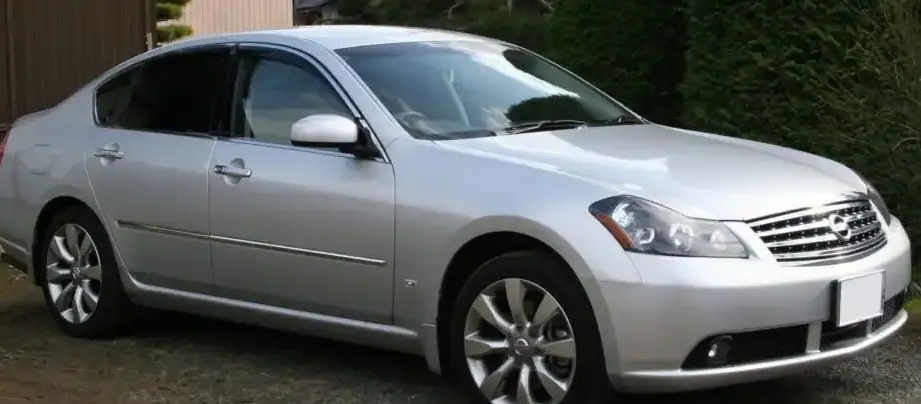
The Nissan Fuga I (Y50), produced between 2004 and 2006, represented a significant step for Nissan in the luxury sedan segment, particularly within the Japanese domestic market (JDM). Positioned above the Nissan Cefiro and Skyline, the Fuga aimed to offer a blend of performance, comfort, and advanced technology. The Y50 generation was the first iteration of the Fuga, built on the rear-wheel-drive FM platform, and was notable for its distinctive styling and powerful engine options. This article will focus specifically on the 4.5-liter V8 variant, producing 333 horsepower, and equipped with a five-speed automatic transmission.
Technical Specifications
| Brand | Nissan |
| Model | Fuga |
| Generation | Fuga I (Y50) |
| Type (Engine) | 4.5L V8 (333 Hp) |
| Start of production | 2004 |
| End of production | 2006 |
| Powertrain Architecture | Internal Combustion engine |
| Body type | Sedan |
| Seats | 5 |
| Doors | 4 |
| Fuel Type | Petrol (Gasoline) |
| Weight-to-power ratio | 5.3 kg/Hp, 188.1 Hp/tonne |
| Weight-to-torque ratio | 3.9 kg/Nm, 254.8 Nm/tonne |
| Power | 333 Hp @ 6400 rpm |
| Power per litre | 74.1 Hp/l |
| Torque | 451 Nm @ 4000 rpm |
| Torque (lb-ft) | 332.64 lb.-ft. @ 4000 rpm |
| Engine layout | Front, Longitudinal |
| Engine displacement | 4495 cm3 |
| Engine displacement (cu. in.) | 274.3 cu. in. |
| Number of cylinders | 8 |
| Engine configuration | V-engine |
| Number of valves per cylinder | 4 |
| Fuel injection system | Multi-port manifold injection |
| Engine aspiration | Naturally aspirated engine |
| Valvetrain | DOHC |
| Kerb Weight | 1770 kg |
| Kerb Weight (lbs) | 3902.18 lbs |
| Fuel tank capacity | 80 l |
| Fuel tank capacity (US gal) | 21.13 US gal |
| Fuel tank capacity (UK gal) | 17.6 UK gal |
| Length | 4900 mm |
| Length (in) | 192.91 in |
| Width | 1795 mm |
| Width (in) | 70.67 in |
| Height | 1510 mm |
| Height (in) | 59.45 in |
| Wheelbase | 2900 mm |
| Wheelbase (in) | 114.17 in |
| Front track | 1535 mm |
| Front track (in) | 60.43 in |
| Rear track | 1550 mm |
| Rear track (in) | 61.02 in |
| Drivetrain Architecture | Rear wheel drive |
| Drive wheel | Rear wheel drive |
| Number of gears | 5 |
| Gearbox type | automatic transmission |
| Front brakes | Ventilated discs |
| Rear brakes | Ventilated discs |
| Assisting systems | ABS (Anti-lock braking system) |
| Tires size | 245/45 R18 |
Introduction
The Nissan Fuga I (Y50) 4.5L V8 was introduced in 2004 as the flagship model of the Fuga lineup. It was designed to compete with established luxury sedans from Toyota and Honda, offering a more driver-focused experience than some of its competitors. The Y50 platform, known as the FM (Front Midship) platform, positioned the engine slightly rearward, contributing to a more balanced weight distribution. This 4.5-liter variant represented the top-of-the-line offering, boasting the most powerful engine available in the Fuga range during its initial production run.
Powertrain & Engine Architecture
At the heart of the Fuga 4.5L lies the VK45DE engine, a 4.5-liter naturally aspirated V8. This engine utilizes a 60-degree V-angle and features dual overhead camshafts (DOHC) with four valves per cylinder. The engine employs multi-port fuel injection, delivering fuel directly into the intake ports. The VK45DE is known for its smooth power delivery and relatively high output for a naturally aspirated engine of its time. The five-speed automatic transmission, designated as the 5AT, was the sole transmission option for this variant. This transmission was chosen for its balance of responsiveness and comfort, suiting the luxury sedan character of the Fuga. While not a particularly advanced transmission by modern standards, it was reliable and well-matched to the engine’s torque curve.
Driving Characteristics
The Fuga 4.5L offered a distinctly different driving experience compared to the lower-trim models. The substantial 451 Nm (332.64 lb-ft) of torque provided strong acceleration, making overtaking effortless. The rear-wheel-drive configuration contributed to a more engaging driving feel, although it wasn’t overtly sporty. The five-speed automatic transmission, while smooth, wasn’t as quick to shift as some contemporary transmissions. Gear ratios were tuned for comfortable cruising rather than outright performance. Compared to the 2.5-liter inline-six or the later 3.5-liter V6 models, the 4.5L V8 offered significantly more power and a more refined driving experience, but at the cost of increased fuel consumption.
Equipment & Trim Levels
The 4.5L Fuga typically came equipped with a high level of standard features. These included leather upholstery, woodgrain interior trim, power-adjustable front seats with memory function, a premium sound system, and automatic climate control. Optional extras included a navigation system, a rear-seat entertainment system, and advanced safety features like adaptive cruise control and lane departure warning. The trim level for the 4.5L was generally the highest available, offering the most luxurious appointments and technology features. The interior design focused on creating a comfortable and sophisticated environment for both the driver and passengers.
Chassis & Braking
The Fuga 4.5L utilized a fully independent suspension system, with double wishbones at the front and a multi-link setup at the rear. This suspension configuration provided a comfortable ride while maintaining good handling characteristics. Ventilated disc brakes were fitted on all four wheels, providing ample stopping power. The inclusion of ABS (Anti-lock Braking System) was standard, enhancing safety during emergency braking situations. The chassis was designed to be rigid, minimizing body roll and contributing to a more stable driving experience. The 18-inch wheels, typically fitted with 245/45 R18 tires, provided a good balance of grip and ride comfort.
Market Reception & Comparison
The Nissan Fuga 4.5L was generally well-received by critics in Japan. It was praised for its powerful engine, comfortable ride, and luxurious interior. However, some reviewers noted that the styling was somewhat polarizing and that the rear-wheel-drive configuration wasn’t ideal for all weather conditions. Compared to its rivals, such as the Toyota Crown and Honda Inspire, the Fuga offered a more driver-focused experience and a more distinctive design. Fuel economy was a common criticism, as the 4.5L V8 consumed significantly more fuel than the smaller-engined models. Reliability was generally good, although the complexity of the engine and transmission meant that maintenance costs could be higher.
Legacy
The Nissan Fuga I (Y50) 4.5L V8 remains a desirable vehicle in the used car market, particularly among enthusiasts who appreciate its powerful engine and unique styling. The VK45DE engine is known for its durability, although regular maintenance is essential to prevent issues. Parts availability can be a concern, as the Fuga was not widely exported outside of Japan. The Y50 Fuga paved the way for subsequent generations of the model, establishing the Fuga as a key player in the Japanese luxury sedan segment. Today, it represents a unique and relatively rare example of a Japanese-built rear-wheel-drive luxury sedan with a naturally aspirated V8 engine.