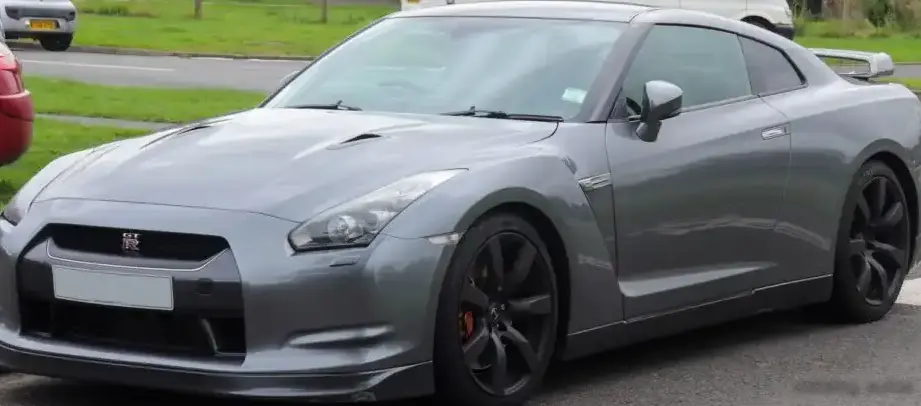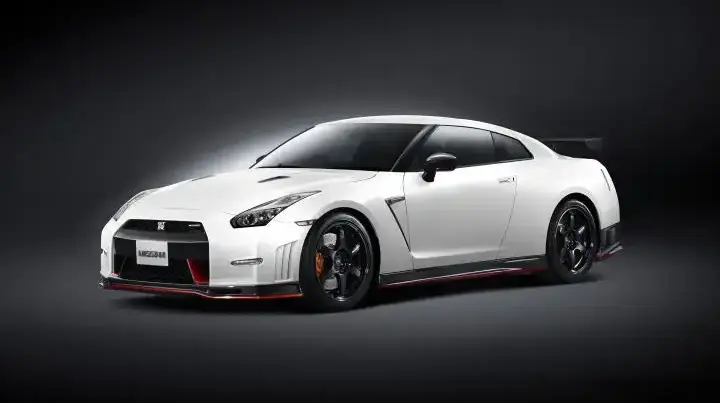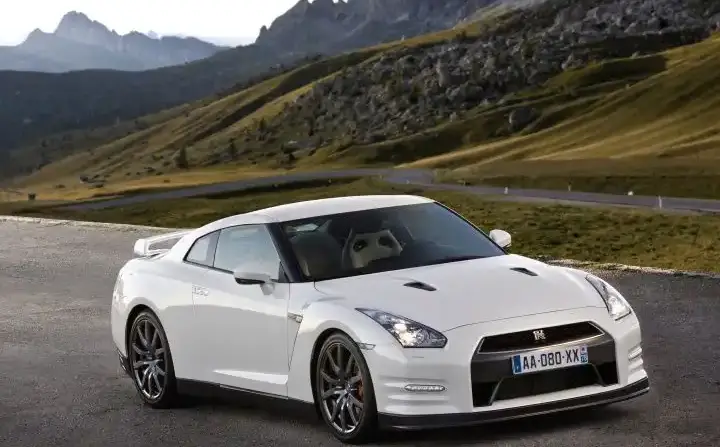
The Nissan GT-R (R35) facelift, produced from November 2010 to 2012, represents a significant evolution of Nissan’s flagship performance vehicle. This iteration, specifically equipped with the 3.8-liter V6 engine producing 530 horsepower and a six-speed dual-clutch transmission (DCT) paired with all-wheel drive, solidified the GT-R’s reputation as a world-class sports car. Positioned as the top-tier performance variant within the R35 range during its production run, it offered a substantial leap in power and refinement over earlier models. The facelift brought revised styling, improved aerodynamics, and enhanced interior appointments, further elevating the GT-R’s status.
Technical Specifications
| Brand | Nissan |
| Model | GT-R |
| Generation | GT-R (R35, facelift 2010) |
| Type (Engine) | 3.8 V6 (530 Hp) AWD DCT |
| Start of production | November, 2010 |
| End of production | 2012 |
| Powertrain Architecture | Internal Combustion engine |
| Body type | Coupe |
| Seats | 4 |
| Doors | 2 |
| Fuel consumption (economy) – urban (NEDC) | 17.3 l/100 km (13.6 US mpg, 16.3 UK mpg, 5.8 km/l) |
| Fuel consumption (economy) – extra urban (NEDC) | 8.9 l/100 km (26.4 US mpg, 31.7 UK mpg, 11.2 km/l) |
| Fuel consumption (economy) – combined (NEDC) | 12 l/100 km (19.6 US mpg, 23.5 UK mpg, 8.3 km/l) |
| CO2 emissions (NEDC) | 279 g/km |
| Fuel Type | Petrol (Gasoline) |
| Acceleration 0 – 100 km/h | 3.1 sec |
| Acceleration 0 – 62 mph | 3.1 sec |
| Acceleration 0 – 60 mph | 2.9 sec |
| Maximum speed | 315 km/h (195.73 mph) |
| Emission standard | Euro 5 |
| Weight-to-power ratio | 3.3 kg/Hp, 304.6 Hp/tonne |
| Weight-to-torque ratio | 2.8 kg/Nm, 351.7 Nm/tonne |
| Power | 530 Hp @ 6400 rpm |
| Power per litre | 139.5 Hp/l |
| Torque | 612 Nm @ 3200-6000 rpm (451.39 lb.-ft. @ 3200-6000 rpm) |
| Engine layout | Front, Longitudinal |
| Engine Model/Code | VR38DETT |
| Engine displacement | 3799 cm3 (231.83 cu. in.) |
| Number of cylinders | 6 |
| Engine configuration | V-engine |
| Cylinder Bore | 95.5 mm (3.76 in.) |
| Piston Stroke | 88.4 mm (3.48 in.) |
| Compression ratio | 9:1 |
| Number of valves per cylinder | 4 |
| Fuel injection system | Multi-port manifold injection |
| Engine aspiration | Twin-Turbo, Intercooler |
| Valvetrain | DOHC |
| Engine oil capacity | 5 l (5.28 US qt | 4.4 UK qt) |
| Coolant | 11 l (11.62 US qt | 9.68 UK qt) |
| Kerb Weight | 1740 kg (3836.04 lbs.) |
| Max. weight | 2200 kg (4850.17 lbs.) |
| Max load | 460 kg (1014.13 lbs.) |
| Trunk (boot) space – minimum | 315 l (11.12 cu. ft.) |
| Fuel tank capacity | 74 l (19.55 US gal | 16.28 UK gal) |
| Length | 4670 mm (183.86 in.) |
| Width | 1895 mm (74.61 in.) |
| Height | 1370 mm (53.94 in.) |
| Wheelbase | 2780 mm (109.45 in.) |
| Front track | 1590 mm (62.6 in.) |
| Rear (Back) track | 1600 mm (62.99 in.) |
| Ride height (ground clearance) | 105 mm (4.13 in.) |
| Drag coefficient (Cd) | 0.26 |
| Minimum turning circle (turning diameter) | 11.4 m (37.4 ft.) |
| Approach angle | 9.8° |
| Departure angle | 16.5° |
| Drivetrain Architecture | The Internal combustion engine (ICE) drives permanently the four wheels of the vehicle. |
| Drive wheel | All wheel drive (4×4) |
| Number of gears and type of gearbox | 6 gears, automatic transmission DCT |
| Front suspension | Double wishbone, Transverse stabilizer |
| Rear suspension | Independent multi-link suspension, Transverse stabilizer |
| Front brakes | Ventilated discs, 390 mm |
| Rear brakes | Ventilated discs, 380 mm |
| Assisting systems | ABS (Anti-lock braking system) |
| Steering type | Steering rack and pinion |
| Power steering | Hydraulic Steering |
| Tires size | Front wheel tires: 255/40 R20 Rear wheel tires: 285/35 R20 |
| Wheel rims size | Front wheel rims: 9.5J x 20 Rear wheel rims: 10.5J x 20 |
Powertrain & Engine Architecture
At the heart of the 2010-2012 GT-R facelift lies the VR38DETT 3.8-liter V6 engine. This engine is a hand-assembled, twin-turbocharged masterpiece. Each engine is individually tested and signed by a master craftsman, a testament to Nissan’s commitment to quality. The “DETT” designation signifies dual turbochargers, which are positioned to minimize turbo lag and provide a broad, flat torque curve. The engine utilizes a multi-port fuel injection system and a double overhead camshaft (DOHC) valvetrain. The 9:1 compression ratio is a compromise between performance and reliability, allowing for high boost pressures without detonation. The VR38DETT produces 530 horsepower at 6,400 rpm and a substantial 451 lb-ft of torque between 3,200 and 6,000 rpm.
The six-speed dual-clutch transmission (DCT) is a crucial component of the GT-R’s performance. Unlike traditional automatic transmissions, a DCT offers incredibly fast and seamless gear changes, minimizing power interruption. The DCT is programmed with three distinct shift modes – Normal, Sport, and R-Mode – allowing the driver to tailor the transmission’s behavior to their driving style and conditions. All-wheel drive is standard, utilizing a sophisticated system that actively distributes torque between the front and rear axles to maximize grip and stability.
Driving Characteristics
The 2010-2012 GT-R facelift delivers breathtaking acceleration. The 0-60 mph sprint takes approximately 2.9 seconds, and it can reach 100 km/h (62 mph) in 3.1 seconds. The DCT provides near-instantaneous shifts, contributing to the car’s blistering pace. While the power delivery is linear and predictable, the twin-turbochargers provide a noticeable surge of acceleration as boost builds. The all-wheel-drive system inspires confidence, providing exceptional traction even in challenging conditions. Compared to earlier GT-R models, the facelifted version benefits from revised suspension tuning, resulting in a more compliant and controlled ride. However, it remains a firm and focused sports car, prioritizing performance over outright comfort.
Equipment & Trim Levels
The 2010-2012 GT-R facelift came generously equipped as standard. Interior features included leather-trimmed seats, a Bose premium audio system, navigation, and automatic climate control. Optional extras included carbon fiber interior trim, Recaro seats, and a variety of exterior styling enhancements. The interior design was refined compared to earlier models, with improved materials and a more sophisticated layout. The dashboard featured a multi-function display that provided real-time performance data, including boost pressure, oil temperature, and G-forces.
Chassis & Braking
The GT-R’s chassis is a rigid and lightweight monocoque construction, providing a solid foundation for the high-performance suspension. The front suspension utilizes a double wishbone design with a transverse stabilizer bar, while the rear features an independent multi-link setup, also with a stabilizer bar. Braking duties are handled by ventilated discs at all four corners, measuring 390mm at the front and 380mm at the rear. The braking system is assisted by ABS (Anti-lock Braking System) and provides exceptional stopping power.
Market Reception & Comparison
The 2010-2012 GT-R facelift was widely praised by automotive critics for its exceptional performance, advanced technology, and overall refinement. It was often compared favorably to established sports cars such as the Porsche 911 Turbo and the Chevrolet Corvette ZR1. While the GT-R’s fuel economy was not a strong point (approximately 19.6 US mpg combined), its performance capabilities were considered to be unmatched in its price range. Compared to lower-powered GT-R variants, the 530 hp model offered a significant performance upgrade, justifying its higher price tag.
Legacy
The Nissan GT-R (R35) facelift, particularly the 530 hp variant, has become a highly sought-after vehicle in the used car market. The VR38DETT engine is known for its durability and tunability, although regular maintenance is essential. The DCT transmission is generally reliable, but can be expensive to repair if issues arise. The GT-R’s advanced technology and iconic status have ensured its place as a modern classic, and it continues to be a benchmark for performance and innovation.