
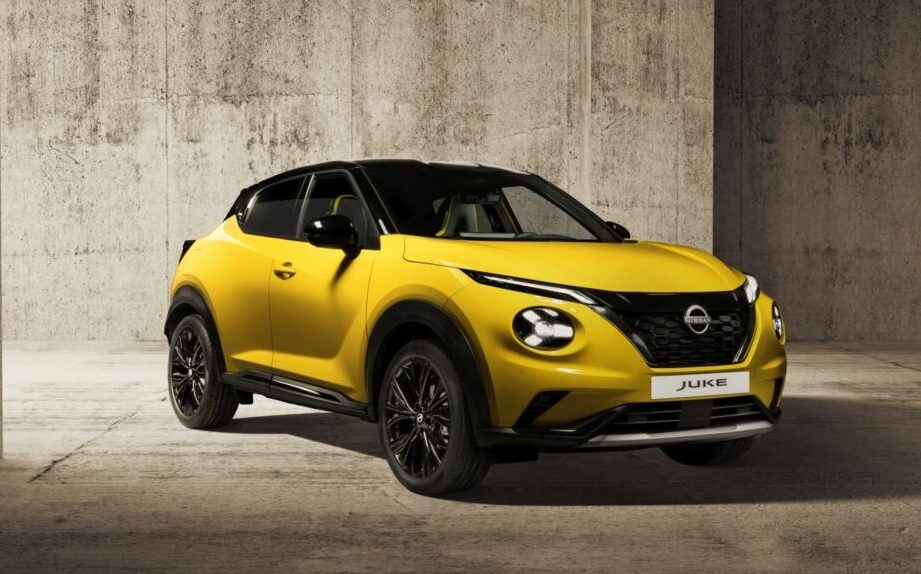
Technical Specifications
| Brand | Nissan |
| Model | Juke |
| Generation | Juke II (facelift 2024) |
| Type (Engine) | 1.6 (143 Hp) Full Hybrid Multi-Mode |
| Start of production | March, 2024 |
| Powertrain Architecture | FHEV (Full Hybrid Electric Vehicle) |
| Body type | SUV, Crossover |
| Seats | 5 |
| Doors | 5 |
| Fuel consumption at Low speed (WLTP) | 4.6-4.8 l/100 km (51.1 – 49 US mpg) |
| Fuel consumption at Medium speed (WLTP) | 4.0-4.3 l/100 km (58.8 – 54.7 US mpg) |
| Fuel consumption at high speed (WLTP) | 4.2-4.3 l/100 km (56 – 54.7 US mpg) |
| Fuel consumption at very high speed (WLTP) | 5.6-5.8 l/100 km (42 – 40.6 US mpg) |
| Combined fuel consumption (WLTP) | 4.7-4.9 l/100 km (50 – 48 US mpg) |
| CO2 emissions (WLTP) | 107-111 g/km |
| Fuel Type | Petrol (Gasoline) |
| Acceleration 0 – 100 km/h | 10.1 sec |
| Acceleration 0 – 62 mph | 10.1 sec |
| Acceleration 0 – 60 mph | 9.6 sec |
| Maximum speed | 166 km/h (103.15 mph) |
| Emission standard | Euro 6d-ISC-FCM |
| Weight-to-power ratio | 9.3 kg/Hp, 107.5 Hp/tonne |
| Weight-to-torque ratio | 9 kg/Nm, 111.3 Nm/tonne |
| Battery technology | Lithium-ion (Li-Ion) |
| Battery location | Under the trunk |
| Electric motor power | 49 Hp |
| Electric motor Torque | 205 Nm @ 1677-2000 rpm (151.2 lb.-ft. @ 1677-2000 rpm) |
| System power | 143 Hp |
| Internal combustion engine power | 94 Hp @ 5600 rpm |
| Internal combustion engine Torque | 148 Nm @ 3600 rpm (109.16 lb.-ft. @ 3600 rpm) |
| Engine Model/Code | HR16DE |
| Engine displacement | 1598 cm3 (97.52 cu. in.) |
| Number of cylinders | 4 |
| Cylinder Bore | 78 mm (3.07 in.) |
| Piston Stroke | 83.6 mm (3.29 in.) |
| Compression ratio | 10.8:1 |
| Fuel injection system | Multi-port manifold injection |
| Engine oil capacity | 4.8 l (5.07 US qt | 4.22 UK qt) |
| Coolant capacity | 6.9 l (7.29 US qt | 6.07 UK qt) |
| Kerb Weight | 1330-1374 kg (2932.15 – 3029.15 lbs.) |
| Max. weight | 1810 kg (3990.37 lbs.) |
| Max load | 436-480 kg (961.22 – 1058.22 lbs.) |
| Trunk (boot) space – minimum | 354 l (12.5 cu. ft.) |
| Trunk (boot) space – maximum | 1237 l (43.68 cu. ft.) |
| Fuel tank capacity | 46 l (12.15 US gal | 10.12 UK gal) |
| Permitted trailer load with brakes (12%) | 750 kg (1653.47 lbs.) |
| Permitted trailer load without brakes | 500 kg (1102.31 lbs.) |
| Permitted towbar download | 75 kg (165.35 lbs.) |
| Length | 4210 mm (165.75 in.) |
| Width | 1800 mm (70.87 in.) |
| Width including mirrors | 1983 mm (78.07 in.) |
| Height | 1593 mm (62.72 in.) |
| Wheelbase | 2636 mm (103.78 in.) |
| Minimum turning circle | 10.57 m (34.68 ft.) |
| Number of gears and type of gearbox | 4 gears, automatic transmission Multi-Mode |
| Front brakes | Ventilated discs |
| Rear brakes | Disc |
| Tires size | 215/60 R17; 225/45 R19 |
| Wheel rims size | 7.0J x 17; 7.5J x 19 |
The 2024 Nissan Juke II 1.6 Hybrid represents Nissan’s commitment to fuel efficiency and innovative powertrain technology within the competitive subcompact crossover segment. Introduced in March 2024, this variant builds upon the second-generation Juke (F16) launched in 2020, incorporating a hybrid powertrain to enhance fuel economy and reduce emissions. Positioned as a mid-range offering within the Juke II lineup, it sits between the standard 1.0-liter turbocharged gasoline engine and potentially higher-performance variants, appealing to buyers seeking a balance of practicality, efficiency, and modern features. The facelift brought styling updates and refinements to the existing Juke II platform.
Powertrain & Engine Architecture
The 2024 Nissan Juke II 1.6 Hybrid utilizes Nissan’s second-generation e-POWER system. This isn’t a traditional hybrid where the electric motor solely powers the wheels; instead, the 1.6-liter HR16DE gasoline engine acts primarily as a generator, charging the battery and, when needed, directly powering the electric motor. The electric motor then drives the front wheels. The HR16DE engine produces 94 horsepower at 5600 rpm and 148 Nm (109.16 lb-ft) of torque at 3600 rpm. The electric motor contributes an additional 49 horsepower and 205 Nm (151.2 lb-ft) of torque, resulting in a combined system output of 143 horsepower. The transmission is a “Multi-Mode” automatic, essentially a continuously variable transmission (CVT) optimized for hybrid operation, offering smooth and efficient power delivery. The lithium-ion battery is located under the trunk floor, minimizing impact on passenger space.
Driving Characteristics
The Juke II 1.6 Hybrid offers a distinctly different driving experience compared to the standard 1.0-liter turbocharged gasoline version. The electric motor provides instant torque, resulting in brisk acceleration, particularly from a standstill. The 0-60 mph time of around 9.6 seconds is respectable for the class. The e-POWER system prioritizes electric drive at lower speeds, offering near-silent operation and excellent fuel economy in urban environments. The transition between electric and gasoline power is generally seamless, although some drivers may notice a slight change in engine note when the gasoline engine kicks in. The CVT transmission, while efficient, lacks the direct feel of a traditional automatic, but it contributes to the smooth and refined driving experience. Compared to a manual transmission, the hybrid offers convenience and ease of use, but sacrifices some driver engagement.
Equipment & Trim Levels
The 1.6 Hybrid trim typically includes a generous level of standard equipment. Features commonly found on this variant include Nissan’s touchscreen infotainment system with Apple CarPlay and Android Auto compatibility, automatic climate control, keyless entry, and a suite of advanced driver-assistance systems (ADAS) such as automatic emergency braking, lane departure warning, and adaptive cruise control. Interior upholstery is typically cloth, with options for leather upgrades. Available options often include a premium audio system, heated front seats, and a panoramic sunroof. The exterior styling features unique hybrid badging and potentially distinctive alloy wheel designs.
Chassis & Braking
The Juke II utilizes a front-wheel-drive platform with a MacPherson strut front suspension and a torsion beam rear suspension. The suspension is tuned to provide a comfortable ride while maintaining reasonable handling characteristics. The 1.6 Hybrid variant typically features ventilated disc brakes at the front and solid disc brakes at the rear. The braking system is equipped with ABS (Anti-lock Braking System), electronic brake-force distribution (EBD), and brake assist. The steering is electric power-assisted, providing light and precise steering feel.
Market Reception & Comparison
The Nissan Juke II 1.6 Hybrid has been generally well-received by automotive critics, praised for its fuel efficiency, smooth driving experience, and stylish design. Compared to the standard 1.0-liter gasoline version, the hybrid offers significantly improved fuel economy, particularly in city driving. However, it comes at a higher price point. Competitors in the hybrid subcompact crossover segment include the Toyota Corolla Cross Hybrid, Kia Niro, and Hyundai Kona Hybrid. The Juke II Hybrid distinguishes itself with its unique e-POWER system and distinctive styling.
Legacy
The long-term reliability of the Nissan Juke II 1.6 Hybrid powertrain remains to be fully established, as it is a relatively new offering. However, Nissan’s e-POWER technology has proven reliable in other applications. The hybrid system’s regenerative braking capabilities contribute to reduced brake wear, potentially lowering maintenance costs. On the used car market, the Juke II 1.6 Hybrid is expected to hold its value well due to its fuel efficiency and growing demand for hybrid vehicles. Its unique powertrain and stylish design should continue to appeal to buyers seeking a practical and efficient subcompact crossover.


