
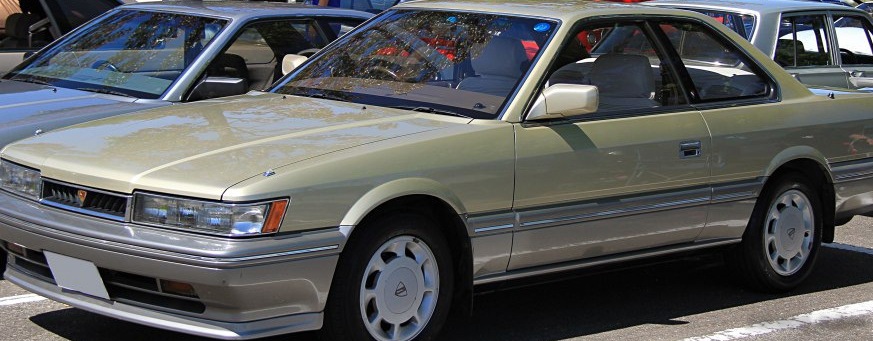
The Nissan Leopard (F31), specifically the 2.0-liter V6 variant producing 115 horsepower, represented a significant offering in Nissan’s lineup during its 1986-1992 production run. Positioned as a personal luxury coupe, the F31 Leopard aimed to blend sporty styling with comfortable appointments, primarily targeting the Japanese domestic market (JDM). While not widely exported to the United States, the Leopard found a niche following in other regions, particularly Australia and Europe, offering a sophisticated alternative to more mainstream coupes. This particular 2.0L V6 with an automatic transmission served as a mid-range option within the Leopard family, offering a balance between performance and ease of use.
Technical Specifications
| Brand | Nissan |
| Model | Leopard |
| Generation | Leopard (F31) |
| Type (Engine) | 2.0 V6 (115 Hp) |
| Start of production | 1986 |
| End of production | 1992 |
| Powertrain Architecture | Internal Combustion engine |
| Body type | Coupe |
| Seats | 5 |
| Doors | 2 |
| Fuel consumption (urban) | 12 l/100 km (19.6 US mpg) |
| Fuel consumption (extra urban) | 8 l/100 km (29.4 US mpg) |
| Fuel Type | Petrol (Gasoline) |
| Maximum speed | 180 km/h (111.85 mph) |
| Weight-to-power ratio | 11.8 kg/Hp |
| Weight-to-torque ratio | 8.3 kg/Nm |
| Power | 115 Hp @ 6000 rpm |
| Power per litre | 57.6 Hp/l |
| Torque | 163 Nm @ 3200 rpm (120.22 lb.-ft. @ 3200 rpm) |
| Engine layout | Front, Longitudinal |
| Engine displacement | 1998 cm3 (121.93 cu. in.) |
| Number of cylinders | 6 |
| Engine configuration | V-engine |
| Cylinder Bore | 78 mm (3.07 in.) |
| Piston Stroke | 69.7 mm (2.74 in.) |
| Compression ratio | 9.5:1 |
| Number of valves per cylinder | 2 |
| Fuel injection system | Multi-port manifold injection |
| Engine aspiration | Naturally aspirated engine |
| Valvetrain | OHC |
| Kerb Weight | 1360 kg (2998.29 lbs.) |
| Fuel tank capacity | 65 l (17.17 US gal | 14.3 UK gal) |
| Length | 4695 mm (184.84 in.) |
| Width | 1690 mm (66.54 in.) |
| Height | 1370 mm (53.94 in.) |
| Wheelbase | 2615 mm (102.95 in.) |
| Front track | 1425 mm (56.1 in.) |
| Rear track | 1425 mm (56.1 in.) |
| Drivetrain Architecture | Rear wheel drive |
| Drive wheel | Rear wheel drive |
| Number of gears and type of gearbox | 4 gears, automatic transmission |
| Front suspension | Wishbone |
| Rear suspension | Coil spring |
| Front brakes | Ventilated discs |
| Rear brakes | Ventilated discs |
| Assisting systems | ABS (Anti-lock braking system) |
| Steering type | Steering rack and pinion |
| Power steering | Hydraulic Steering |
| Tires size | 205/60 R15 |
Powertrain & Engine Architecture
The heart of this Leopard variant is the VG20E engine, a 2.0-liter V6. This engine, part of Nissan’s VG series, is a naturally aspirated, 60-degree V6 featuring a single overhead camshaft (OHC) per cylinder bank. The VG20E utilizes multi-port fuel injection, contributing to improved fuel efficiency and smoother power delivery compared to earlier carbureted engines. The engine produces 115 horsepower at 6000 rpm and 163 Nm (120.22 lb-ft) of torque at 3200 rpm. The automatic transmission is a four-speed unit, designed for comfortable cruising rather than aggressive performance. This transmission was chosen to appeal to buyers prioritizing convenience and ease of driving.
Driving Characteristics
The 2.0L V6 automatic Leopard offered a refined driving experience. While not a sports car, the V6 provided adequate power for everyday driving and highway merging. The automatic transmission, while smooth, did result in some power loss compared to the available five-speed manual transmission. Gear ratios were tuned for comfort and fuel economy, meaning acceleration wasn’t particularly brisk. The rear-wheel-drive configuration provided a balanced feel, though the relatively soft suspension setup prioritized ride comfort over sharp handling. Compared to the more powerful 3.0-liter V6 variants, this 2.0L model felt noticeably less energetic, but it offered a more economical and accessible entry point into the Leopard range.
Equipment & Trim Levels
The 2.0L V6 automatic Leopard typically came equipped with a respectable level of standard features. These included power windows, power locks, and an AM/FM stereo. Interior upholstery was typically cloth, though leather options were available as upgrades. Dashboard design featured woodgrain accents and a generally upscale appearance. Optional extras included a sunroof, upgraded sound system, and cruise control. The trim level often dictated the availability of these features, with higher trims offering more luxurious appointments.
Chassis & Braking
The F31 Leopard utilized a traditional body-on-frame construction, contributing to its relatively heavy curb weight of 1360 kg (2998.29 lbs). The front suspension employed a wishbone setup, while the rear featured a coil spring arrangement. Braking duties were handled by ventilated discs on all four wheels, and an Anti-lock Braking System (ABS) was often included as standard equipment, enhancing safety. Steering was rack and pinion, assisted by hydraulic power steering for ease of maneuverability.
Market Reception & Comparison
The Nissan Leopard, in general, was well-regarded for its stylish design and comfortable interior. However, the 2.0L V6 automatic variant received mixed reviews. Critics often praised its smoothness and refinement but noted its lack of outright performance. Fuel economy was considered reasonable for the time, falling in line with other coupes in its class. Compared to the more potent 3.0-liter V6 models, the 2.0L offered a more affordable price point and lower running costs, making it attractive to a broader range of buyers. Reliability was generally good, though maintenance costs could be higher due to the V6 engine’s complexity.
Legacy
Today, the Nissan Leopard (F31) is gaining recognition as a classic Japanese coupe. The 2.0L V6 automatic variant, while not the most sought-after version, remains a viable option for enthusiasts seeking a comfortable and stylish classic. The VG20E engine is known for its durability, though age-related issues such as oil leaks and worn rubber components are common. Parts availability can be challenging, particularly outside of Japan, but a dedicated community of owners and enthusiasts helps to keep these cars on the road. The F31 Leopard represents a unique chapter in Nissan’s history, showcasing the company’s ability to create sophisticated and well-equipped coupes for the discerning driver.
