
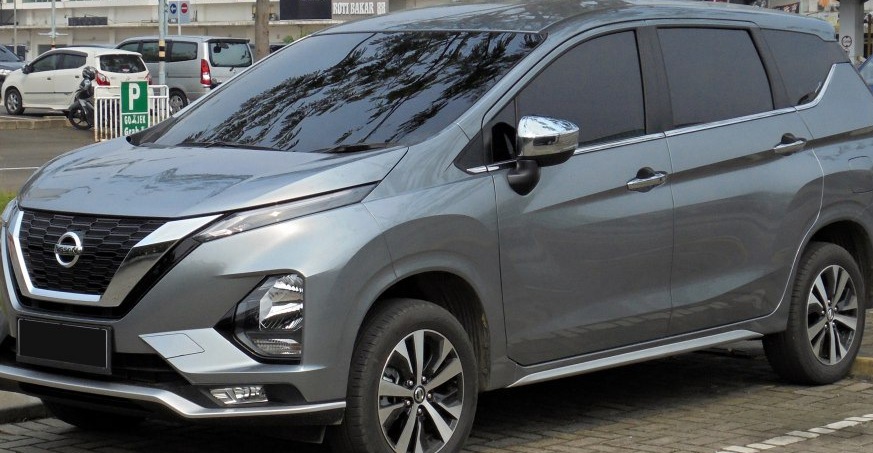
Technical Specifications
| Brand | Nissan |
| Model | Livina |
| Generation | Livina II |
| Type (Engine) | 1.5i (104 Hp) Automatic |
| Start of production | February, 2019 |
| Powertrain Architecture | Internal Combustion engine |
| Body type | MPV |
| Seats | 7 |
| Doors | 5 |
| Fuel Type | Petrol (Gasoline) |
| Weight-to-power ratio | 11.7 kg/Hp, 85.2 Hp/tonne |
| Weight-to-torque ratio | 8.7 kg/Nm, 115.6 Nm/tonne |
| Power | 104 Hp @ 6000 rpm |
| Power per litre | 69.4 Hp/l |
| Torque | 141 Nm @ 4000 rpm (104 lb.-ft. @ 4000 rpm) |
| Engine layout | Front, Transverse |
| Engine displacement | 1499 cm3 (91.47 cu. in.) |
| Number of cylinders | 4 |
| Engine configuration | Inline |
| Cylinder Bore | 78 mm (3.07 in.) |
| Piston Stroke | 78.4 mm (3.09 in.) |
| Number of valves per cylinder | 4 |
| Fuel injection system | Multi-port manifold injection |
| Engine aspiration | Naturally aspirated engine |
| Valvetrain | DOHC, VTC |
| Kerb Weight | 1220-1240 kg (2689.64 – 2733.73 lbs.) |
| Fuel tank capacity | 52 l (13.74 US gal | 11.44 UK gal) |
| Length | 4510 mm (177.56 in.) |
| Width | 1750 mm (68.9 in.) |
| Height | 1695 mm (66.73 in.) |
| Wheelbase | 2775 mm (109.25 in.) |
| Ride height (ground clearance) | 200 mm (7.87 in.) |
| Minimum turning circle (turning diameter) | 11.0 m (36.09 ft.) |
| Drivetrain Architecture | The Internal combustion engine (ICE) drives the front wheels of the vehicle. |
| Drive wheel | Front wheel drive |
| Number of gears and type of gearbox | 4 gears, automatic transmission |
| Front suspension | Independent, type McPherson with coil spring and anti-roll bar |
| Rear suspension | Torsion |
| Front brakes | Ventilated discs |
| Rear brakes | Drum |
| Assisting systems | ABS (Anti-lock braking system) |
| Steering type | Steering rack and pinion |
| Power steering | Electric Steering |
| Tires size | 185/65 R15 |
| Wheel rims size | 15 |
The Nissan Livina II 1.5i Automatic, launched in February 2019, represents a significant evolution of Nissan’s compact MPV (Multi-Purpose Vehicle) offering, primarily aimed at the Southeast Asian market. Positioned as an entry-level to mid-range trim within the Livina II generation (built on the B0 platform), this variant sought to provide affordable family transportation with a focus on practicality and fuel efficiency. It played a key role in Nissan’s strategy to meet the increasing demand for versatile vehicles in developing economies, offering seven-seat capability in a relatively compact package. The Livina II, and specifically this 1.5i Automatic trim, was designed to compete with other affordable MPVs such as the Toyota Avanza and Mitsubishi Xpander.
Powertrain & Engine Architecture
The Nissan Livina II 1.5i Automatic is powered by the HR15DE inline-four cylinder gasoline engine. This 1.5-liter engine utilizes multi-point fuel injection and a double overhead camshaft (DOHC) valvetrain with Variable Timing Control (VTC) to optimize both performance and fuel economy. The HR15DE is a well-established engine within the Nissan/Renault alliance, known for its reliability and relatively straightforward design. It’s a naturally aspirated engine, meaning it doesn’t employ turbocharging or supercharging. The engine produces 104 horsepower at 6000 rpm and 141 Nm (104 lb-ft) of torque at 4000 rpm. This power is then transferred through a four-speed automatic transmission to the front wheels. The four-speed automatic, while offering convenience, is a somewhat older design compared to the continuously variable transmissions (CVTs) becoming increasingly common in modern vehicles. It prioritizes cost-effectiveness over ultimate efficiency or performance.
Driving Characteristics
The 1.5i Automatic Livina delivers adequate, though not particularly exciting, performance. The four-speed automatic transmission has relatively broad gear ratios, which can result in noticeable shifts during acceleration. Compared to the manual transmission versions of the Livina II, the automatic experiences a slight performance decrease due to the transmission’s inherent efficiency losses. The power delivery is linear, but the engine feels strained when fully loaded with passengers and cargo, especially when attempting to overtake at highway speeds. The gear ratios are tuned for fuel economy rather than rapid acceleration. The steering is light and easy, making it well-suited for urban driving, but it lacks the precision and feedback desired by more enthusiastic drivers. Overall, the driving experience is geared towards comfort and practicality rather than sporty handling.
Equipment & Trim Levels
The 1.5i Automatic trim typically included standard features such as air conditioning, power windows, power door locks, and a basic audio system with USB connectivity. Safety features generally included dual front airbags and ABS (Anti-lock Braking System). Higher trim levels, such as the 1.5 VL, added features like alloy wheels, a touchscreen infotainment system, rear parking sensors, and a reverse camera. Interior upholstery was typically cloth, with a functional and durable design. Optional extras often included a roof rack, side steps, and upgraded audio systems. The interior design prioritized space and practicality, with numerous storage compartments throughout the cabin.
Chassis & Braking
The Livina II utilizes a McPherson strut suspension setup at the front, providing a comfortable ride quality. The rear suspension employs a torsion beam axle, a cost-effective solution that prioritizes space efficiency. The front brakes are ventilated discs, offering adequate stopping power, while the rear brakes are drums, a common feature in this price segment to reduce manufacturing costs. The electric power steering provides light and easy steering, particularly useful in congested urban environments. The 185/65 R15 tires offer a good balance between ride comfort and handling, although they aren’t particularly sporty. The relatively high ground clearance of 200mm (7.87 inches) allows the Livina to navigate rough roads and uneven surfaces with ease.
Market Reception & Comparison
The Nissan Livina II 1.5i Automatic was generally well-received in its target markets for its affordability, practicality, and seven-seat capacity. Critics noted that the four-speed automatic transmission felt dated compared to newer CVTs, and the engine lacked significant power when fully loaded. However, the Livina’s spacious interior, comfortable ride, and relatively fuel-efficient engine were praised. Compared to the manual transmission version, the automatic offered greater convenience but at the expense of slightly reduced fuel economy and performance. Against competitors like the Toyota Avanza and Mitsubishi Xpander, the Livina II offered a competitive package, often priced slightly lower, making it an attractive option for budget-conscious families.
Legacy
The Nissan Livina II 1.5i Automatic has established a reputation for reliability and affordability in the used car market. The HR15DE engine is known for its durability, and the relatively simple mechanical design makes it relatively easy and inexpensive to maintain. While the four-speed automatic transmission isn’t the most sophisticated, it has proven to be reasonably reliable. As a used vehicle, the Livina II 1.5i Automatic represents a good value proposition for those seeking a practical and spacious family vehicle. Its continued presence on the roads in Southeast Asia is a testament to its enduring appeal and robust construction. However, potential buyers should be aware of the vehicle’s age and the potential for wear and tear on components like the suspension and brakes.
