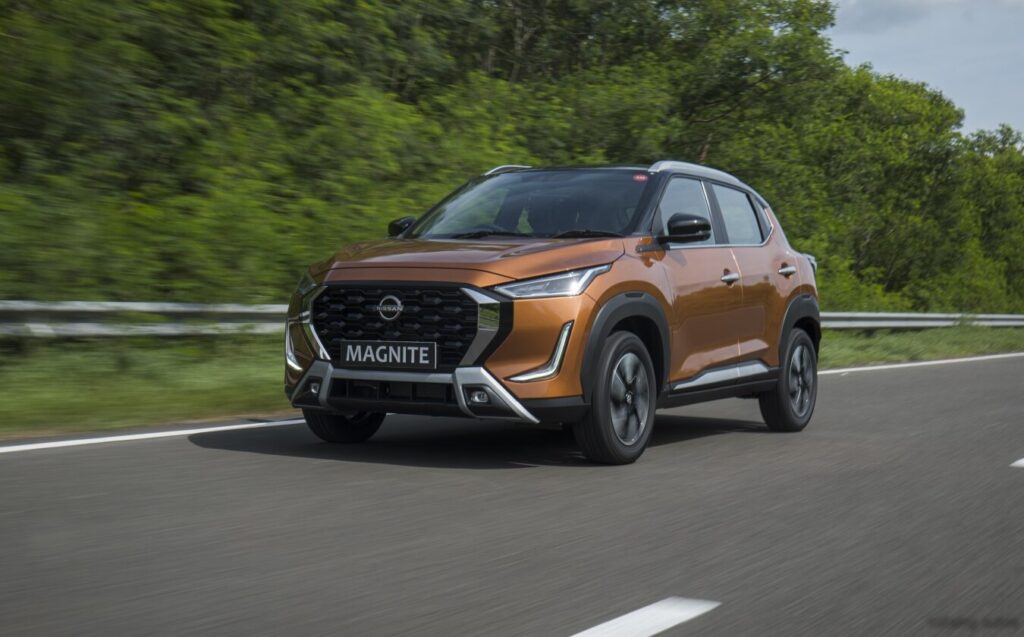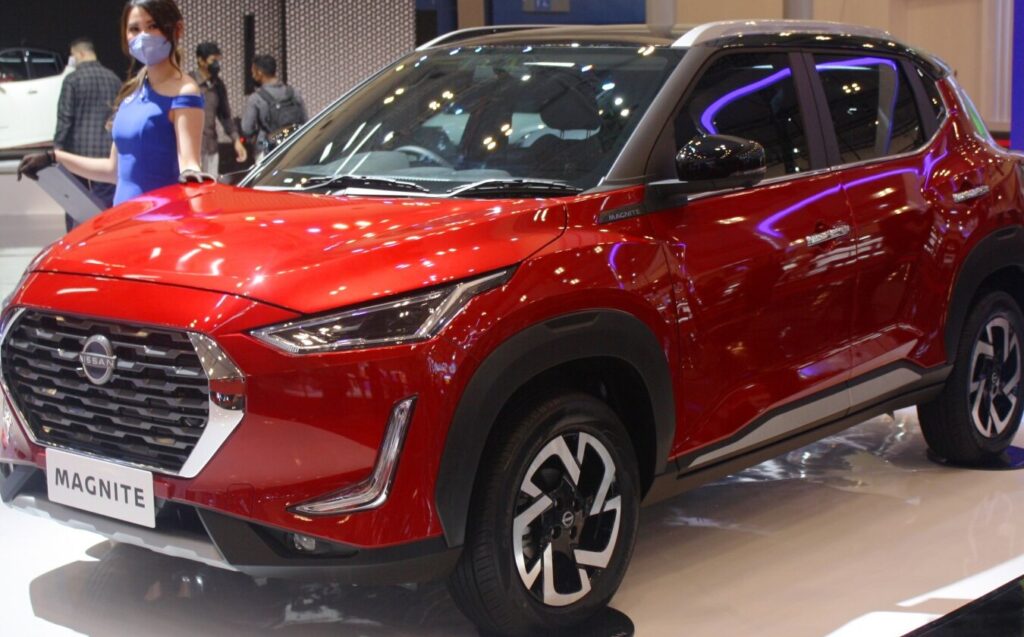
The Nissan Magnite 1.0 Turbo, produced from 2020 to 2024, represents Nissan’s entry into the highly competitive subcompact SUV segment, particularly targeting the Indian and emerging markets. Positioned as an affordable and feature-rich option, the Magnite aimed to disrupt the market with its bold styling and competitive pricing. This specific variant, powered by the 1.0-liter turbocharged three-cylinder engine producing 100 horsepower, served as a key volume seller within the Magnite lineup, offering a balance between fuel efficiency and acceptable performance. It was designed to appeal to first-time car buyers and urban commuters seeking a practical and stylish vehicle.
Technical Specifications
| Brand | Nissan |
| Model | Magnite |
| Generation | Magnite |
| Type (Engine) | 1.0 Turbo (100 Hp) |
| Start of production | 2020 |
| End of production | 2024 |
| Powertrain Architecture | Internal Combustion engine |
| Body type | SUV |
| Seats | 5 |
| Doors | 5 |
| Fuel consumption (combined) | 5 l/100 km (47 US mpg, 56.5 UK mpg, 20 km/l) |
| Fuel Type | Petrol (Gasoline) |
| Weight-to-power ratio | 10.1 kg/Hp, 98.6 Hp/tonne |
| Weight-to-torque ratio | 6.3 kg/Nm, 157.8 Nm/tonne |
| Power | 100 Hp @ 5000 rpm |
| Power per litre | 100.1 Hp/l |
| Torque | 160 Nm @ 2800-3600 rpm (118.01 lb.-ft. @ 2800-3600 rpm) |
| Engine layout | Front, Transverse |
| Engine Model/Code | HRA0DET |
| Engine displacement | 999 cm3 (60.96 cu. in.) |
| Number of cylinders | 3 |
| Engine configuration | Inline |
| Cylinder Bore | 71 mm (2.8 in.) |
| Piston Stroke | 84.1 mm (3.31 in.) |
| Number of valves per cylinder | 4 |
| Fuel injection system | Multi-port manifold injection |
| Engine aspiration | Turbocharger, Intercooler |
| Valvetrain | DOHC |
| Engine oil capacity | 3.4 l (3.59 US qt | 2.99 UK qt) |
| Coolant | 5.95 l (6.29 US qt | 5.24 UK qt) |
| Kerb Weight | 1014 kg (2235.49 lbs.) |
| Trunk (boot) space – minimum | 336 l (11.87 cu. ft.) |
| Trunk (boot) space – maximum | 690 l (24.37 cu. ft.) |
| Fuel tank capacity | 40 l (10.57 US gal | 8.8 UK gal) |
| Length | 3994 mm (157.24 in.) |
| Width | 1758 mm (69.21 in.) |
| Height | 1572 mm (61.89 in.) |
| Wheelbase | 2500 mm (98.43 in.) |
| Ride height (ground clearance) | 205 mm (8.07 in.) |
| Minimum turning circle | 10 m (32.81 ft.) |
| Drivetrain Architecture | The Internal combustion engine (ICE) drives the front wheels of the vehicle. |
| Drive wheel | Front wheel drive |
| Number of gears and type of gearbox | 5 gears, manual transmission |
| Front suspension | Independent, type McPherson with coil spring and anti-roll bar |
| Rear suspension | Spring Strut |
| Front brakes | Disc |
| Rear brakes | Drum |
| Assisting systems | ABS (Anti-lock braking system) |
| Steering type | Steering rack and pinion |
| Power steering | Electric Steering |
| Tires size | 195/60 R16 |
Powertrain & Engine Architecture
The heart of the Magnite 1.0 Turbo is the HRA0DET engine, a 999cc inline three-cylinder petrol engine. This engine utilizes a single-scroll turbocharger with an intercooler to boost power output. The engine employs multi-point fuel injection and a double overhead camshaft (DOHC) valvetrain, contributing to its relatively efficient operation. The 5-speed manual transmission was the standard offering for this variant, chosen for its affordability and simplicity. The engine’s design prioritizes fuel economy and responsiveness in urban driving conditions, rather than outright performance. The turbocharger is tuned to provide a noticeable boost in torque from around 2800 rpm, aiding in city driving and overtaking maneuvers.
Driving Characteristics
The 100 hp and 160 Nm (118 lb-ft) of torque delivered by the 1.0-liter turbo engine provide adequate, though not exhilarating, performance. Acceleration is best described as sufficient for everyday driving, with a 0-60 mph time estimated around 12-13 seconds. The five-speed manual transmission is well-matched to the engine’s characteristics, offering a reasonably precise shift feel. Compared to higher-spec Magnite variants with the more powerful 1.0-liter turbo (around 120 hp), this version feels noticeably less responsive, particularly at higher speeds. However, the lighter engine weight contributes to slightly better fuel economy and a more nimble feel in city traffic. The gear ratios are tuned for maximizing fuel efficiency, which can sometimes result in the engine feeling strained when climbing hills or carrying a full load.
Equipment & Trim Levels
The Magnite 1.0 Turbo was typically offered in base and mid-level trim configurations. Standard features generally included air conditioning, power steering, power windows, and a basic audio system. Safety features such as dual airbags and ABS were also standard. Higher trims added features like alloy wheels, a touchscreen infotainment system with Apple CarPlay and Android Auto compatibility, a rear parking camera, and automatic climate control. Interior upholstery was typically cloth, with a focus on durability rather than luxury. Optional extras included body-colored door handles and mirrors, and upgraded audio systems.
Chassis & Braking
The Magnite utilizes a McPherson strut front suspension and a torsion beam rear suspension. This setup provides a comfortable ride quality, well-suited for the often-rough road conditions found in its target markets. The front brakes are ventilated discs, while the rear brakes are drums. This configuration is a cost-effective solution for a vehicle in this price segment. ABS (Anti-lock Braking System) is standard, enhancing safety during emergency braking situations. The steering is electrically assisted, providing light and easy steering feel, particularly useful for maneuvering in tight urban spaces.
Market Reception & Comparison
The Nissan Magnite 1.0 Turbo received generally positive reviews for its value proposition. Critics praised its bold styling, spacious interior, and competitive pricing. However, some reviewers noted the engine’s lack of outright power and the somewhat basic interior materials. Compared to other subcompact SUVs in the Indian market, such as the Maruti Suzuki Vitara Brezza and Hyundai Venue, the Magnite offered a more distinctive design and a more engaging driving experience, albeit with slightly lower power output in this 1.0-liter turbo configuration. Fuel economy was consistently rated as good, making it an attractive option for budget-conscious buyers.
Legacy
The Nissan Magnite 1.0 Turbo has established itself as a popular choice in the subcompact SUV segment, particularly in emerging markets. While long-term reliability data is still emerging, initial reports suggest that the HRA0DET engine is generally reliable, provided it receives regular maintenance. The Magnite’s success has demonstrated Nissan’s ability to create a compelling product for price-sensitive markets. On the used car market, the 1.0 Turbo variants are generally more affordable than the higher-spec models, making them an attractive option for first-time car buyers seeking a stylish and practical SUV.