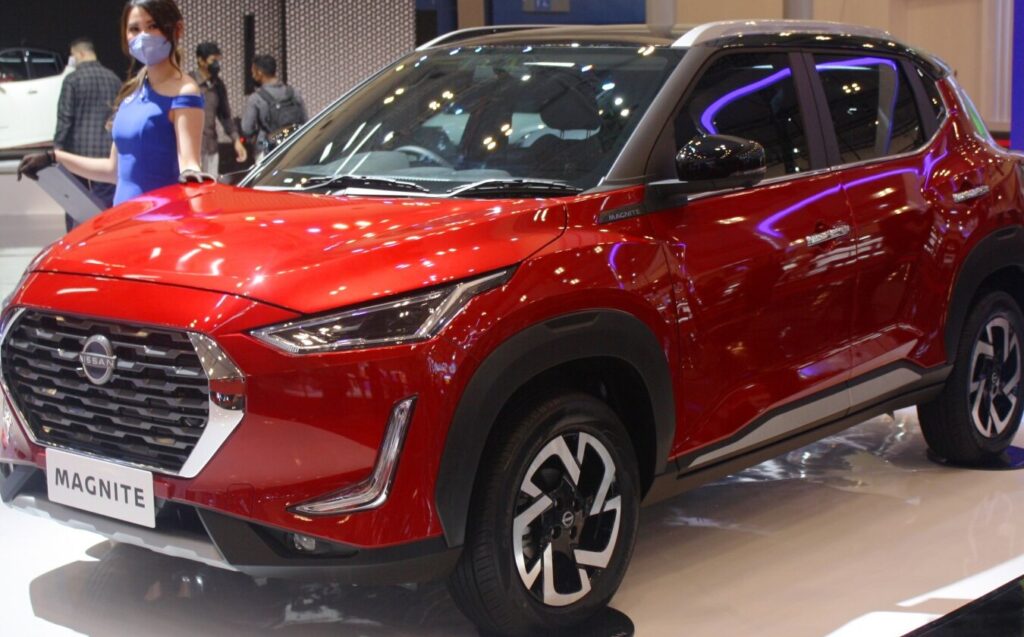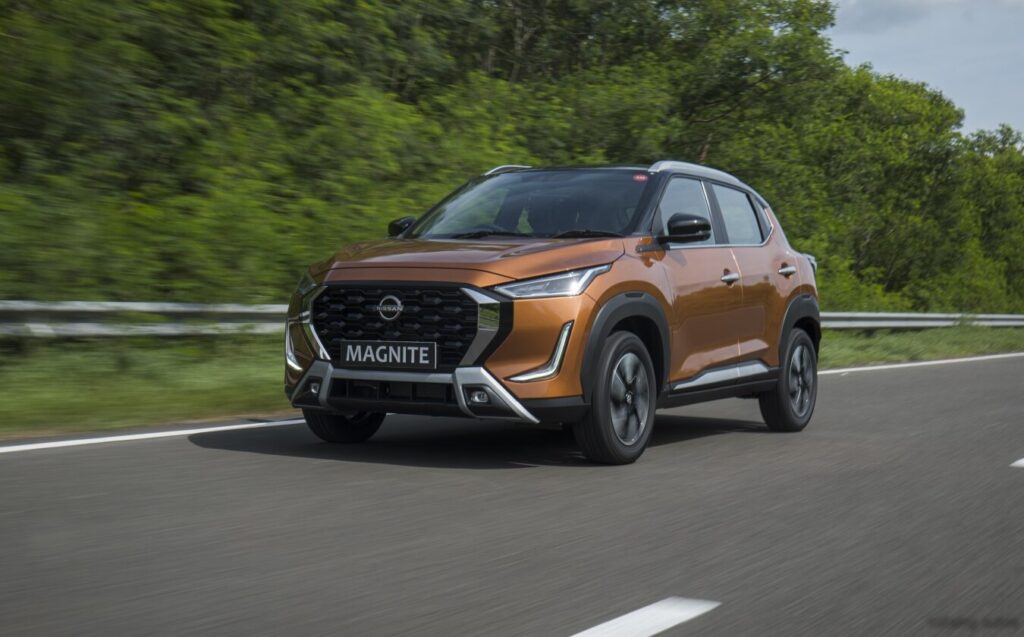
The Nissan Magnite (facelift 2024) 1.0, introduced in October 2024, represents Nissan’s entry-level offering within the Magnite subcompact SUV range. Positioned as the most accessible variant, it aims to provide affordable and fuel-efficient transportation for the price-conscious consumer. This facelift builds upon the original Magnite launched in India and select international markets, refining the styling and potentially incorporating minor mechanical updates. The 1.0-liter engine and five-speed manual transmission combination is specifically targeted at buyers prioritizing economy over outright performance, and is a key model in Nissan’s strategy for emerging markets.
Technical Specifications
| Brand | Nissan |
| Model | Magnite |
| Generation | Magnite (facelift 2024) |
| Type (Engine) | 1.0 (72 Hp) |
| Start of production | October, 2024 |
| Powertrain Architecture | Internal Combustion engine |
| Body type | SUV |
| Seats | 5 |
| Doors | 5 |
| Fuel consumption (combined) | 5.1-5.2 l/100 km (46.1 – 45.2 US mpg, 55.4 – 54.3 UK mpg, 19.6 – 19.2 km/l) |
| Fuel Type | Petrol (Gasoline) |
| Emission standard | BS VI Phase 2 |
| Weight-to-power ratio | 14.2 kg/Hp, 70.7 Hp/tonne |
| Weight-to-torque ratio | 10.6 kg/Nm, 94.2 Nm/tonne |
| Power | 72 Hp @ 6250 rpm |
| Power per litre | 72.1 Hp/l |
| Torque | 96 Nm @ 3400-3600 rpm (70.81 lb.-ft. @ 3400-3600 rpm) |
| Engine layout | Front, Transverse |
| Engine Model/Code | BR10 HS |
| Engine displacement | 999 cm3 (60.96 cu. in.) |
| Number of cylinders | 3 |
| Engine configuration | Inline |
| Cylinder Bore | 71 mm (2.8 in.) |
| Piston Stroke | 84.1 mm (3.31 in.) |
| Number of valves per cylinder | 4 |
| Fuel injection system | Multi-port manifold injection |
| Engine aspiration | Naturally aspirated engine |
| Valvetrain | DOHC |
| Engine oil capacity | 2.91 l (3.07 US qt | 2.56 UK qt) |
| Coolant | 4.7 l (4.97 US qt | 4.14 UK qt) |
| Kerb Weight | 1019 kg (2246.51 lbs.) |
| Max. weight | 1402 kg (3090.88 lbs.) |
| Max load | 383 kg (844.37 lbs.) |
| Trunk (boot) space – minimum | 336 l (11.87 cu. ft.) |
| Trunk (boot) space – maximum | 690 l (24.37 cu. ft.) |
| Fuel tank capacity | 40 l (10.57 US gal | 8.8 UK gal) |
| Max. roof load | 50 kg (110.23 lbs.) |
| Length | 3994 mm (157.24 in.) |
| Width | 1758 mm (69.21 in.) |
| Height | 1572 mm (61.89 in.) |
| Wheelbase | 2500 mm (98.43 in.) |
| Front track | 1536 mm (60.47 in.) |
| Rear (Back) track | 1535 mm (60.43 in.) |
| Ride height (ground clearance) | 205 mm (8.07 in.) |
| Minimum turning circle | 10 m (32.81 ft.) |
| Drivetrain Architecture | Front wheel drive |
| Number of gears and type of gearbox | 5 gears, manual transmission |
| Front suspension | Independent, type McPherson with coil spring and anti-roll bar |
| Rear suspension | Semi-independent, coil spring |
| Front brakes | Disc |
| Rear brakes | Drum |
| Assisting systems | ABS (Anti-lock braking system) |
| Steering type | Steering rack and pinion |
| Power steering | Electric Steering |
| Tires size | 195/60 R16 |
| Wheel rims size | 5.5J x 16 |
INTRODUCTION
The Nissan Magnite (facelift 2024) 1.0 represents a significant offering in the subcompact SUV segment, particularly in markets like India and developing nations. Building on the success of the initial Magnite launch, the facelifted model aims to enhance its appeal with updated styling and potentially improved features. This variant, powered by a 999cc three-cylinder engine, is designed to deliver a balance of affordability, fuel efficiency, and practicality. It slots into the Magnite lineup as the base model, offering a more accessible price point compared to higher-trim levels with larger engines or additional features. The Magnite competes directly with other subcompact SUVs like the Hyundai Venue, Kia Sonet, and Tata Punch.
Powertrain & Engine Architecture
At the heart of the Magnite 1.0 lies the BR10 HS engine, a 999cc inline three-cylinder petrol engine. This engine utilizes a multi-port fuel injection system and a double overhead camshaft (DOHC) valvetrain. The naturally aspirated configuration prioritizes simplicity and fuel economy over outright power. The engine produces 72 horsepower at 6250 rpm and 96 Nm of torque between 3400-3600 rpm. This power is delivered to the front wheels via a five-speed manual transmission. The engine’s compact size and lightweight construction contribute to the vehicle’s overall efficiency. While not a powerhouse, the BR10 HS is known for its reliability and relatively low maintenance costs.
Driving Characteristics
The 1.0-liter engine and five-speed manual transmission combination in the Magnite delivers a driving experience focused on efficiency and ease of use. Acceleration is modest, with the vehicle prioritizing fuel economy over rapid acceleration. The five-speed gearbox is well-matched to the engine’s characteristics, providing adequate ratios for both city driving and highway cruising. Compared to higher-output variants, the 1.0-liter model feels less responsive, particularly when fully loaded or climbing hills. However, the lighter engine weight contributes to nimble handling in urban environments. The gear ratios are tuned for maximizing fuel efficiency, resulting in a slightly higher engine speed at highway speeds.
Equipment & Trim Levels
The base Magnite 1.0 typically comes equipped with essential features such as air conditioning, power steering, and basic safety equipment like dual airbags and ABS. The interior generally features cloth upholstery and a functional, if somewhat basic, dashboard layout. Infotainment systems vary depending on the specific market and sub-trim level, but often include a touchscreen display with Bluetooth connectivity. Optional extras may include alloy wheels, rear parking sensors, and a more advanced infotainment system with Apple CarPlay and Android Auto compatibility. The focus of this trim level is on providing a practical and affordable vehicle, so luxury features are generally limited.
Chassis & Braking
The Magnite utilizes a McPherson strut front suspension and a semi-independent coil spring rear suspension. This setup provides a comfortable ride quality, particularly on well-maintained roads. The front brakes are discs, while the rear brakes are drums, a cost-saving measure common in this segment. ABS (Anti-lock Braking System) is standard, enhancing safety during emergency braking situations. The vehicle’s relatively lightweight construction contributes to its agility and handling. The ride height of 205mm provides adequate ground clearance for navigating rough roads and speed bumps.
Market Reception & Comparison
The Nissan Magnite 1.0 has been generally well-received in its target markets, particularly for its competitive pricing and fuel efficiency. Critics have praised its spacious interior and practical features, but some have noted the engine’s lack of power, especially when compared to rivals offering turbocharged engines. Fuel economy figures of 5.1-5.2 l/100 km are competitive within the subcompact SUV segment. Compared to higher-trim Magnite variants, the 1.0-liter model offers a more affordable entry point, but sacrifices performance and some features. Its reliability has been generally positive, with the BR10 HS engine proving to be a durable and dependable unit.
Legacy
The Nissan Magnite 1.0 is poised to become a popular choice in the used car market due to its affordability and fuel efficiency. The BR10 HS engine is known for its relatively low maintenance costs, making it an attractive option for budget-conscious buyers. While not a performance-oriented vehicle, the Magnite 1.0 provides a practical and reliable transportation solution for urban commuters and first-time car buyers. Its long-term durability and availability of spare parts are expected to contribute to its continued popularity in the years to come.