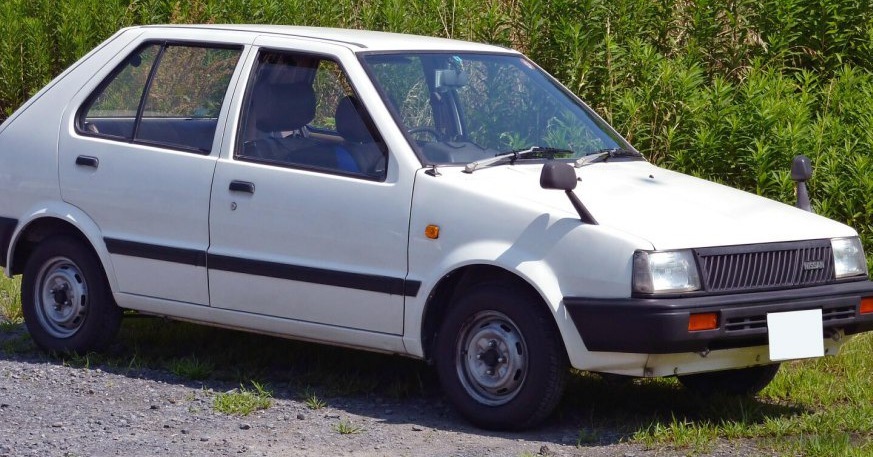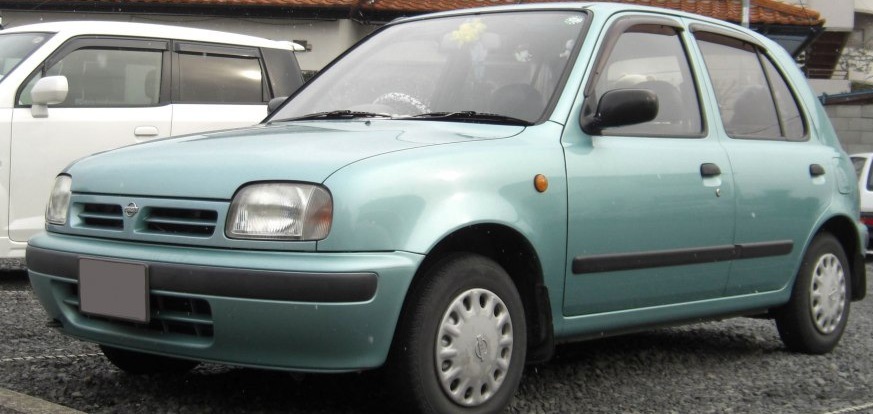
The Nissan March, known as the Micra in many markets, is a supermini car produced by Nissan since 1982. The K11 series, manufactured from 1992 to 2000, represented a significant redesign and a move towards a more rounded, contemporary aesthetic. Within the K11 generation, the 1.0i 16V variant with a Continuously Variable Transmission (CVT) occupied the entry-level position in many European and Asian markets. This model aimed to provide affordable and economical transportation, prioritizing fuel efficiency and ease of use over outright performance. It was a popular choice for city driving and first-time car buyers.
Technical Specifications
| Brand | Nissan |
| Model | March |
| Generation | March (K11) |
| Type (Engine) | 1.0i 16V (54 Hp) CVT |
| Start of production | 1992 |
| End of production | 2000 |
| Powertrain Architecture | Internal Combustion engine |
| Body type | Hatchback |
| Seats | 5 |
| Doors | 3/5 |
| Fuel consumption (urban) | 7.1 l/100 km (33.1 US mpg, 39.8 UK mpg, 14.1 km/l) |
| Fuel consumption (extra urban) | 5.2 l/100 km (45.2 US mpg, 54.3 UK mpg, 19.2 km/l) |
| Fuel consumption (combined) | 6.1 l/100 km (38.6 US mpg, 46.3 UK mpg, 16.4 km/l) |
| Fuel Type | Petrol (Gasoline) |
| Acceleration 0 – 100 km/h | 19.7 sec |
| Acceleration 0 – 62 mph | 19.7 sec |
| Acceleration 0 – 60 mph | 18.7 sec |
| Maximum speed | 145 km/h (90.1 mph) |
| Weight-to-power ratio | 14.4 kg/Hp, 69.7 Hp/tonne |
| Weight-to-torque ratio | 9.8 kg/Nm, 101.9 Nm/tonne |
| Power | 54 Hp @ 6000 rpm |
| Power per litre | 54.1 Hp/l |
| Torque | 79 Nm @ 4000 rpm (58.27 lb.-ft. @ 4000 rpm) |
| Engine layout | Front, Transverse |
| Engine displacement | 998 cm3 (60.9 cu. in.) |
| Number of cylinders | 4 |
| Engine configuration | Inline |
| Cylinder Bore | 71 mm (2.8 in.) |
| Piston Stroke | 63 mm (2.48 in.) |
| Compression ratio | 9.5:1 |
| Number of valves per cylinder | 4 |
| Fuel injection system | Multi-port manifold injection |
| Engine aspiration | Naturally aspirated engine |
| Valvetrain | DOHC |
| Kerb Weight | 775 kg (1708.58 lbs.) |
| Max. weight | 1290 kg (2843.96 lbs.) |
| Max load | 515 kg (1135.38 lbs.) |
| Trunk (boot) space – minimum | 206 l (7.27 cu. ft.) |
| Trunk (boot) space – maximum | 960 l (33.9 cu. ft.) |
| Fuel tank capacity | 42 l (11.1 US gal | 9.24 UK gal) |
| Length | 3695 mm (145.47 in.) |
| Width | 1585 mm (62.4 in.) |
| Height | 1430 mm (56.3 in.) |
| Wheelbase | 2360 mm (92.91 in.) |
| Front track | 1360 mm (53.54 in.) |
| Rear (Back) track | 1325 mm (52.17 in.) |
| Drivetrain Architecture | The Internal combustion engine (ICE) drives the front wheels of the vehicle. |
| Drive wheel | Front wheel drive |
| Number of gears and type of gearbox | 1 gears, automatic transmission CVT |
| Front suspension | Wishbone |
| Rear suspension | Spring Strut |
| Front brakes | Disc |
| Rear brakes | Drum |
| Steering type | Steering rack and pinion |
| Tires size | 155/70 R13 |
| Wheel rims size | 13 |
INTRODUCTION
The K11 Nissan March, launched in 1992, represented a significant departure from its predecessors. It was designed with a focus on maximizing interior space within a compact footprint, a key requirement for the European and Japanese city car markets. The 1.0i 16V CVT model was positioned as the most accessible entry point into the K11 range, appealing to buyers seeking a low-cost, fuel-efficient vehicle for urban commuting. Available in both three and five-door configurations, it offered a practical and economical solution for everyday transportation. The introduction of the CVT transmission was a notable feature, aiming to provide smoother acceleration and improved fuel economy compared to traditional automatic gearboxes.
Powertrain & Engine Architecture
The heart of the 1.0i 16V March is the CG10DE engine, a 998cc inline-four cylinder petrol engine. This engine utilizes a multi-point fuel injection system and a double overhead camshaft (DOHC) valvetrain, contributing to its relatively efficient operation for its displacement. The 16 valves (four per cylinder) enhance breathing and contribute to a modest power output of 54 horsepower at 6000 rpm and 79 Nm (58.27 lb-ft) of torque at 4000 rpm. The engine’s compact size and lightweight construction were key to the March’s overall efficiency. Paired with this engine is a Continuously Variable Transmission (CVT). Nissan’s early CVTs, like the one used in the K11 March, employed a belt-and-pulley system to provide a theoretically infinite number of gear ratios, optimizing engine speed for either fuel economy or acceleration. While not known for sporty performance, the CVT offered a smooth and seamless driving experience.
Driving Characteristics
The 1.0i 16V CVT March was never intended to be a performance car. Acceleration was leisurely, with a 0-60 mph time of around 18.7 seconds. The CVT transmission, while smooth, contributed to a somewhat “rubber band” feel, where engine speed would rise independently of vehicle speed during acceleration. This could feel unusual to drivers accustomed to traditional automatic transmissions. However, the CVT’s ability to keep the engine operating in its most efficient range resulted in respectable fuel economy for the time. The light weight of the vehicle (around 775 kg or 1708 lbs) helped to mitigate the lack of power, making it reasonably nimble in city traffic. Compared to the slightly more powerful 1.3L variants, the 1.0L felt noticeably slower, particularly when carrying passengers or cargo. Manual transmission versions of the 1.0L offered slightly improved performance due to reduced drivetrain losses.
Equipment & Trim Levels
The 1.0i 16V CVT March typically came with a basic level of equipment, reflecting its position as the entry-level model. Standard features generally included power steering, central locking, and a basic stereo system. Interior upholstery was typically cloth, and the dashboard featured a simple, functional design. Optional extras included air conditioning, electric windows, and alloy wheels. Higher trim levels, such as the ‘S’ or ‘SE’ variants, added these features as standard. Safety equipment was relatively basic for the era, typically consisting of a driver’s airbag and seatbelts. The interior space was surprisingly generous for a car of its size, offering adequate room for four adults.
Chassis & Braking
The K11 March utilized a front-wheel-drive layout with a relatively simple suspension setup. The front suspension employed independent wishbones, while the rear suspension featured a torsion beam. This configuration provided a comfortable ride quality, although handling was not particularly sporty. Braking consisted of disc brakes on the front wheels and drum brakes on the rear. The braking system was adequate for the car’s weight and performance, but lacked the stopping power of more sophisticated setups. The relatively narrow tires (typically 155/70 R13) contributed to a modest level of grip.
Market Reception & Comparison
The 1.0i 16V CVT March was generally well-received as an affordable and economical city car. Critics praised its fuel efficiency, compact size, and ease of driving. However, the lack of power and the somewhat unusual feel of the CVT transmission were common criticisms. Compared to other superminis of the time, such as the Fiat Punto or the Peugeot 106, the March offered a competitive price point and a reputation for reliability. The 1.3L variants of the March offered significantly improved performance, but at a higher cost. The 1.0L CVT model appealed to buyers who prioritized fuel economy and low running costs over driving excitement.
Legacy
The K11 Nissan March, particularly the 1.0i 16V CVT variant, has proven to be a relatively reliable and durable vehicle. The CG10DE engine is known for its longevity, and the CVT transmission, while not without its quirks, has generally held up well over time. Today, these cars are increasingly sought after by enthusiasts and collectors, particularly those looking for a classic city car or a project vehicle. Parts availability is generally good, and the simple mechanical design makes them relatively easy to maintain. While not a particularly fast or luxurious car, the K11 March remains a testament to Nissan’s ability to produce affordable and practical transportation.