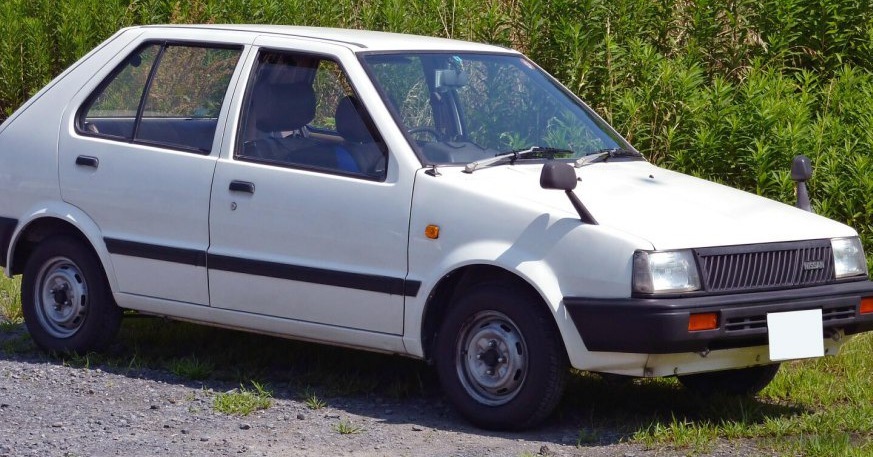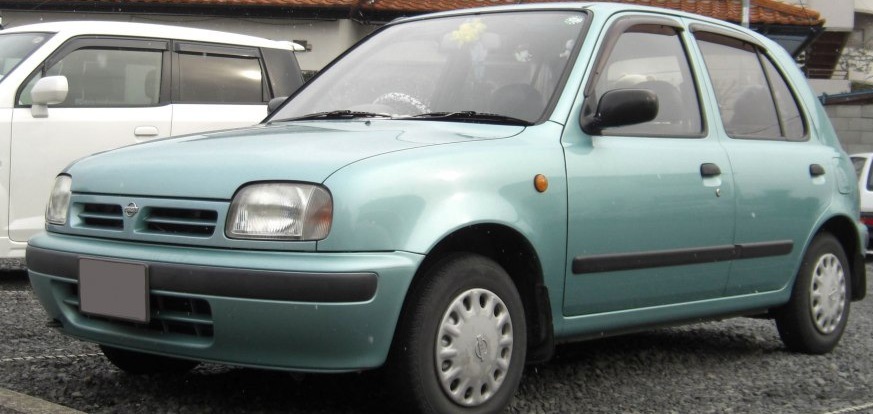
The Nissan March, known as the Micra in many markets, is a supermini car produced by Nissan since 1982. The K11 series, manufactured from 1992 to 2000, represented a significant redesign and a move towards a more rounded, contemporary aesthetic. The 1.3i 16V variant, equipped with a Continuously Variable Transmission (CVT), was a popular choice, particularly in European and Asian markets, offering a blend of affordability, fuel efficiency, and ease of use. This model occupied a mid-range position within the K11 lineup, slotting between the base 1.0-liter models and the slightly more powerful 1.4-liter options.
Technical Specifications
| Brand | Nissan |
| Model | March |
| Generation | March (K11) |
| Type (Engine) | 1.3i 16V (75 Hp) CVT |
| Start of production | 1992 |
| End of production | 2000 |
| Powertrain Architecture | Internal Combustion engine |
| Body type | Hatchback |
| Seats | 5 |
| Doors | 3/5 |
| Fuel consumption (urban) | 6.9 l/100 km (34.1 US mpg, 40.9 UK mpg, 14.5 km/l) |
| Fuel consumption (extra urban) | 5.2 l/100 km (45.2 US mpg, 54.3 UK mpg, 19.2 km/l) |
| Fuel consumption (combined) | 6.8 l/100 km (34.6 US mpg, 41.5 UK mpg, 14.7 km/l) |
| Fuel Type | Petrol (Gasoline) |
| Acceleration 0 – 100 km/h | 13.7 sec |
| Acceleration 0 – 62 mph | 13.7 sec |
| Acceleration 0 – 60 mph | 13 sec |
| Maximum speed | 165 km/h (102.53 mph) |
| Weight-to-power ratio | 11 kg/Hp |
| Weight-to-torque ratio | 8 kg/Nm |
| Power | 75 Hp @ 6000 rpm |
| Power per litre | 58.8 Hp/l |
| Torque | 103 Nm @ 4000 rpm (75.97 lb.-ft. @ 4000 rpm) |
| Engine layout | Front, Transverse |
| Engine displacement | 1275 cm3 (77.81 cu. in.) |
| Number of cylinders | 4 |
| Engine configuration | Inline |
| Cylinder Bore | 71 mm (2.8 in.) |
| Piston Stroke | 80.5 mm (3.17 in.) |
| Compression ratio | 9.5:1 |
| Number of valves per cylinder | 4 |
| Fuel injection system | Multi-port manifold injection |
| Engine aspiration | Naturally aspirated engine |
| Valvetrain | DOHC |
| Kerb Weight | 825 kg (1818.81 lbs.) |
| Max. weight | 1300 kg (2866.01 lbs.) |
| Max load | 475 kg (1047.2 lbs.) |
| Trunk (boot) space – minimum | 206 l (7.27 cu. ft.) |
| Trunk (boot) space – maximum | 960 l (33.9 cu. ft.) |
| Fuel tank capacity | 42 l (11.1 US gal | 9.24 UK gal) |
| Length | 3695 mm (145.47 in.) |
| Width | 1585 mm (62.4 in.) |
| Height | 1430 mm (56.3 in.) |
| Wheelbase | 2360 mm (92.91 in.) |
| Front track | 1360 mm (53.54 in.) |
| Rear (Back) track | 1325 mm (52.17 in.) |
| Drivetrain Architecture | The Internal combustion engine (ICE) drives the front wheels of the vehicle. |
| Drive wheel | Front wheel drive |
| Number of gears and type of gearbox | 1 gears, automatic transmission CVT |
| Front suspension | Wishbone |
| Rear suspension | Spring Strut |
| Front brakes | Disc |
| Rear brakes | Drum |
| Steering type | Steering rack and pinion |
| Power steering | Hydraulic Steering |
| Tires size | 165/60 R13 |
| Wheel rims size | 13 |
INTRODUCTION
The K11 Nissan March, launched in 1992, represented a significant departure from its predecessors. Designed with a focus on maximizing interior space within a compact footprint, the K11 was a key player in the burgeoning supermini segment, particularly in Europe and Japan. The 1.3i 16V CVT model was introduced as a refinement, offering a more accessible and user-friendly driving experience compared to the base models. It was positioned as a practical and economical choice for urban commuters and first-time car buyers. The K11 platform (also underpinning the Renault Clio II) proved to be remarkably versatile, allowing for a range of engine and trim level options.
Powertrain & Engine Architecture
The heart of the 1.3i 16V March is the CG13DE engine, a 1.3-liter inline-four cylinder gasoline engine. This engine utilizes a multi-point fuel injection system and a double overhead camshaft (DOHC) valvetrain, contributing to its relatively efficient operation and respectable power output for its size. The 16 valves (four per cylinder) enhance breathing and contribute to the engine’s responsiveness. The engine code ‘CG13DE’ is crucial for identifying specific parts and service information. Paired with this engine is a Continuously Variable Transmission (CVT), offering seamless gear changes and optimized fuel efficiency. Nissan’s early CVTs, while not as sophisticated as later iterations, provided a smooth and comfortable driving experience, particularly in city traffic. The CVT eliminates traditional fixed gear ratios, instead using a belt-and-pulley system to provide an infinite number of ratios within a specific range.
Driving Characteristics
The 1.3i 16V CVT March delivers a modest 75 horsepower, resulting in a 0-60 mph time of around 13 seconds. While not a performance-oriented vehicle, the CVT helps to maximize the available power, providing smooth acceleration and a predictable driving experience. Compared to the manual transmission versions, the CVT sacrifices some driver engagement but offers greater convenience, especially in stop-and-go traffic. The CVT’s ‘rubber band’ effect – where engine RPMs rise independently of vehicle speed – is noticeable, but less pronounced than in some other early CVT implementations. The gear ratios are continuously adjusted to keep the engine operating within its optimal power band, resulting in decent fuel economy. The relatively light weight of the K11 (around 825 kg) helps to mitigate the effects of the modest power output.
Equipment & Trim Levels
The 1.3i 16V CVT March typically came equipped with features considered standard for its class in the early 1990s. These included power steering, central locking, and an AM/FM radio. Higher trim levels offered options such as electric windows, air conditioning, and alloy wheels. Interior upholstery was typically cloth, with a relatively simple and functional dashboard layout. The K11 March prioritized practicality over luxury, with a focus on providing a comfortable and efficient driving experience. Optional extras often included a sunroof and upgraded audio systems.
Chassis & Braking
The K11 March utilizes a front-wheel-drive layout with a relatively simple suspension setup. The front suspension consists of independent wishbones, while the rear employs a torsion beam setup. This configuration provides a reasonable balance between ride comfort and handling. Braking duties are handled by disc brakes at the front and drum brakes at the rear. The braking system is adequate for the vehicle’s weight and performance, but lacks the stopping power of more modern vehicles. Stabilizer bars were often included, contributing to reduced body roll during cornering.
Market Reception & Comparison
The 1.3i 16V CVT March was generally well-received by critics as a practical and economical city car. Its fuel efficiency was a major selling point, and the CVT transmission was praised for its smoothness and ease of use. Compared to the 1.0-liter models, the 1.3i offered a noticeable improvement in performance, making it more suitable for longer journeys. However, it lacked the outright performance of the 1.4-liter variants. Reliability was generally good, although early CVTs could be prone to issues if not properly maintained. The March competed with other superminis such as the Ford Fiesta, Peugeot 205, and Renault Clio.
Legacy
The Nissan March K11, particularly the 1.3i 16V CVT variant, remains a popular choice in the used car market, especially for those seeking an affordable and reliable city car. The CG13DE engine is known for its durability, and the CVT transmission, while requiring regular fluid changes, can provide years of trouble-free service. Parts availability is generally good, and the K11’s simple mechanical design makes it relatively easy to maintain. While not a particularly exciting vehicle, the K11 March represents a well-engineered and practical supermini that has stood the test of time.