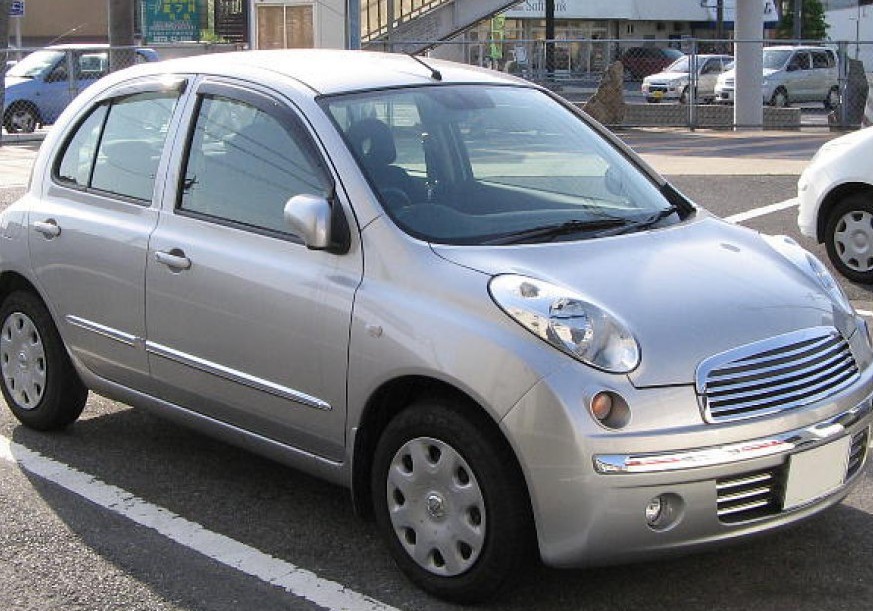
Technical Specifications
| Brand | Nissan |
| Model | March |
| Generation | March (K12) |
| Type (Engine) | 1.0 i 16V (65 Hp) |
| Start of production | 2003 |
| End of production | 2005 |
| Powertrain Architecture | Internal Combustion engine |
| Body type | Hatchback |
| Seats | 5 |
| Doors | 3/5 |
| Fuel consumption (urban) | 7.1 l/100 km (33.1 US mpg, 39.8 UK mpg, 14.1 km/l) |
| Fuel consumption (extra urban) | 5.1 l/100 km (46.1 US mpg, 55.4 UK mpg, 19.6 km/l) |
| Fuel consumption (combined) | 5.8 l/100 km (40.6 US mpg, 48.7 UK mpg, 17.2 km/l) |
| Fuel Type | Petrol (Gasoline) |
| Acceleration 0 – 100 km/h | 15.7 sec |
| Acceleration 0 – 62 mph | 15.7 sec |
| Acceleration 0 – 60 mph | 14.9 sec |
| Maximum speed | 154 km/h (95.69 mph) |
| Weight-to-power ratio | 14.5 kg/Hp, 69.1 Hp/tonne |
| Weight-to-torque ratio | 10.6 kg/Nm, 94.7 Nm/tonne |
| Power | 65 Hp @ 5600 rpm |
| Power per litre | 65.1 Hp/l |
| Torque | 89 Nm @ 3600 rpm (65.64 lb.-ft. @ 3600 rpm) |
| Engine layout | Front, Transverse |
| Engine displacement | 998 cm3 (60.9 cu. in.) |
| Number of cylinders | 4 |
| Engine configuration | Inline |
| Cylinder Bore | 71 mm (2.8 in.) |
| Piston Stroke | 63 mm (2.48 in.) |
| Compression ratio | 10.1:1 |
| Number of valves per cylinder | 4 |
| Fuel injection system | Multi-port manifold injection |
| Engine aspiration | Naturally aspirated engine |
| Valvetrain | DOHC |
| Kerb Weight | 940 kg (2072.35 lbs.) |
| Max. weight | 1430 kg (3152.61 lbs.) |
| Max load | 490 kg (1080.27 lbs.) |
| Trunk (boot) space – minimum | 371 l (13.1 cu. ft.) |
| Trunk (boot) space – maximum | 584 l (20.62 cu. ft.) |
| Fuel tank capacity | 46 l (12.15 US gal, 10.12 UK gal) |
| Length | 3715 mm (146.26 in.) |
| Width | 1660 mm (65.35 in.) |
| Height | 1525 mm (60.04 in.) |
| Wheelbase | 2430 mm (95.67 in.) |
| Front track | 1470 mm (57.87 in.) |
| Rear (Back) track | 1445 mm (56.89 in.) |
| Minimum turning circle | 9.8 m (32.15 ft.) |
| Drivetrain Architecture | Front wheel drive |
| Number of gears | 5 gears, manual transmission |
| Front suspension | Spring Strut |
| Rear suspension | Torsion |
| Front brakes | Ventilated discs |
| Rear brakes | Disc |
| Assisting systems | ABS (Anti-lock braking system) |
| Steering type | Steering rack and pinion |
| Tires size | 165/70 R14 |
| Wheel rims size | 5.5J x 14 |
The Nissan March, known as the Micra in many global markets, is a supermini car that debuted in 1982. The K12 series, manufactured from 2003 to 2010, marked a substantial redesign, embracing a more modern aesthetic. Within the K12 generation, the 1.0 i 16V variant, producing 65 horsepower, served as the entry-level model in numerous European and Asian countries. This version gained popularity due to its affordability and fuel efficiency, appealing to first-time car buyers and those needing a practical urban vehicle. Production of this specific configuration spanned from 2003 to 2005, before being superseded by minor updates within the K12 lineup.
Powertrain & Engine Architecture
The K12 March 1.0 i 16V is powered by the CG10DE engine, a 998cc inline-four cylinder gasoline engine. This engine employs a single overhead camshaft (SOHC) design, but incorporates four valves per cylinder (16V) to enhance airflow. Fuel delivery is handled by a multi-point fuel injection system, ensuring precise fuel metering for optimal combustion efficiency. The engine’s relatively low compression ratio of 10.1:1 allows it to operate reliably on a variety of fuel grades. The engine code, CG10DE, is essential for identifying specific parts and accessing service information. A 5-speed manual transmission was the standard offering, engineered to maximize the engine’s limited power output and deliver reasonable fuel economy. The transmission’s gear ratios were tailored for city driving, featuring a relatively tall final drive to prioritize fuel efficiency.
Driving Characteristics
The 65 horsepower and 89 Nm (65.64 lb-ft) of torque generated by the 1.0-liter engine resulted in modest, yet adequate, performance. Acceleration from 0-60 mph took around 14.9 seconds, and the top speed hovered around 95.69 mph. In everyday driving, the 1.0 i 16V performed best in urban settings and on slower country roads. The engine necessitated frequent downshifts to maintain momentum during overtaking maneuvers or when ascending hills. Compared to the more powerful 1.5-liter versions, the 1.0-liter felt noticeably slower, but it offered a smoother and more forgiving driving experience. The manual transmission, while not particularly sporty, was light and easy to operate, making it well-suited for less experienced drivers.
Equipment & Trim Levels
The 1.0 i 16V typically represented the base trim level within the K12 March range. Standard features generally included power steering, central locking, electric front windows, and an immobilizer system. Interior upholstery was typically a basic cloth material. Air conditioning and alloy wheels were frequently offered as optional extras, allowing buyers to personalize their vehicle. Higher trim levels, such as those equipped with the 1.5-liter engine, included additional amenities like automatic climate control, upgraded audio systems, and more refined interior trim.
Chassis & Braking
The K12 March featured a relatively straightforward chassis design. The front suspension utilized MacPherson struts, while the rear employed a torsion beam setup. This configuration provided a comfortable ride quality, although it wasn’t optimized for sporty handling. The braking system consisted of ventilated discs on the front wheels and solid discs on the rear. An Anti-lock Braking System (ABS) was standard, enhancing safety by preventing wheel lockup during emergency braking. The relatively light weight of the 1.0-liter model helped to offset its modest braking power.
Market Reception & Comparison
The K12 March 1.0 i 16V was generally well-received as an affordable and economical city car. Reviewers praised its fuel efficiency and ease of driving, but acknowledged its lack of substantial performance. When compared to other superminis of the era, such as the Ford Fiesta or Volkswagen Polo, the March offered a more budget-conscious option. The 1.5-liter March variants provided a noticeable performance boost, but came at a higher price. The 1.0-liter model’s fuel economy was a significant selling point, consistently achieving around 40-48 mpg in mixed driving conditions.
Legacy
The CG10DE engine, while not renowned for its high performance, proved to be a reliable and durable powerplant. Well-maintained examples of the K12 March 1.0 i 16V can still be found in the used car market today. Common issues are typically limited to age-related wear and tear, such as corrosion in the exhaust system and deterioration of suspension components. The engine’s simplicity and relatively low maintenance requirements make it an appealing choice for budget-minded buyers. While not considered a collectible vehicle, the K12 March 1.0 i 16V remains a practical and economical option for those seeking a basic, dependable city car.