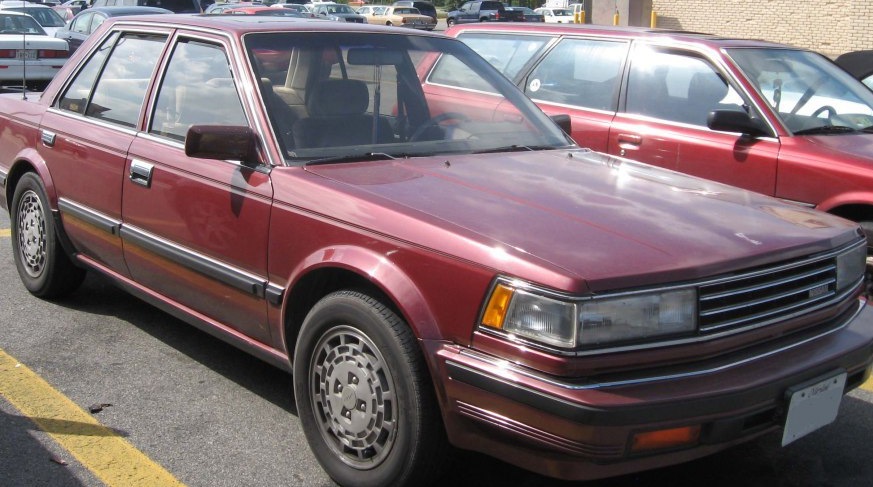
The Nissan Maxima I (G910), produced from 1983 to 1984, represented a significant step for Nissan in the mid-size sedan market, particularly as it aimed to establish a foothold in the North American market. Positioned as a more upscale offering than the Nissan 610 and 810, the Maxima sought to compete with established American and European sedans. The 2.4-liter (120 hp) automatic variant was a key component of the initial Maxima lineup, offering a balance of performance and convenience aimed at a broad range of buyers. It was the entry point into the Maxima range, offering a more accessible price point than the later, more powerful options.
Technical Specifications
| Brand | Nissan |
| Model | Maxima |
| Generation | Maxima I (G910) |
| Type (Engine) | 2.4 (120 Hp) Automatic |
| Start of production | 1983 |
| End of production | 1984 |
| Powertrain Architecture | Internal Combustion engine |
| Body type | Sedan |
| Seats | 4 |
| Doors | 4 |
| Fuel Type | Petrol (Gasoline) |
| Weight-to-power ratio | 10.4 kg/Hp, 96.5 Hp/tonne |
| Weight-to-torque ratio | 6.8 kg/Nm, 146.4 Nm/tonne |
| Power | 120 Hp @ 5200 rpm |
| Power per litre | 50.1 Hp/l |
| Torque | 182 Nm @ 2800 rpm (134.24 lb.-ft. @ 2800 rpm) |
| Engine layout | Front, Longitudinal |
| Engine displacement | 2393 cm3 (146.03 cu. in.) |
| Number of cylinders | 6 |
| Engine configuration | Inline |
| Cylinder Bore | 83 mm (3.27 in.) |
| Piston Stroke | 73.7 mm (2.9 in.) |
| Compression ratio | 8.9:1 |
| Number of valves per cylinder | 2 |
| Fuel injection system | Multi-port manifold injection |
| Engine aspiration | Naturally aspirated engine |
| Valvetrain | SOHC |
| Kerb Weight | 1243 kg (2740.35 lbs.) |
| Fuel tank capacity | 62 l (16.38 US gal | 13.64 UK gal) |
| Length | 4670 mm (183.86 in.) |
| Width | 1645 mm (64.76 in.) |
| Height | 1395 mm (54.92 in.) |
| Wheelbase | 2625 mm (103.35 in.) |
| Front track | 1379 mm (54.29 in.) |
| Rear (Back) track | 1359 mm (53.5 in.) |
| Drag coefficient (Cd) | 0.45 |
| Drivetrain Architecture | The Internal combustion engine (ICE) drives the rear wheels of the vehicle. |
| Drive wheel | Rear wheel drive |
| Number of gears and type of gearbox | 3 gears, automatic transmission |
| Front brakes | Ventilated discs |
| Rear brakes | Drum |
| Tires size | 185/70 R14 |
| Wheel rims size | 14 |
Powertrain & Engine Architecture
The heart of the Maxima I 2.4 Automatic was Nissan’s L24E inline-six engine. This 2.4-liter (2393 cc) engine featured a single overhead camshaft (SOHC) valvetrain operating two valves per cylinder. The L24E utilized multi-port fuel injection, a relatively modern feature for the early 1980s, contributing to improved fuel efficiency and smoother operation compared to carbureted engines. The engine produced 120 horsepower at 5200 rpm and 182 Nm (134.24 lb-ft) of torque at 2800 rpm. The engine’s longitudinal mounting and rear-wheel-drive configuration were a deliberate choice, aligning the Maxima with traditional European sports sedans. The automatic transmission was a 3-speed unit, designed for comfortable cruising rather than outright performance. It was a fairly standard automatic for the time, prioritizing smooth shifts over aggressive downshifts.
Driving Characteristics
The 2.4-liter automatic Maxima offered a comfortable and refined driving experience, but it wasn’t particularly sporty. The 3-speed automatic transmission, while smooth, resulted in relatively leisurely acceleration. The gear ratios were optimized for fuel economy and ease of driving, rather than maximizing performance. Compared to the later, more powerful V6 versions of the Maxima, the 2.4 automatic felt noticeably slower, especially when accelerating for highway merging or overtaking. The rear-wheel-drive layout provided balanced handling, but the relatively soft suspension tuning prioritized ride comfort over sharp cornering. The power delivery was linear, with usable torque available from relatively low engine speeds, making it a pleasant daily driver.
Equipment & Trim Levels
The 2.4-liter automatic Maxima typically came with a reasonable level of standard equipment for its price point. This included features like power steering, a basic AM/FM radio, cloth upholstery, and manual windows. Air conditioning was often an optional extra. Interior trim was generally functional and durable, with a focus on practicality rather than luxury. Higher trim levels, which were available with the more powerful engines, offered upgrades such as upgraded upholstery, a more sophisticated sound system, and power windows and locks. The base 2.4 automatic model was positioned as an entry-level offering, appealing to buyers who prioritized value and reliability.
Chassis & Braking
The Maxima I featured a conventional chassis design with independent front suspension and a solid rear axle. The front suspension utilized MacPherson struts, while the rear employed leaf springs. Braking was accomplished via ventilated discs at the front and drum brakes at the rear. The braking system was adequate for the car’s weight and performance, but it lacked the stopping power of more modern systems. The suspension tuning was geared towards providing a comfortable ride, with a focus on absorbing bumps and minimizing road noise. Stabilizer bars were included to reduce body roll during cornering, but the overall handling characteristics were more oriented towards comfort than sportiness.
Market Reception & Comparison
The Maxima I was generally well-received by automotive critics, who praised its comfortable ride, spacious interior, and relatively modern features. However, the 2.4-liter automatic variant was often criticized for its lack of performance. Compared to the more powerful V6 versions of the Maxima, the 2.4 automatic felt underpowered. Fuel economy was respectable for the time, but not exceptional. Reliability was generally good, although some owners reported minor issues with the automatic transmission. The Maxima I successfully established Nissan as a contender in the mid-size sedan market, and the 2.4 automatic variant played a key role in attracting a broad range of buyers.
Legacy
The Nissan Maxima I, particularly the 2.4-liter automatic version, holds a place in automotive history as a pioneering effort by Nissan to gain a foothold in the competitive North American market. While not known for blistering performance, the L24E engine proved to be a durable and reliable powerplant. Today, well-maintained examples of the Maxima I are becoming increasingly collectible, appealing to enthusiasts who appreciate classic Japanese automobiles. The 3-speed automatic transmission, while not particularly advanced, is generally considered to be reliable, although finding replacement parts can be challenging. The Maxima I laid the foundation for the subsequent generations of Maxima, which would go on to become a popular and respected nameplate in the US market.