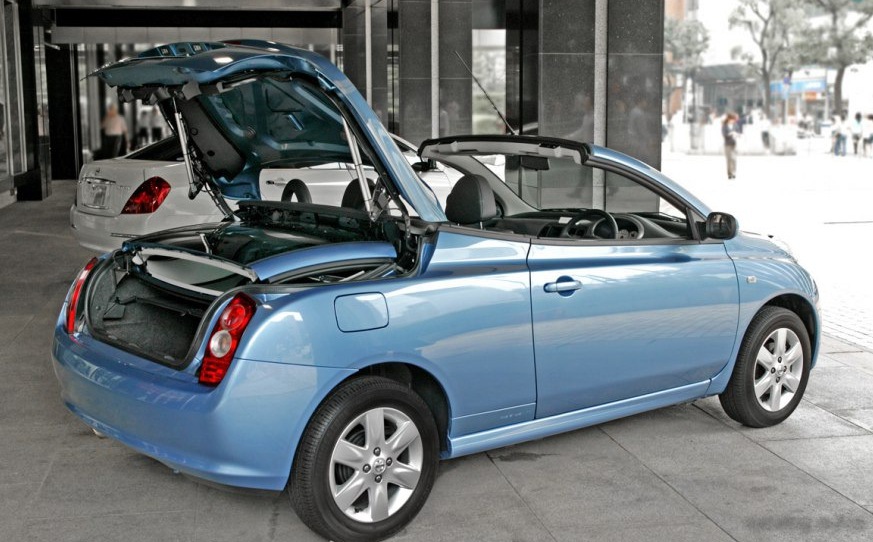
The Nissan Micra C+C (K12) 1.4 16V, produced between 2005 and 2009, represented Nissan’s foray into the affordable, retractable hardtop convertible market. Positioned as the entry-level engine option within the K12 C+C range, it aimed to provide accessible open-top motoring. The C+C, standing for “Compact Coupe,” was based on the second-generation (K12) Nissan Micra supermini, but distinguished itself with its electrically operated retractable hardtop – a feature typically found on more expensive vehicles. This variant was primarily sold in Europe and other international markets, offering a stylish and practical alternative to traditional soft-top convertibles.
Technical Specifications
| Brand | Nissan |
| Model | Micra |
| Generation | Micra C+C (K12) |
| Type (Engine) | 1.4 16V (88 Hp) |
| Start of production | 2005 |
| End of production | 2009 |
| Powertrain Architecture | Internal Combustion engine |
| Body type | Cabriolet |
| Seats | 4 |
| Doors | 2 |
| Fuel consumption (urban) | 8.2 l/100 km (28.7 US mpg) |
| Fuel consumption (extra urban) | 5.6 l/100 km (42 US mpg) |
| Fuel Type | Petrol (Gasoline) |
| Acceleration 0 – 100 km/h | 12.8 sec |
| Acceleration 0 – 62 mph | 12.8 sec |
| Acceleration 0 – 60 mph | 12.2 sec |
| Maximum speed | 176 km/h (109.36 mph) |
| Weight-to-power ratio | 12.9 kg/Hp |
| Weight-to-torque ratio | 8.9 kg/Nm |
| Power | 88 Hp @ 5600 rpm |
| Torque | 128 Nm @ 3200 rpm (94.41 lb.-ft. @ 3200 rpm) |
| Engine layout | Front, Transverse |
| Engine Model/Code | CR14DE |
| Engine displacement | 1386 cm3 (84.58 cu. in.) |
| Number of cylinders | 4 |
| Engine configuration | Inline |
| Cylinder Bore | 73 mm (2.87 in.) |
| Piston Stroke | 82.8 mm (3.26 in.) |
| Compression ratio | 9.9:1 |
| Number of valves per cylinder | 4 |
| Fuel injection system | Multi-port manifold injection |
| Engine aspiration | Naturally aspirated |
| Valvetrain | DOHC |
| Engine oil capacity | 3 l (3.17 US qt | 2.64 UK qt) |
| Coolant capacity | 5.3 l (5.6 US qt | 4.66 UK qt) |
| Kerb Weight | 1135 kg (2502.25 lbs.) |
| Max. weight | 1540 kg (3395.12 lbs.) |
| Max load | 405 kg (892.87 lbs.) |
| Trunk (boot) space – minimum | 255 l (9.01 cu. ft.) |
| Trunk (boot) space – maximum | 457 l (16.14 cu. ft.) |
| Fuel tank capacity | 46 l (12.15 US gal | 10.12 UK gal) |
| Length | 3808 mm (149.92 in.) |
| Width | 1668 mm (65.67 in.) |
| Height | 1441 mm (56.73 in.) |
| Wheelbase | 2432 mm (95.75 in.) |
| Front track | 1460 mm (57.48 in.) |
| Rear track | 1448 mm (57.01 in.) |
| Drivetrain Architecture | Front wheel drive |
| Number of gears | 5 |
| Gearbox type | Manual transmission |
Powertrain & Engine Architecture
The heart of the Micra C+C 1.4 16V is the CR14DE engine, a 1.4-liter inline-four cylinder gasoline engine. This engine utilizes a multi-point fuel injection system and a double overhead camshaft (DOHC) valvetrain, contributing to its relatively efficient operation. The CR14DE is a naturally aspirated engine, meaning it doesn’t employ turbocharging or supercharging. Its 88 horsepower output at 5600 rpm and 94.41 lb-ft of torque at 3200 rpm were considered adequate for the vehicle’s weight, but didn’t offer particularly brisk acceleration. The engine’s design prioritized fuel economy and reliability over outright performance. The five-speed manual transmission was the standard offering, providing a fairly conventional gear ratio spread. The transmission was chosen for its simplicity and cost-effectiveness, aligning with the Micra C+C’s positioning as an affordable convertible.
Driving Characteristics
The 1.4-liter engine, paired with the five-speed manual transmission, delivered a driving experience best described as relaxed and economical. Acceleration from 0-60 mph took around 12.2 seconds, which was noticeably slower than the more powerful 1.6-liter variants. The engine required frequent downshifts to maintain momentum when tackling hills or overtaking. However, the light weight of the C+C helped mitigate the lack of raw power. The steering was light and precise, making it easy to maneuver in urban environments. The suspension, while tuned for comfort, provided adequate control in most driving situations. The retractable hardtop added weight to the vehicle, impacting handling slightly compared to the standard Micra hatchback, but the trade-off was a more refined and secure driving experience with the top up.
Equipment & Trim Levels
The 1.4 16V typically represented the base trim level for the Micra C+C. Standard equipment generally included air conditioning, power steering, electric front windows, and a basic audio system. Safety features such as ABS (Anti-lock Braking System) were also standard. Interior upholstery was typically cloth, with a relatively simple dashboard layout. Optional extras included alloy wheels, a CD player, and metallic paint finishes. Higher trim levels, such as those equipped with the 1.6-liter engine, offered additional features like leather upholstery, automatic climate control, and upgraded audio systems.
Chassis & Braking
The Micra C+C utilized a front-engine, front-wheel-drive layout. The front suspension consisted of independent coil springs, while the rear suspension also employed an independent coil spring setup. Braking duties were handled by disc brakes at the front and drum brakes at the rear – a cost-saving measure common in this segment. The braking system, combined with ABS, provided adequate stopping power for everyday driving. The chassis was reinforced compared to the standard Micra hatchback to compensate for the removal of the roof structure, ensuring sufficient torsional rigidity.
Market Reception & Comparison
The Nissan Micra C+C 1.4 16V was generally well-received by critics as an affordable and stylish convertible. However, the 1.4-liter engine was often criticized for its lack of power, particularly when compared to the 1.6-liter option. Fuel economy was a strong point, with the 1.4-liter engine achieving around 42 mpg on the extra-urban cycle. Reliability was generally good, although the complex retractable hardtop mechanism required careful maintenance. Compared to rivals like the Peugeot 206 CC, the Micra C+C offered a more practical and user-friendly hardtop system, but lacked the Peugeot’s more premium interior appointments.
Legacy
The Nissan Micra C+C 1.4 16V remains a relatively affordable and accessible entry point into the world of convertible motoring. The CR14DE engine is known for its durability and relatively low maintenance costs. While not a performance car, the 1.4-liter variant offers a comfortable and economical driving experience. On the used car market, these models are generally sought after for their practicality and the appeal of the retractable hardtop. However, potential buyers should be aware of the potential for issues with the hardtop mechanism, and ensure it is properly maintained. The Micra C+C, particularly the 1.4 variant, represents a unique and often overlooked chapter in Nissan’s history, demonstrating their ability to offer innovative and affordable vehicles to a broad audience.