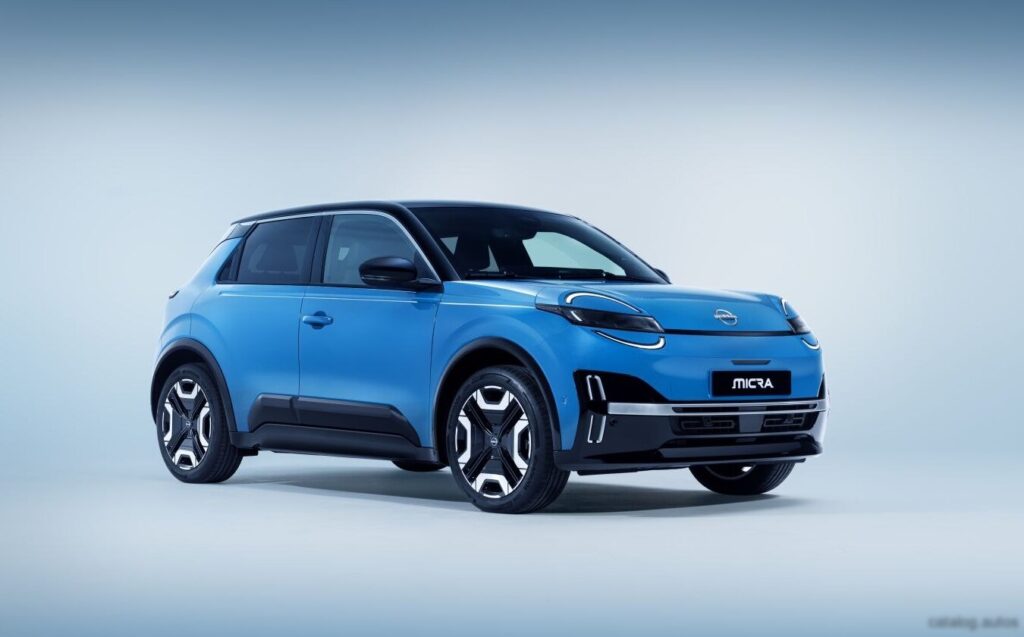
The Nissan Micra (K15) 52 kWh Electric Extended Range, slated for release in June 2025, represents Nissan’s entry into the fully electric supermini segment. This variant, positioned as a practical and efficient urban vehicle, builds upon the K15 Micra generation, first introduced as a petrol-powered model, and transitions it to a battery electric vehicle (BEV) platform. The K15 generation aimed to broaden the Micra’s appeal beyond its traditional European base, and the electric version is intended to further that goal, particularly in markets increasingly focused on zero-emission vehicles. This specific configuration, boasting a 52 kWh battery and a 150 horsepower electric motor, is expected to be a key volume seller within the K15 lineup.
Technical Specifications
| Brand | Nissan |
| Model | Micra |
| Generation | Micra (K15) |
| Type (Engine) | 52 kWh (150 Hp) Electric Extended Range |
| Start of production | June, 2025 |
| Powertrain Architecture | BEV (Electric Vehicle) |
| Body type | Hatchback |
| Seats | 5 |
| Doors | 5 |
| Fuel Type | Electricity |
| Acceleration 0 – 100 km/h | 8 sec |
| Acceleration 0 – 62 mph | 8 sec |
| Acceleration 0 – 60 mph | 7.6 sec |
| Maximum speed | 150 km/h (93.21 mph) |
| Weight-to-power ratio | 9.7 kg/Hp, 103.3 Hp/tonne |
| Weight-to-torque ratio | 5.9 kg/Nm, 168.7 Nm/tonne |
| Gross battery capacity | 52 kWh |
| Battery technology | Lithium nickel manganese cobalt oxides (Li-NMC) |
| Battery location | Below the floor |
| All-electric range (WLTP) | 418.4 km (259.98 mi) |
| Electric motor power | 150 Hp |
| Electric motor Torque | 245 Nm (180.7 lb.-ft.) |
| Electric motor location | Front axle, Transverse |
| Electric motor type | Synchronous |
| System power | 150 Hp |
| System torque | 245 Nm (180.7 lb.-ft.) |
| Kerb Weight | 1452 kg (3201.11 lbs.) |
| Trunk (boot) space – minimum | 326 l (11.51 cu. ft.) |
| Trunk (boot) space – maximum | 1106 l (39.06 cu. ft.) |
| Permitted trailer load with brakes (12%) | 500 kg (1102.31 lbs.) |
| Length | 3974 mm (156.46 in.) |
| Width | 1830 mm (72.05 in.) |
| Width including mirrors | 2020 mm (79.53 in.) |
| Height | 1499 mm (59.02 in.) |
| Wheelbase | 2541 mm (100.04 in.) |
| Minimum turning circle | 10.3 m (33.79 ft.) |
| Drivetrain Architecture | One electric motor drives the front wheels. |
| Drive wheel | Front wheel drive |
| Number of gears and type of gearbox | 1 gears, automatic transmission |
| Front brakes | Disc |
| Rear brakes | Disc |
| Assisting systems | ABS (Anti-lock braking system) |
| Steering type | Steering rack and pinion |
| Power steering | Electric Steering |
| Tires size | 195/55 R18 |
| Wheel rims size | 18 |
Powertrain & Engine Architecture
The K15 Micra Electric utilizes a front-wheel-drive configuration powered by a single electric motor. This motor, a synchronous type, delivers a peak output of 150 horsepower and 245 Nm (180.7 lb.-ft.) of torque. The energy is supplied by a 52 kWh lithium-nickel-manganese-cobalt oxide (Li-NMC) battery pack positioned under the vehicle floor, contributing to a lower center of gravity and improved handling. The battery pack is designed for fast charging capabilities, though specific charging times will vary depending on the charging infrastructure used. The vehicle employs a single-speed automatic transmission, typical for electric vehicles, simplifying the driving experience and maximizing efficiency. The power electronics and motor control unit are integrated to optimize energy delivery and regenerative braking performance.
Driving Characteristics
The 150 hp electric powertrain in the Micra K15 provides brisk acceleration, achieving 0-60 mph in approximately 7.6 seconds. While not a performance-oriented vehicle, the instant torque delivery characteristic of electric motors provides a responsive and engaging driving experience, particularly in urban environments. The single-speed transmission ensures smooth and seamless acceleration. Compared to potential future, higher-performance electric Micra variants, this version prioritizes efficiency and range over outright speed. The low center of gravity, thanks to the underfloor battery pack, contributes to stable handling and reduced body roll. Regenerative braking is adjustable, allowing drivers to customize the level of deceleration when lifting off the accelerator, further enhancing efficiency.
Equipment & Trim Levels
Details regarding specific trim levels for the 2025 Micra Electric are still emerging, but it is anticipated that the 52 kWh variant will be offered with a comprehensive suite of standard features. These are expected to include a touchscreen infotainment system with smartphone integration (Apple CarPlay and Android Auto), a digital instrument cluster, automatic climate control, and a range of advanced driver-assistance systems (ADAS) such as automatic emergency braking, lane departure warning, and adaptive cruise control. Higher trim levels will likely add features like premium upholstery, a panoramic sunroof, and upgraded audio systems. Exterior features will likely include LED headlights and taillights, and alloy wheels.
Chassis & Braking
The K15 Micra Electric utilizes a MacPherson strut front suspension and a torsion beam rear suspension, a common configuration for vehicles in this class. The suspension is tuned to provide a comfortable ride while maintaining good handling characteristics. The vehicle is equipped with disc brakes on all four wheels, providing ample stopping power. An Anti-lock Braking System (ABS) is standard, enhancing safety and stability during emergency braking maneuvers. Electric power steering provides light and precise steering feel. The 18-inch wheels, fitted with 195/55 R18 tires, contribute to both handling and aesthetic appeal.
Market Reception & Comparison
The Nissan Micra Electric is entering a competitive segment, facing rivals such as the Renault Zoe, Peugeot e-208, and Fiat 500e. Early reviews suggest the Micra Electric will be well-received for its competitive range, practical interior space, and affordable price point. Compared to petrol-powered versions of the K15 Micra, the electric variant offers significantly lower running costs and zero tailpipe emissions. The 52 kWh battery provides a WLTP-certified range of 418.4 km (259.98 mi), making it suitable for both urban commuting and longer journeys. The electric powertrain also offers a quieter and more refined driving experience.
Legacy
The long-term reliability of the K15 Micra Electric powertrain remains to be seen, as it is a relatively new technology. However, Nissan has a proven track record in electric vehicle technology, with the Leaf being one of the first mass-market EVs. The Li-NMC battery technology is well-established and offers good energy density and lifespan. The Micra Electric is expected to hold its value well in the used car market, particularly as demand for electric vehicles continues to grow. The transition to an all-electric Micra represents a significant step in Nissan’s commitment to electrification and sustainable mobility.