
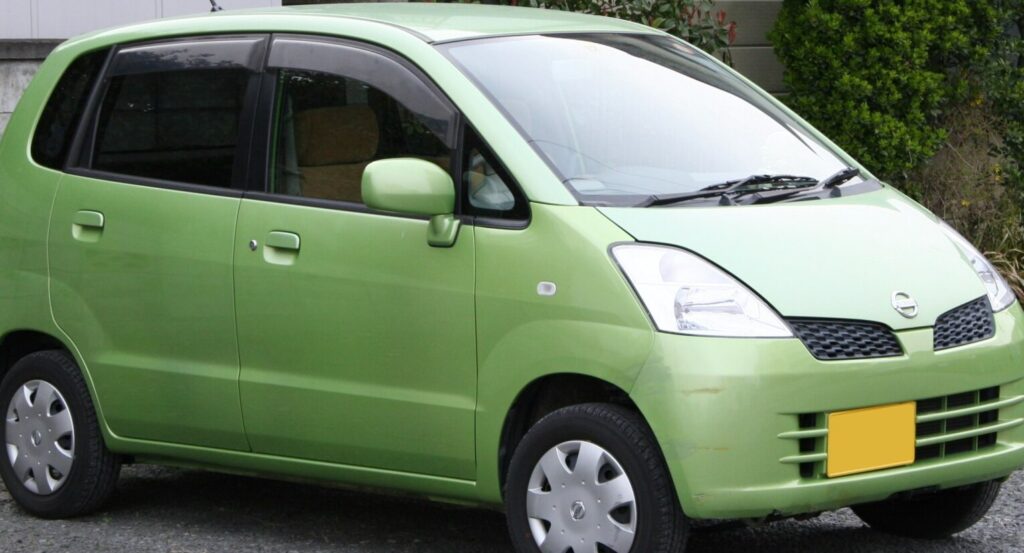
The Nissan Moco 0.7 i 12V, producing 54 horsepower, was a compact hatchback primarily sold in the Japanese domestic market (JDM) between 2001 and 2006. Positioned as an entry-level vehicle, it represented Nissan’s offering in the “kei car” segment – a class of highly regulated, small vehicles designed for urban environments. The Moco, built in collaboration with Suzuki (who also produced a similar model called the Alto), aimed to provide affordable and practical transportation. This particular variant, with its 658cc engine and four-speed automatic transmission, was a popular choice for drivers prioritizing ease of use and fuel efficiency over outright performance.
Technical Specifications
| Brand | Nissan |
| Model | Moco |
| Generation | Moco |
| Type (Engine) | 0.7 i 12V (54 Hp) |
| Start of production | December, 2001 |
| End of production | 2006 |
| Powertrain Architecture | Internal Combustion engine |
| Body type | Hatchback |
| Seats | 5 |
| Doors | 5 |
| Fuel Type | Petrol (Gasoline) |
| Maximum speed | 130 km/h (80.78 mph) |
| Weight-to-power ratio | 15.7 kg/Hp, 63.5 Hp/tonne |
| Weight-to-torque ratio | 13.5 kg/Nm, 74.1 Nm/tonne |
| Power | 54 Hp @ 6500 rpm |
| Power per litre | 82.1 Hp/l |
| Torque | 63 Nm @ 3500 rpm (46.47 lb.-ft. @ 3500 rpm) |
| Engine layout | Front, Longitudinal |
| Engine displacement | 658 cm3 (40.15 cu. in.) |
| Number of cylinders | 3 |
| Engine configuration | Inline |
| Cylinder Bore | 68 mm (2.68 in.) |
| Piston Stroke | 60.6 mm (2.39 in.) |
| Compression ratio | 10.5:1 |
| Number of valves per cylinder | 4 |
| Fuel injection system | Multi-port manifold injection |
| Engine aspiration | Naturally aspirated engine |
| Valvetrain | DOHC |
| Kerb Weight | 850 kg (1873.93 lbs.) |
| Max. weight | 1070 kg (2358.95 lbs.) |
| Max load | 220 kg (485.02 lbs.) |
| Fuel tank capacity | 30 l (7.93 US gal | 6.6 UK gal) |
| Length | 3395 mm (133.66 in.) |
| Width | 1475 mm (58.07 in.) |
| Height | 1590 mm (62.6 in.) |
| Wheelbase | 2360 mm (92.91 in.) |
| Front track | 1295 mm (50.98 in.) |
| Rear (Back) track | 1290 mm (50.79 in.) |
| Minimum turning circle | 8.4 m (27.56 ft.) |
| Drivetrain Architecture | The Internal combustion engine (ICE) drives the front wheels of the vehicle. |
| Drive wheel | Front wheel drive |
| Number of gears and type of gearbox | 4 gears, automatic transmission |
| Front suspension | Coil spring |
| Rear suspension | Coil spring |
| Front brakes | Ventilated discs |
| Rear brakes | Drum |
| Assisting systems | ABS (Anti-lock braking system) |
| Steering type | Steering rack and pinion |
| Power steering | Hydraulic Steering |
| Tires size | 155/65 R13 |
Powertrain & Engine Architecture
The heart of the Moco 0.7 i 12V is the F6A engine, a 658cc inline-three cylinder petrol engine. This engine, also used in other kei cars of the era, features a double overhead camshaft (DOHC) valvetrain and four valves per cylinder, contributing to its relatively high power output for its size. The engine utilizes a multi-port fuel injection system, providing precise fuel delivery for improved efficiency and emissions. The four-speed automatic transmission was a key feature of this variant, offering convenient operation for city driving. It’s a relatively simple automatic, prioritizing reliability and fuel economy over sporty shift characteristics. The engine is longitudinally mounted, a common layout in kei cars to maximize interior space within the vehicle’s compact footprint.
Driving Characteristics
The Moco 0.7 i 12V automatic is not a performance-oriented vehicle. With only 54 horsepower, acceleration is modest, and overtaking requires careful planning. The four-speed automatic transmission has relatively long gear ratios, prioritizing fuel efficiency over quick acceleration. Compared to the available manual transmission, the automatic version sacrifices some responsiveness. However, the automatic provides a smoother and more relaxed driving experience, particularly in congested urban traffic. The lightweight nature of the Moco helps mitigate the lack of power, making it feel reasonably nimble around town. The steering is light and easy to use, further enhancing its suitability for city driving.
Equipment & Trim Levels
The Moco 0.7 i 12V typically came with a basic level of equipment, reflecting its position as an entry-level vehicle. Standard features generally included power steering, air conditioning, and a basic audio system. Interior upholstery was typically cloth, and the dashboard featured a simple, functional design. Optional extras could include power windows, central locking, and upgraded audio systems. Higher trim levels, though not common with this engine/transmission combination, might have added features like alloy wheels and body-colored door handles.
Chassis & Braking
The Moco utilizes a simple but effective chassis design. Front suspension consists of coil springs, while the rear also employs coil springs. The front brakes are ventilated discs, providing adequate stopping power for the vehicle’s weight and performance. However, the rear brakes are drums, a cost-saving measure common in this segment. Anti-lock braking system (ABS) was included as a standard safety feature. The relatively narrow tires (155/65 R13) contribute to fuel efficiency but offer limited grip in demanding conditions.
Market Reception & Comparison
The Nissan Moco 0.7 i 12V was generally well-received in Japan as a practical and affordable kei car. Critics praised its fuel efficiency and ease of use, particularly the convenience of the automatic transmission. However, its limited power and basic interior were points of criticism. Compared to other kei car options, such as the Suzuki Alto (which shared many components with the Moco) and the Daihatsu Mira, the Moco offered a competitive package in terms of price and features. The automatic transmission version was particularly popular among older drivers and those seeking a hassle-free driving experience.
Legacy
The Nissan Moco, and specifically the 0.7 i 12V automatic variant, remains a common sight on Japanese roads today. The F6A engine is known for its reliability, and with proper maintenance, these vehicles can provide years of service. In the used car market, the Moco 0.7 i 12V is valued for its affordability and low running costs. While not a collector’s item, it represents a significant example of the kei car segment and Nissan’s commitment to providing practical transportation solutions for the Japanese market. Parts availability remains good, making maintenance relatively straightforward and inexpensive.
