
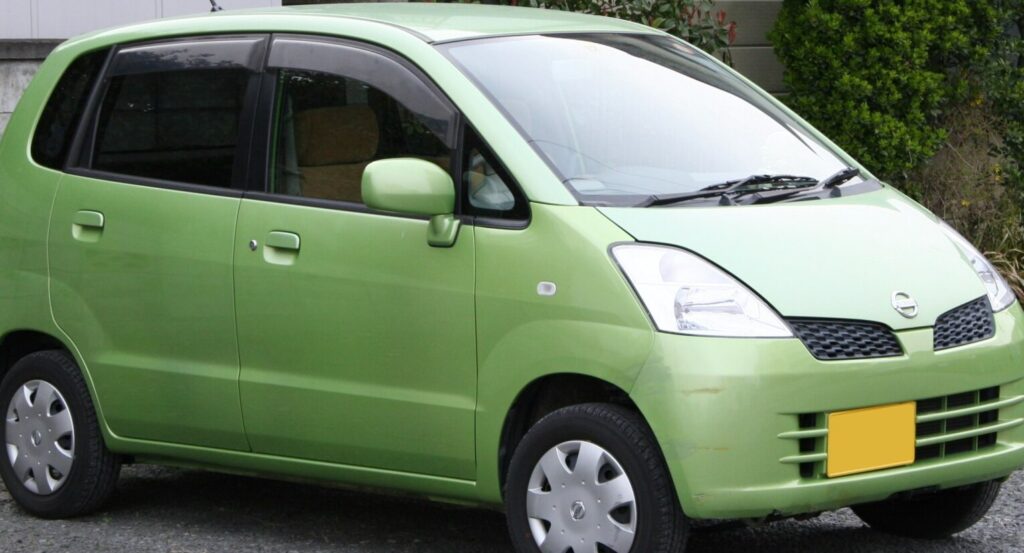
The Nissan Moco 0.7 i 12V Turbo 4WD, produced between December 2001 and 2006, represents a unique offering within the Japanese Kei car segment. Designed primarily for the domestic Japanese market, the Moco was a collaborative effort between Nissan and Suzuki, leveraging Suzuki’s expertise in small vehicle engineering. This particular variant, equipped with the 658cc turbocharged three-cylinder engine and a four-speed automatic transmission, aimed to provide a practical and affordable all-wheel-drive option for navigating Japan’s often challenging road conditions. It occupied a niche position within the Moco lineup, offering a balance between fuel efficiency and all-weather capability, appealing to buyers who prioritized practicality over outright performance.
Technical Specifications
| Brand | Nissan |
| Model | Moco |
| Generation | Moco |
| Type (Engine) | 0.7 i 12V Turbo (60 Hp) 4WD |
| Start of production | December, 2001 |
| End of production | 2006 |
| Powertrain Architecture | Internal Combustion engine |
| Body type | Hatchback |
| Seats | 5 |
| Doors | 5 |
| Fuel Type | Petrol (Gasoline) |
| Weight-to-power ratio | 15 kg/Hp, 66.7 Hp/tonne |
| Weight-to-torque ratio | 10.8 kg/Nm, 92.2 Nm/tonne |
| Power | 60 Hp @ 6000 rpm |
| Power per litre | 91.2 Hp/l |
| Torque | 83 Nm @ 3000 rpm, 61.22 lb.-ft. @ 3000 rpm |
| Engine layout | Front, Transverse |
| Engine displacement | 658 cm3, 40.15 cu. in. |
| Number of cylinders | 3 |
| Engine configuration | Inline |
| Cylinder Bore | 68 mm, 2.68 in. |
| Piston Stroke | 60.4 mm, 2.38 in. |
| Compression ratio | 8.9:1 |
| Number of valves per cylinder | 4 |
| Fuel injection system | Multi-port manifold injection |
| Engine aspiration | Turbocharger, Intercooler |
| Valvetrain | DOHC |
| Kerb Weight | 900 kg, 1984.16 lbs |
| Max. weight | 1120 kg, 2469.18 lbs |
| Max load | 220 kg, 485.02 lbs |
| Fuel tank capacity | 30 l, 7.93 US gal | 6.6 UK gal |
| Length | 3395 mm, 133.66 in. |
| Width | 1475 mm, 58.07 in. |
| Height | 1600 mm, 62.99 in. |
| Wheelbase | 2360 mm, 92.91 in. |
| Front track | 1295 mm, 50.98 in. |
| Rear (Back) track | 1290 mm, 50.79 in. |
| Minimum turning circle | 8.4 m, 27.56 ft. |
| Drive wheel | All wheel drive (4×4) |
| Number of gears | 4 gears, automatic transmission |
| Front suspension | Coil spring |
| Rear suspension | Coil spring |
| Front brakes | Ventilated discs |
| Rear brakes | Drum |
| Assisting systems | ABS (Anti-lock braking system) |
| Steering type | Steering rack and pinion |
| Power steering | Hydraulic Steering |
| Tires size | 155/65 R13 |
Powertrain & Engine Architecture
The heart of the Moco 0.7 i Turbo 4WD is the F6A engine, a 658cc inline three-cylinder unit. This engine, a product of Suzuki’s engineering, features a single overhead camshaft (SOHC) design, although some sources indicate a DOHC configuration. It utilizes a multi-point fuel injection system and a small turbocharger with an intercooler to boost power output to 60 horsepower at 6000 rpm and 83 Nm (61.22 lb-ft) of torque at 3000 rpm. The turbocharger, while small, significantly enhances low-end torque, crucial for a vehicle of this size and weight. The four-speed automatic transmission, while providing ease of use, is a relatively simple unit designed for durability rather than performance. It’s characterized by relatively wide gear ratios, prioritizing fuel economy over rapid acceleration.
Driving Characteristics
The driving experience in the Moco 0.7 i Turbo 4WD is best described as utilitarian. The 60 horsepower engine, coupled with the automatic transmission, delivers modest acceleration. The all-wheel-drive system provides enhanced traction, particularly on slippery surfaces, making it a capable vehicle in inclement weather. However, the automatic transmission’s programming tends to prioritize fuel efficiency, resulting in somewhat sluggish responses to throttle inputs. Compared to the manual transmission versions of the Moco, the automatic sacrifices some responsiveness. The relatively soft suspension setup provides a comfortable ride, but also contributes to noticeable body roll during cornering. The steering, while hydraulically assisted, lacks significant feedback.
Equipment & Trim Levels
The Moco 0.7 i Turbo 4WD typically came equipped with basic amenities. Standard features included air conditioning, power steering, and an AM/FM radio. The interior was functional and spartan, with durable plastic trim and cloth upholstery. Optional extras, depending on the specific year and package, could include power windows, central locking, and upgraded audio systems. The trim level for this variant generally fell into the mid-range of the Moco lineup, offering a step up from the base models in terms of features and performance, but lacking the luxury appointments of higher-spec trims.
Chassis & Braking
The Moco’s chassis is a typical monocoque construction, designed for lightweight and rigidity. The suspension utilizes coil springs and dampers all around, providing a comfortable, if somewhat basic, ride. The front brakes are ventilated discs, offering adequate stopping power, while the rear brakes are drums, a cost-saving measure common in Kei cars. An Anti-lock Braking System (ABS) was included as a standard safety feature. The relatively narrow tires (155/65 R13) contribute to fuel efficiency but limit grip in more demanding driving situations.
Market Reception & Comparison
The Nissan Moco 0.7 i Turbo 4WD was well-received in Japan as a practical and affordable all-wheel-drive Kei car. Critics praised its fuel efficiency and maneuverability in urban environments. However, the limited power output and somewhat sluggish automatic transmission were points of criticism. Compared to other Moco variants, such as the naturally aspirated models, the turbo version offered a noticeable performance boost. Compared to competitors like the Suzuki Wagon R and Daihatsu Mira, the Moco offered a similar level of practicality and affordability, with the all-wheel-drive option providing a distinct advantage in certain regions of Japan.
Legacy
The Nissan Moco, and specifically the 0.7 i Turbo 4WD variant, has developed a modest following in the used car market. The F6A engine, while not known for exceptional longevity, is generally considered reliable with proper maintenance. The simple mechanical design makes it relatively easy and inexpensive to repair. Today, these vehicles are often sought after by those looking for an affordable and practical city car, or as a first car for new drivers. The Moco’s enduring appeal lies in its practicality, fuel efficiency, and the added security of all-wheel drive, making it a unique and enduring example of the Japanese Kei car philosophy.
