
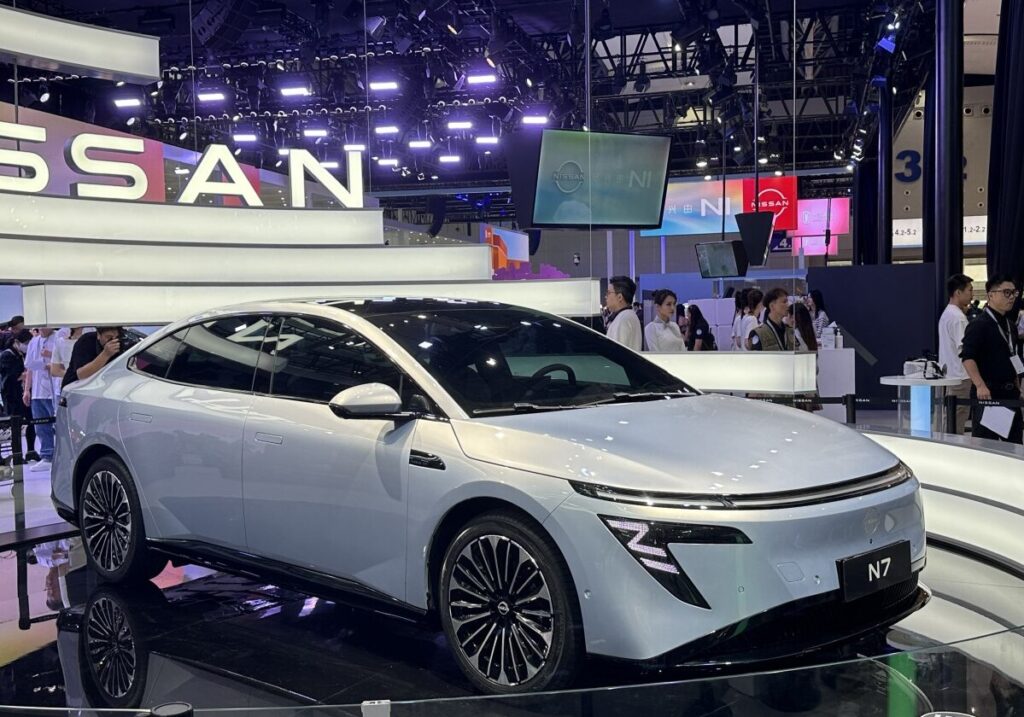
The Nissan N7 73 kWh, launched in April 2025, marks Nissan’s initial foray into the mid-size electric sedan segment. Designed as a mainstream EV, the N7 aims to strike a balance between driving range, performance, and everyday practicality. Built on a dedicated electric vehicle platform, the N7 signifies Nissan’s commitment to electrification and is positioned to compete with established models like the Tesla Model 3 and Hyundai Ioniq 6, offering a compelling alternative in a rapidly expanding market.
Technical Specifications
| Brand | Nissan |
| Model | N7 |
| Generation | N7 |
| Type (Engine) | 73 kWh (272 Hp) |
| Start of production | April, 2025 |
| Powertrain Architecture | BEV (Electric Vehicle) |
| Body type | Sedan |
| Seats | 5 |
| Doors | 4 |
| Fuel Type | Electricity |
| Maximum speed | 160 km/h (99.42 mph) |
| Weight-to-power ratio | 7.2 kg/Hp, 139.6 Hp/tonne |
| Weight-to-torque ratio | 6.4 kg/Nm, 156.5 Nm/tonne |
| Gross battery capacity | 73 kWh |
| Battery technology | Lithium iron phosphate (LiFePO4) |
| Battery location | Below the floor |
| All-electric range (CLTC) | 625-635 km (388.36 – 394.57 mi) |
| Average Energy consumption (CLTC) | 13.2-13.4 kWh/100 km (21.24 – 21.57 kWh/100 mi) |
| MPGe | 159 – 156 |
| km/kWh | 7.6 – 7.5 |
| mi/kWh | 4.7 – 4.6 |
| Electric motor power | 272 Hp |
| Electric motor Torque | 305 Nm (224.96 lb.-ft.) |
| Electric motor model/code | TZ200XS3JD |
| Electric motor location | Front axle, Transverse |
| Electric motor type | Synchronous |
| System power | 272 Hp |
| System torque | 305 Nm (224.96 lb.-ft.) |
| Kerb Weight | 1949-1962 kg (4296.81 – 4325.47 lbs.) |
| Max. weight | 2380-2395 kg (5247 – 5280.07 lbs.) |
| Max load | 431-433 kg (950.19 – 954.6 lbs.) |
| Trunk (boot) space – minimum | 484 l (17.09 cu. ft.) |
| Length | 4930 mm (194.09 in.) |
| Width | 1895 mm (74.61 in.) |
| Height | 1487 mm (58.54 in.) |
| Wheelbase | 2915 mm (114.76 in.) |
| Front track | 1634 mm (64.33 in.) |
| Rear (Back) track | 1643 mm (64.69 in.) |
| Drag coefficient (Cd) | 0.208 |
| Minimum turning circle (turning diameter) | 11.6 m (38.06 ft.) |
| Approach angle | 13° |
| Departure angle | 18° |
| Drivetrain Architecture | One electric motor drives the front wheels. |
| Drive wheel | Front wheel drive |
| Number of gears and type of gearbox | 1 gears, automatic transmission |
| Front suspension | Independent, type McPherson with coil spring and anti-roll bar |
| Rear suspension | Independent multi-link spring suspension with stabilizer |
| Front brakes | Ventilated discs |
| Rear brakes | Disc |
| Assisting systems | ABS (Anti-lock braking system) |
| Steering type | Steering rack and pinion |
| Power steering | Electric Steering |
| Tires size | 225/45 R19 |
| Wheel rims size | 19 |
Powertrain & Engine Architecture
The Nissan N7 73 kWh is a Battery Electric Vehicle (BEV), relying solely on electrical power for propulsion. The core of the system is a 73 kWh Lithium Iron Phosphate (LiFePO4) battery pack positioned under the vehicle floor, contributing to a lower center of gravity and enhanced handling. This battery powers a single synchronous electric motor, identified as TZ200XS3JD, transversely mounted on the front axle. The motor generates 272 horsepower and 305 Nm (224.96 lb.-ft.) of torque. The N7 employs a single-speed automatic transmission, a common feature in electric vehicles, providing seamless acceleration. The selection of LiFePO4 battery chemistry prioritizes safety and longevity, although it generally offers slightly lower energy density compared to Nickel Manganese Cobalt (NMC) batteries.
Driving Characteristics
The front-wheel-drive configuration of the N7 73 kWh delivers sufficient performance for everyday commuting and highway travel. While not designed as a high-performance EV, the electric motor’s instant torque provides brisk acceleration. The single-speed transmission ensures a smooth and linear power delivery. The N7 prioritizes efficiency and comfort over sporty handling dynamics. The battery pack’s placement influences the weight distribution, resulting in predictable handling characteristics. Compared to potential future, higher-performance variants, the 73 kWh model emphasizes range and affordability.
Equipment & Trim Levels
The N7 73 kWh comes standard with a comprehensive array of features intended to appeal to a wide range of buyers. Standard equipment includes a large touchscreen infotainment system, compatibility with Apple CarPlay and Android Auto, a suite of advanced driver-assistance systems (ADAS) such as automatic emergency braking and lane-keeping assist, and comfortable cloth upholstery. Higher trim levels, anticipated to be available, will likely add features like leather upholstery, a premium sound system, and a panoramic sunroof. The interior design is modern and minimalist, emphasizing usability and a spacious cabin environment.
Chassis & Braking
The N7 utilizes an independent suspension system on all four wheels. The front suspension features a McPherson strut design with coil springs and an anti-roll bar, while the rear incorporates a multi-link setup with a stabilizer bar. This configuration aims to deliver a comfortable ride and stable handling. The braking system consists of ventilated discs at the front and solid discs at the rear, coupled with an Anti-lock Braking System (ABS) for improved safety. The N7’s relatively low curb weight (1949-1962 kg / 4296.81 – 4325.47 lbs.) contributes to its braking performance.
Market Reception & Comparison
Initial reviews of the Nissan N7 73 kWh have been largely positive, with reviewers praising its competitive range, comfortable ride quality, and well-equipped interior. The CLTC range of 625-635 km (388.36 – 394.57 mi) positions it favorably against some competitors. The energy consumption of 13.2-13.4 kWh/100 km (21.24 – 21.57 kWh/100 mi) is also competitive within its class. Compared to other trims, the 73 kWh model represents the entry point to the N7 lineup, offering a balance of range and affordability. It’s expected to attract buyers who prioritize practicality and efficiency over outright performance.
Legacy
The long-term reliability of the Nissan N7 73 kWh remains to be determined, given its recent launch. However, Nissan generally enjoys a reputation for building dependable vehicles. The use of LiFePO4 battery technology is anticipated to contribute to the longevity of the battery pack. As the electric vehicle market matures, the N7 73 kWh is likely to become a popular choice in the used car market, offering a compelling combination of range, features, and value. Its ultimate success will depend on Nissan’s ability to maintain its competitive position in a rapidly evolving industry.
