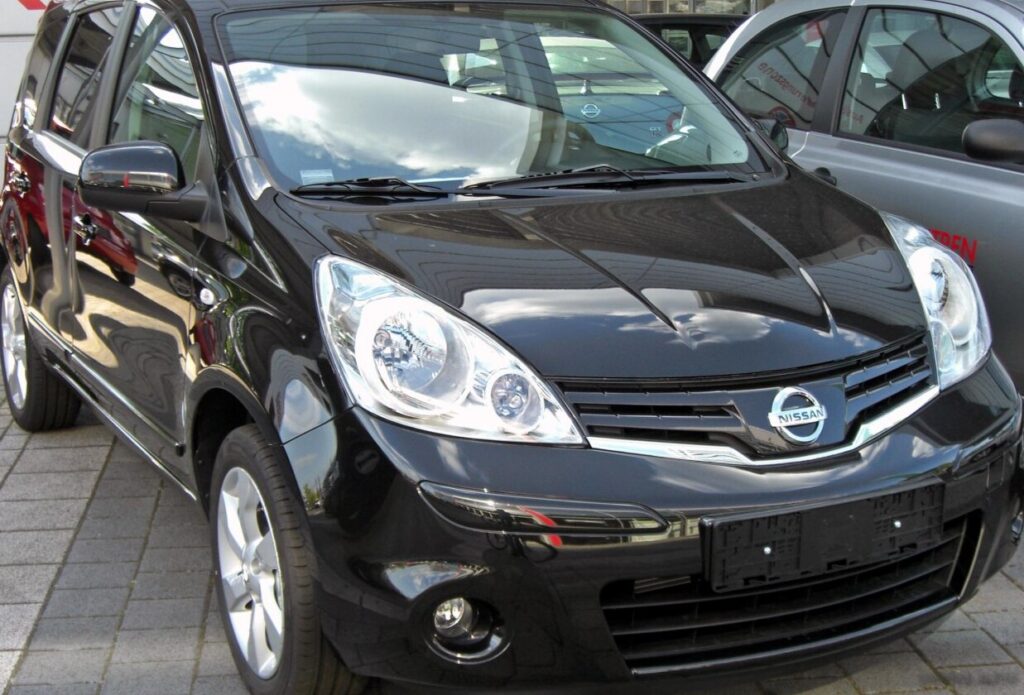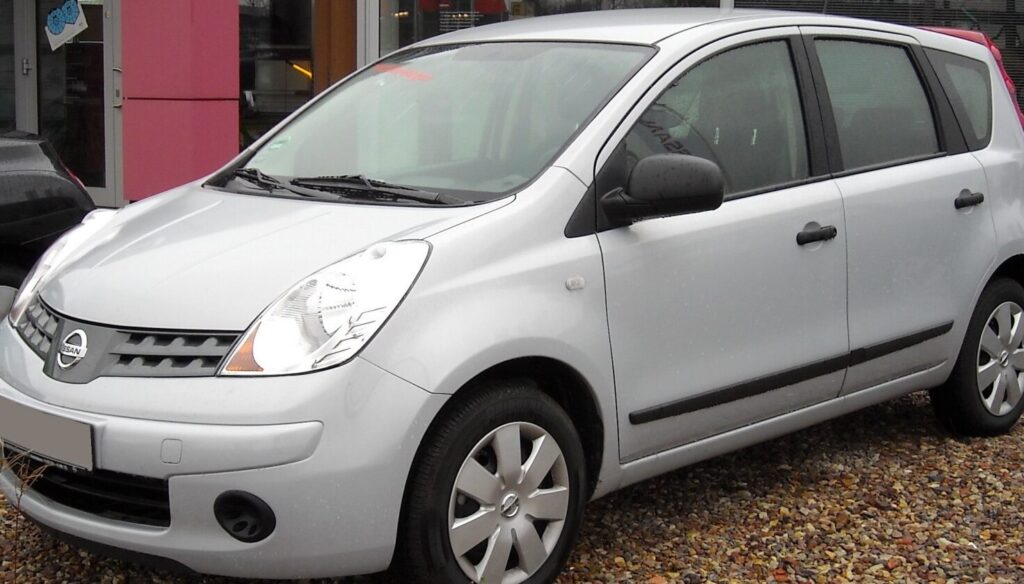
The Nissan Note I (E11) 1.5 dCi, producing 68 horsepower, was a key variant in the first generation of Nissan’s popular supermini, sold primarily in the European market from 2005 to 2009. Positioned as the entry-level diesel option, it aimed to provide fuel efficiency and affordability within the Note’s lineup. The E11 Note, built on Nissan’s ‘B’ platform, represented a significant step forward in small car design, emphasizing interior space and practicality. This particular 1.5 dCi variant offered a diesel alternative to the petrol engines available, catering to drivers prioritizing economy over outright performance.
Technical Specifications
| Brand | Nissan |
| Model | Note |
| Generation | Note I (E11) |
| Type (Engine) | 1.5 dCi (68 Hp) |
| Start of production | 2005 |
| End of production | 2009 |
| Powertrain Architecture | Internal Combustion engine |
| Body type | Hatchback |
| Seats | 5 |
| Doors | 5 |
| Fuel consumption (urban) | 5.9 l/100 km (39.9 US mpg, 47.9 UK mpg, 16.9 km/l) |
| Fuel consumption (extra urban) | 4.7 l/100 km (50 US mpg, 60.1 UK mpg, 21.3 km/l) |
| Fuel Type | Diesel |
| Acceleration 0 – 100 km/h | 16.5 sec |
| Acceleration 0 – 62 mph | 16.5 sec |
| Acceleration 0 – 60 mph | 15.7 sec |
| Maximum speed | 155 km/h (96.31 mph) |
| Weight-to-power ratio | 17.1 kg/Hp, 58.4 Hp/tonne |
| Weight-to-torque ratio | 7.3 kg/Nm, 137.3 Nm/tonne |
| Power | 68 Hp @ 4000 rpm |
| Power per litre | 46.5 Hp/l |
| Torque | 160 Nm @ 2000 rpm (118.01 lb.-ft. @ 2000 rpm) |
| Engine layout | Front, Transverse |
| Engine Model/Code | K9K 700 |
| Engine displacement | 1461 cm3 (89.16 cu. in.) |
| Number of cylinders | 4 |
| Engine configuration | Inline |
| Cylinder Bore | 76 mm (2.99 in.) |
| Piston Stroke | 80.5 mm (3.17 in.) |
| Compression ratio | 18.8:1 |
| Number of valves per cylinder | 2 |
| Fuel injection system | Diesel Commonrail |
| Engine aspiration | Turbocharger, Intercooler |
| Valvetrain | OHC |
| Engine oil capacity | 4.4 l (4.65 US qt | 3.87 UK qt) |
| Coolant | 6 l (6.34 US qt | 5.28 UK qt) |
| Kerb Weight | 1165 kg (2568.39 lbs.) |
| Max. weight | 1605 kg (3538.42 lbs.) |
| Max load | 440 kg (970.03 lbs.) |
| Trunk (boot) space – minimum | 280 l (9.89 cu. ft.) |
| Trunk (boot) space – maximum | 1332 l (47.04 cu. ft.) |
| Fuel tank capacity | 46 l (12.15 US gal | 10.12 UK gal) |
| Length | 4083 mm (160.75 in.) |
| Width | 1690 mm (66.54 in.) |
| Height | 1550 mm (61.02 in.) |
| Wheelbase | 2600 mm (102.36 in.) |
| Front track | 1470 mm (57.87 in.) |
| Rear (Back) track | 1460 mm (57.48 in.) |
| Minimum turning circle | 11 m (36.09 ft.) |
| Drivetrain Architecture | Front wheel drive |
| Number of gears | 5 gears, manual transmission |
| Front suspension | Spring Strut |
| Rear suspension | Torsion |
| Front brakes | Disc |
| Rear brakes | Drum |
| Assisting systems | ABS (Anti-lock braking system) |
| Steering type | Steering rack and pinion |
| Tires size | 185/55 R16 |
INTRODUCTION
The Nissan Note I (E11) 1.5 dCi 68 hp, launched in 2005, was a significant addition to Nissan’s European lineup. Designed as a compact, five-door hatchback, the Note aimed to blend practicality with affordability. The 1.5 dCi variant, powered by the Renault-sourced K9K engine, was specifically targeted at buyers seeking low running costs and reasonable fuel economy. It occupied the lower end of the Note range, offering a more accessible price point compared to the higher-powered petrol options. The E11 Note was a key player in Nissan’s strategy to gain market share in the competitive European small car segment.
Powertrain & Engine Architecture
At the heart of the Note 1.5 dCi lies the K9K 700 engine, a 1.5-liter inline-four cylinder diesel engine developed jointly by Renault and Nissan. This engine is renowned for its robustness and fuel efficiency. The K9K 700 utilizes a common rail direct injection system, delivering fuel directly into the combustion chamber at extremely high pressure for optimized combustion. A turbocharger with an intercooler is employed to boost power output and improve torque. The engine features an overhead camshaft (OHC) valvetrain with two valves per cylinder. The 68 horsepower output is achieved at 4000 rpm, while peak torque of 160 Nm (118 lb-ft) is available from 2000 rpm. The engine is transversely mounted in the front of the vehicle. The transmission is a five-speed manual gearbox, chosen for its simplicity and efficiency. This configuration prioritized fuel economy over sporty performance.
Driving Characteristics
The 1.5 dCi 68 hp Note offered a decidedly economy-focused driving experience. Acceleration was modest, with a 0-60 mph time of around 15.7 seconds. The engine felt strained when pushed hard, and overtaking required careful planning. However, in typical urban and highway driving, the engine provided sufficient power for everyday tasks. The five-speed manual gearbox was well-matched to the engine’s characteristics, with relatively short gear ratios aiding acceleration. The turbocharger provided a noticeable boost in mid-range power, improving responsiveness. Compared to the 1.4-liter petrol versions, the 1.5 dCi offered significantly better fuel economy, but at the expense of performance. The manual transmission provided more driver engagement than the optional automatic available on other Note trims.
Equipment & Trim Levels
The 1.5 dCi variant of the Note typically came with a relatively basic level of equipment, reflecting its position as the entry-level diesel model. Standard features generally included power steering, central locking, electric front windows, and an adjustable steering column. Safety features included ABS brakes and driver and passenger airbags. Interior upholstery was typically cloth, and the dashboard featured a functional, if somewhat plain, design. Optional extras included air conditioning, alloy wheels, and a CD player. Higher trim levels, such as the S and SE, added features like air conditioning, remote central locking, and upgraded interior trim.
Chassis & Braking
The Note I (E11) utilized a front-wheel-drive layout with a MacPherson strut suspension system at the front and a torsion beam suspension at the rear. This setup provided a comfortable ride quality, although it wasn’t particularly sporty. The front brakes were ventilated discs, while the rear brakes were drums. This configuration was typical for vehicles in this weight class and price range. ABS (Anti-lock Braking System) was standard, enhancing braking performance and safety. The steering was a rack and pinion system, providing reasonably precise control.
Market Reception & Comparison
The Nissan Note 1.5 dCi was generally well-received by critics for its fuel efficiency and practicality. It was praised for its spacious interior and comfortable ride. However, the engine’s lack of outright power was a common criticism. Compared to other small diesel hatchbacks of the time, such as the Ford Fiesta TDCi and the Volkswagen Polo TDI, the Note offered a competitive level of fuel economy and a slightly more spacious interior. However, it lacked the refinement and driving dynamics of some of its rivals. The 1.5 dCi was a popular choice for drivers prioritizing economy and practicality over performance.
Legacy
The K9K engine, used in the Note 1.5 dCi, proved to be a remarkably durable and reliable unit. Many examples are still on the road today, having covered significant mileage. While diesel engines, in general, have faced increased scrutiny in recent years, the K9K remains a respected powerplant. In the used car market, the Note 1.5 dCi is often sought after by buyers looking for an affordable and fuel-efficient small car. Maintenance costs are generally reasonable, and parts availability is good. The Note I (E11) 1.5 dCi represents a practical and economical choice for those seeking a reliable and affordable supermini.