Technical Specifications
| Brand | Nissan |
| Model | Note |
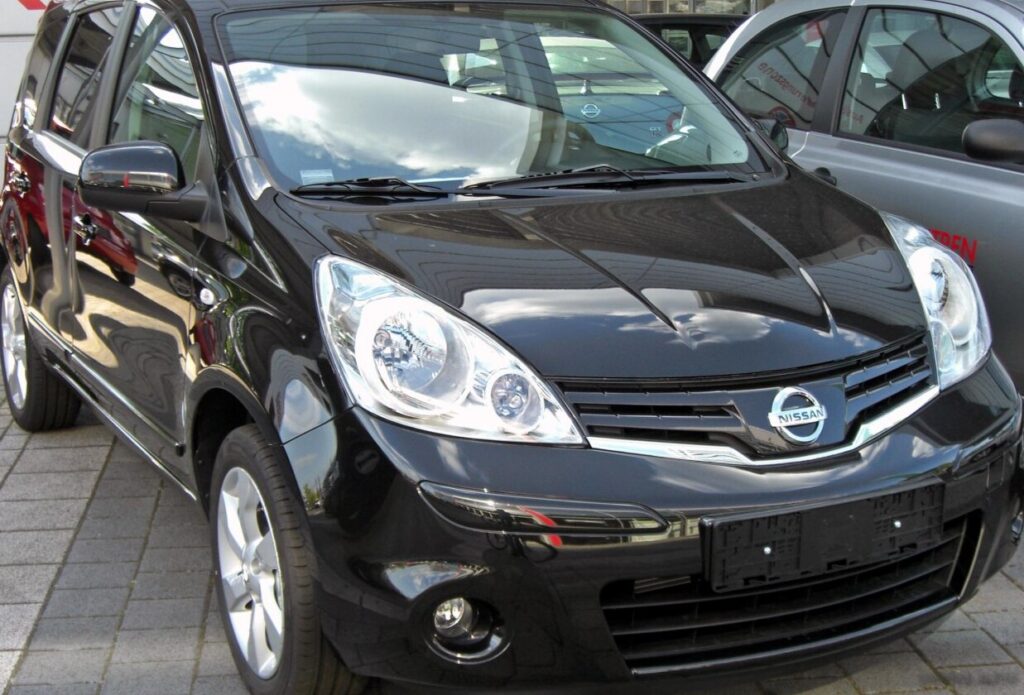
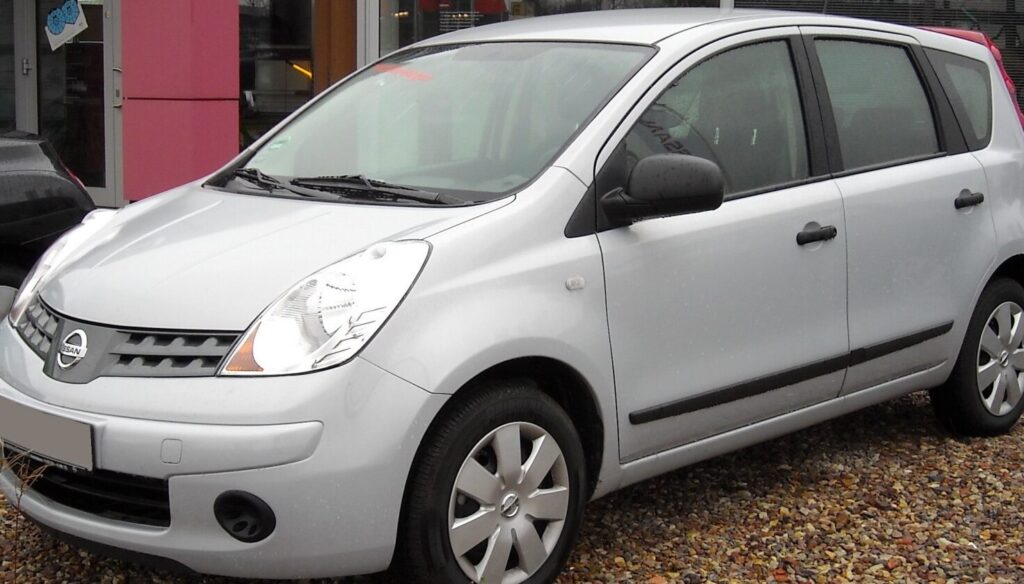
| Generation | Note I (E11) |
| Type (Engine) | 1.6i 16V (110 Hp) Automatic |
| Start of production | 2005 |
| End of production | 2009 |
| Powertrain Architecture | Internal Combustion engine |
| Body type | Hatchback |
| Seats | 5 |
| Doors | 5 |
| Fuel consumption (urban) | 9.3 l/100 km (25.3 US mpg) |
| Fuel consumption (extra urban) | 5.8 l/100 km (40.6 US mpg) |
| Fuel consumption (combined) | 7 l/100 km (33.6 US mpg) |
| Fuel Type | Petrol (Gasoline) |
| Acceleration 0 – 100 km/h | 11.7 sec |
| Acceleration 0 – 62 mph | 11.7 sec |
| Acceleration 0 – 60 mph | 11.1 sec |
| Maximum speed | 174 km/h (108.12 mph) |
| Weight-to-power ratio | 10.1 kg/Hp |
| Weight-to-torque ratio | 7.2 kg/Nm |
| Power | 110 Hp @ 6000 rpm |
| Torque | 153 Nm @ 4400 rpm (112.85 lb.-ft. @ 4400 rpm) |
| Engine layout | Front, Transverse |
| Engine Model/Code | HR16DE |
| Engine displacement | 1598 cm3 (97.52 cu. in.) |
| Number of cylinders | 4 |
| Engine configuration | Inline |
| Cylinder Bore | 78 mm (3.07 in.) |
| Piston Stroke | 83.6 mm (3.29 in.) |
| Compression ratio | 10.7:1 |
| Number of valves per cylinder | 4 |
| Fuel injection system | Multi-port manifold injection |
| Engine aspiration | Naturally aspirated engine |
| Valvetrain | DOHC |
| Engine oil capacity | 4.6 l (4.86 US qt | 4.05 UK qt) |
| Coolant capacity | 5.4 l (5.71 US qt | 4.75 UK qt) |
| Kerb Weight | 1107 kg (2440.52 lbs.) |
| Max. weight | 1560 kg (3439.21 lbs.) |
| Max load | 453 kg (998.69 lbs.) |
| Trunk (boot) space – minimum | 280 l (9.89 cu. ft.) |
| Trunk (boot) space – maximum | 1332 l (47.04 cu. ft.) |
| Fuel tank capacity | 46 l (12.15 US gal | 10.12 UK gal) |
| Length | 4083 mm (160.75 in.) |
| Width | 1690 mm (66.54 in.) |
| Height | 1550 mm (61.02 in.) |
| Wheelbase | 2600 mm (102.36 in.) |
| Front track | 1470 mm (57.87 in.) |
| Rear track | 1460 mm (57.48 in.) |
| Minimum turning circle | 11 m (36.09 ft.) |
| Drivetrain | Front wheel drive |
| Number of gears | 4 |
| Gearbox type | Automatic transmission |
| Front suspension | Spring Strut |
| Rear suspension | Torsion |
| Front brakes | Ventilated discs |
| Rear brakes | Drum |
| Assisting systems | ABS (Anti-lock braking system) |
| Steering type | Steering rack and pinion |
| Tires size | 185/55 R16 |
The Nissan Note I, launched in 2005, was a significant model for Nissan, representing a move towards more contemporary and versatile small hatchbacks. Built on the S platform (shared with the Renault Modus and other compact Nissans), the Note aimed to provide a spacious interior and practical features within a compact footprint. The 1.6i 16V Automatic variant was a popular choice for buyers prioritizing convenience and ease of driving, particularly in urban settings. It occupied a middle ground in the Note lineup, offering more power than the base 1.4-liter engine but remaining more affordable and fuel-efficient than any potential future performance-oriented trim. The Note was never officially sold in the United States, but it found considerable success in the European and Asian markets.
Powertrain & Engine Architecture
At the heart of the Note 1.6i Automatic lies the HR16DE engine, a 1.6-liter inline-four cylinder gasoline engine. This engine is a member of Nissan’s HR series, known for its relatively lightweight construction and decent fuel economy. The HR16DE utilizes multi-point fuel injection and a double overhead camshaft (DOHC) valvetrain with four valves per cylinder. This configuration contributes to a respectable power output of 110 horsepower at 6000 rpm and 153 Nm (113 lb-ft) of torque at 4400 rpm. The engine’s design prioritized smooth operation and reliability over outright performance. Paired with the HR16DE is a four-speed automatic transmission. While not the most modern transmission available today, it provided smooth shifts and contributed to the vehicle’s ease of driving. The transmission was tuned for fuel efficiency and comfortable cruising rather than sporty acceleration. The automatic transmission utilizes a conventional torque converter design, prioritizing smoothness and drivability over the more aggressive shift characteristics of some contemporary automatics.
Driving Characteristics
The 1.6i Automatic Note offered a comfortable and predictable driving experience. Acceleration from 0-60 mph took around 11.1 seconds, which was adequate for everyday driving but not particularly brisk. The four-speed automatic transmission, while smooth, lacked the responsiveness of a manual gearbox or a more modern automatic with more gears. Gear ratios were optimized for fuel economy, meaning the engine could feel somewhat strained during hard acceleration or when climbing hills. Compared to the manual transmission version of the 1.6i, the automatic offered less direct control and slightly reduced fuel economy. However, it provided a significant convenience factor, especially in congested urban traffic. The steering was light and easy to use, making maneuvering in tight spaces simple. Overall, the driving experience was geared towards comfort and ease of use rather than sporty performance.
Equipment & Trim Levels
The 1.6i Automatic trim typically included features such as air conditioning, power windows, power door locks, and a basic audio system. Higher trim levels added features like alloy wheels, a CD player, and upgraded interior trim. Interior upholstery was typically cloth, with a relatively simple and functional dashboard layout. Optional extras included a sunroof, metallic paint, and upgraded audio systems. The Note’s interior was praised for its spaciousness, particularly considering its compact exterior dimensions. The rear seats offered ample legroom, and the trunk provided a useful amount of cargo space, further enhanced by the folding rear seats. The design focused on practicality and usability, with logically placed controls and ample storage compartments.
Chassis & Braking
The Note I featured a typical front-wheel-drive chassis configuration with a MacPherson strut suspension in the front and a torsion beam suspension in the rear. This setup provided a comfortable ride quality, although it wasn’t particularly sporty. The front brakes were ventilated discs, offering adequate stopping power, while the rear brakes were drums, a cost-saving measure common in this class of vehicle. Anti-lock Braking System (ABS) was standard, enhancing safety. The steering was a rack and pinion system, providing reasonably precise control. The suspension was tuned for comfort, absorbing bumps and irregularities in the road surface effectively. Stabilizer bars were included to reduce body roll during cornering, but the Note was not designed for aggressive driving.
Market Reception & Comparison
The Nissan Note I 1.6i Automatic was generally well-received by automotive critics as a practical and affordable small hatchback. It was praised for its spacious interior, comfortable ride, and ease of use. However, some critics noted that the engine lacked outright power and the automatic transmission could feel somewhat dated. Compared to other small hatchbacks in its class, such as the Ford Fiesta or the Volkswagen Polo, the Note offered a compelling combination of practicality and value. Its fuel economy was competitive, and its reliability was generally good. The 1.4-liter Note offered better fuel economy but lacked the 1.6’s power, while a potential future performance trim would have offered more excitement but at a higher price point. The Note carved a niche for itself as a sensible and well-rounded option for buyers seeking a no-frills, reliable hatchback.
Legacy
The Nissan Note I (E11) 1.6i Automatic has proven to be a relatively reliable vehicle in the used car market. The HR16DE engine is known for its durability, and the four-speed automatic transmission, while not cutting-edge, is generally robust. Common issues are typically related to wear and tear, such as suspension components and brake pads. Today, these Notes represent an affordable and practical option for buyers seeking a small, economical hatchback. While not a performance car, the 1.6i Automatic provides a comfortable and convenient driving experience, making it a suitable choice for urban commuting and everyday transportation. Parts availability remains good, and the relatively simple mechanical design makes it a relatively easy vehicle to maintain for those with some mechanical aptitude.