Technical Specifications
| Brand | Nissan |
| Model | Note |
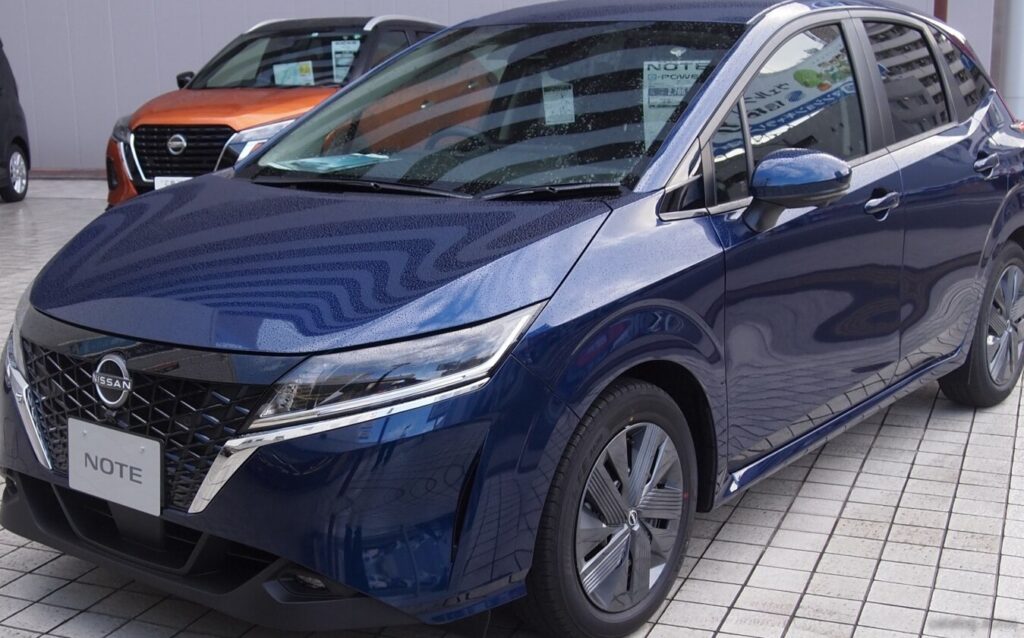
| Generation | Note III (E13) |
| Type (Engine) | e-POWER 1.2 (116 Hp) Hybrid Automatic |
| Start of production | December, 2020 |
| Powertrain Architecture | FHEV (Full Hybrid Electric Vehicle) |
| Body type | Hatchback |
| Seats | 5 |
| Doors | 5 |
| Fuel consumption (economy) – combined (WLTC) | 3.6 l/100 km (65.3 US mpg, 78.5 UK mpg, 27.8 km/l) |
| Fuel Type | Petrol (Gasoline) |
| Weight-to-power ratio | 10.5 kg/Hp, 95.1 Hp/tonne |
| Weight-to-torque ratio | 4.4 kg/Nm, 229.5 Nm/tonne |
| Battery technology | Lithium-ion (Li-Ion) |
| Battery location | Below the floor, under the front seats |
| Electric motor power | 116 Hp @ 5200 rpm |
| Electric motor Torque | 280 Nm @ 0-2900 rpm (206.52 lb.-ft. @ 0-2900 rpm) |
| Electric motor model/code | EM47 |
| Electric motor location | Front axle, Transverse |
| System power | 116 Hp @ 5200 rpm |
| System torque | 280 Nm @ 0-2900 rpm (206.52 lb.-ft. @ 0-2900 rpm) |
| Engine layout | Front, Transverse |
| Engine Model/Code | HR12DE |
| Engine displacement | 1198 cm3 (73.11 cu. in.) |
| Number of cylinders | 3 |
| Engine configuration | Inline |
| Number of valves per cylinder | 4 |
| Fuel injection system | Multi-port manifold injection |
| Engine aspiration | Naturally aspirated engine |
| Valvetrain | DOHC, CVTC |
| Engine oil capacity | 3.4 l (3.59 US qt | 2.99 UK qt) |
| Coolant | 7 l (7.4 US qt | 6.16 UK qt) |
| Kerb Weight | 1220 kg (2689.64 lbs.) |
| Length | 4055 mm (159.65 in.) |
| Width | 1695 mm (66.73 in.) |
| Height | 1520 mm (59.84 in.) |
| Wheelbase | 2580 mm (101.57 in.) |
| Drivetrain Architecture | The Internal combustion engine (ICE) drives the generator only, with no mechanical connection to the drive. An electric motor drives the front wheels. |
| Drive wheel | Front wheel drive |
| Number of gears and type of gearbox | 1 gears, automatic transmission |
| Front suspension | Independent type McPherson |
| Rear suspension | Torsion |
| Front brakes | Ventilated discs |
| Rear brakes | Drum |
| Assisting systems | ABS (Anti-lock braking system) |
| Steering type | Steering rack and pinion |
| Power steering | Electric Steering |
| Tires size | 185/60 R16 |
| Wheel rims size | 16 |
The Nissan Note III (E13) e-POWER 1.2, launched in December 2020, marked a significant advancement in Nissan’s electrification efforts. This variant, producing 116 horsepower, utilizes Nissan’s unique e-POWER system, a series hybrid configuration. Positioned as a mainstream offering within the E13 Note lineup, it aimed to deliver fuel efficiency and a smooth driving experience without the range anxiety often associated with fully electric vehicles. The Note, a compact hatchback, has enjoyed popularity in both the Japanese and European markets, and the e-POWER variant was specifically designed to appeal to environmentally conscious buyers seeking a practical and affordable vehicle.
Powertrain & Engine Architecture
The Nissan Note e-POWER 1.2’s powertrain is its most defining characteristic. It’s a series hybrid system, meaning the 1.2-liter HR12DE three-cylinder gasoline engine doesn’t directly power the wheels. Instead, it functions solely as a generator, charging a lithium-ion battery. This battery then powers the EM47 electric motor, which drives the front wheels. The HR12DE engine, a naturally aspirated unit featuring multi-port fuel injection and a DOHC valvetrain with Continuously Variable Valve Timing Control (CVTC), produces a modest output on its own. The electric motor, however, delivers 116 horsepower and a substantial 280 Nm (206.52 lb-ft) of torque, providing brisk acceleration. The single-speed automatic transmission, inherent to electric motor setups, offers seamless power delivery. This configuration allows for electric-only driving for short distances and at lower speeds, maximizing efficiency.
Driving Characteristics
The e-POWER system delivers a unique driving experience. The instant torque of the electric motor provides responsive acceleration, particularly from a standstill. While the 116 horsepower isn’t overwhelming, the car feels surprisingly lively in urban environments. The lack of traditional gear changes contributes to a smooth and refined ride. Compared to other Note variants, such as those with conventional gasoline engines and manual transmissions, the e-POWER model prioritizes efficiency and ease of use over outright performance. The single-speed transmission means there’s no gear hunting or shift shock, but it also lacks the engine braking found in geared transmissions. The regenerative braking system helps recapture energy during deceleration, further enhancing fuel economy.
Equipment & Trim Levels
The e-POWER 1.2 typically came well-equipped, reflecting its position as a technologically advanced variant. Standard features often included automatic climate control, a touchscreen infotainment system with smartphone integration (Apple CarPlay and Android Auto), and a suite of safety technologies like automatic emergency braking, lane departure warning, and adaptive cruise control. Interior upholstery was generally cloth, with options for higher-grade materials on higher trim levels. Optional extras could include a Bose sound system, heated seats, and a 360-degree camera system. The dashboard layout was modern and functional, with a focus on ease of use.
Chassis & Braking
The Note E13 utilizes a McPherson strut front suspension and a torsion beam rear suspension. This setup provides a comfortable ride quality, well-suited for everyday driving. The front brakes are ventilated discs, offering good stopping power, while the rear brakes are drums, a cost-saving measure common in this class of vehicle. The electric power steering provides light and precise steering feel. The car’s relatively low weight, at 1220 kg (2689.64 lbs), contributes to its nimble handling. Anti-lock Braking System (ABS) is standard, enhancing safety during emergency braking situations.
Market Reception & Comparison
The Nissan Note e-POWER 1.2 was generally well-received by critics, who praised its fuel efficiency, smooth driving experience, and innovative powertrain. It was often compared favorably to other hybrid and electric vehicles in its segment, particularly in terms of value for money. Fuel economy figures of 3.6 l/100 km (65.3 US mpg) were highly competitive. Compared to the standard gasoline-powered Note variants, the e-POWER model offered significantly better fuel economy but came at a higher price point. Reliability reports have been generally positive, with the e-POWER system proving to be relatively robust. However, some owners have reported issues with the battery pack over the long term.
Legacy
The Nissan Note e-POWER 1.2 played a crucial role in establishing Nissan as a leader in electric vehicle technology. It demonstrated the viability of series hybrid systems as a stepping stone towards full electrification. The powertrain’s reliability has proven to be generally good, and the car remains a popular choice in the used car market. As battery technology continues to improve and electric vehicle infrastructure expands, the e-POWER system may eventually be superseded by fully electric powertrains. However, the Note e-POWER 1.2 remains a significant vehicle in Nissan’s history, showcasing the company’s commitment to innovation and sustainability.