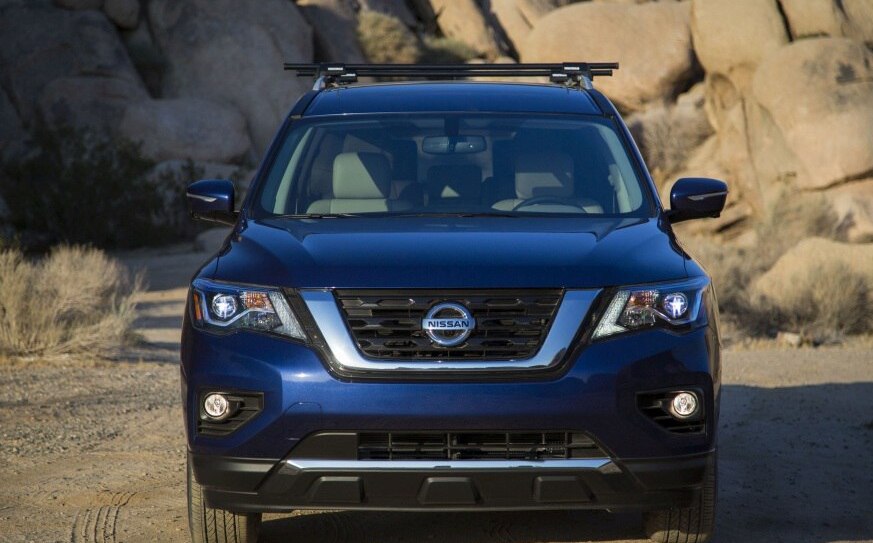
The Nissan Pathfinder IV (facelift, introduced in 2017) with the 3.5-liter V6 engine paired with an automatic transmission represents a significant iteration of Nissan’s popular mid-size SUV. Produced from 2017 through 2021, this version of the Pathfinder aimed to balance family-friendly practicality with a more refined driving experience. Positioned as a mainstream offering within the Pathfinder lineup, it sat above the base models and below any potential premium or technology-focused trims. This facelift brought styling updates and minor mechanical revisions to the fourth-generation Pathfinder (T33 chassis), which originally debuted in 2013. The 3.5L V6/Automatic combination was a core volume seller for Nissan during these years, appealing to buyers prioritizing a smooth, comfortable ride and sufficient power for everyday driving and towing.
Technical Specifications
| Brand | Nissan |
| Model | Pathfinder |
| Generation | Pathfinder IV (facelift 2017) |
| Type (Engine) | 3.5 V6 (284 Hp) Automatic |
| Start of production | 2017 |
| End of production | 2021 |
| Powertrain Architecture | Internal Combustion engine |
| Body type | SUV |
| Seats | 7 |
| Doors | 5 |
| Fuel consumption (urban) | 11.7 l/100 km (20.1 US mpg) |
| Fuel consumption (extra urban) | 8.7 l/100 km (27 US mpg) |
| Fuel consumption (combined) | 10.2 l/100 km (23.1 US mpg) |
| Fuel Type | Petrol (Gasoline) |
| Weight-to-power ratio | 6.9 kg/Hp, 145.9 Hp/tonne |
| Weight-to-torque ratio | 5.5 kg/Nm, 180.3 Nm/tonne |
| Power | 284 Hp @ 6400 rpm |
| Power per litre | 81.2 Hp/l |
| Torque | 351 Nm @ 4800 rpm (258.88 lb.-ft. @ 4800 rpm) |
| Maximum engine speed | 6600 rpm |
| Engine layout | Front, Longitudinal |
| Engine Model/Code | VQ35DD |
| Engine displacement | 3498 cm3 (213.46 cu. in.) |
| Number of cylinders | 6 |
| Engine configuration | V-engine |
| Cylinder Bore | 95.5 mm (3.76 in.) |
| Piston Stroke | 81.4 mm (3.2 in.) |
| Compression ratio | 11:1 |
| Number of valves per cylinder | 4 |
| Fuel injection system | Direct injection |
| Engine aspiration | Naturally aspirated engine |
| Valvetrain | DOHC |
| Engine oil capacity | 4.8 l (5.07 US qt | 4.22 UK qt) |
| Coolant capacity | 9.8 l (10.36 US qt | 8.62 UK qt) |
| Kerb Weight | 1947-2052 kg (4292.4 – 4523.89 lbs.) |
| Max. weight | 2715 kg (5985.55 lbs.) |
| Max load | 663-768 kg (1461.66 – 1693.15 lbs.) |
| Trunk (boot) space – minimum | 453 l (16 cu. ft.) |
| Trunk (boot) space – maximum | 2251 l (79.49 cu. ft.) |
| Fuel tank capacity | 74 l (19.55 US gal | 16.28 UK gal) |
| Permitted trailer load with brakes (12%) | 2722 kg (6000.98 lbs.) |
| Length | 5042 mm (198.5 in.) |
| Width | 1963 mm (77.28 in.) |
| Height | 1793 mm (70.59 in.) |
| Wheelbase | 2901 mm (114.21 in.) |
| Front track | 1669 mm (65.71 in.) |
| Rear (Back) track | 1669 mm (65.71 in.) |
| Ride height (ground clearance) | 178 mm (7.01 in.) |
| Drag coefficient (Cd) | 0.34 |
| Minimum turning circle (turning diameter) | 11.7 m (38.39 ft.) |
| Approach angle | 14.7° |
| Departure angle | 22.3° |
| Ramp-over (brakeover) angle | 16.2° |
| Drivetrain Architecture | The Internal combustion engine (ICE) drives the front wheels of the vehicle. |
| Drive wheel | Front wheel drive |
| Number of gears and type of gearbox | automatic transmission CVT Xtronic |
| Front suspension | Independent coil spring |
| Rear suspension | Independent multi-link suspension |
| Front brakes | Ventilated discs |
| Rear brakes | Ventilated discs |
| Assisting systems | ABS (Anti-lock braking system) |
| Steering type | Steering rack and pinion |
| Power steering | Electric Steering |
| Tires size | 235/65 R18; 235/55 R20 |
| Wheel rims size | 7.5J x 18; 7.5J x 20 |
INTRODUCTION
The 2017-2021 Nissan Pathfinder 3.5 V6 Automatic represents a refinement of the fourth-generation Pathfinder, introduced in 2013. This facelifted model aimed to address some criticisms of the earlier versions, particularly regarding interior quality and driving dynamics. The 3.5-liter V6 engine, designated VQ35DD, was a mainstay of Nissan’s powertrain lineup for many years, known for its relative reliability and smooth power delivery. Coupled with the Xtronic CVT (Continuously Variable Transmission), this configuration provided a comfortable and efficient driving experience, geared towards families and those seeking a versatile SUV. The Pathfinder, in this generation, was primarily sold in North America, serving as a key competitor to vehicles like the Honda Pilot, Toyota Highlander, and Ford Explorer.
Powertrain & Engine Architecture
At the heart of this Pathfinder variant lies the VQ35DD 3.5-liter V6 engine. This engine is a 60-degree V-engine featuring an aluminum alloy block and cylinder heads. It utilizes Nissan’s Dual Fuel Injection System (DFI), combining direct injection with multi-port fuel injection for optimized combustion efficiency and power output. The engine employs a Double Overhead Camshaft (DOHC) valvetrain with four valves per cylinder, contributing to its responsive nature. The Xtronic CVT transmission is a key component of this powertrain. Unlike traditional automatic transmissions with fixed gear ratios, the CVT utilizes a belt and pulley system to provide a virtually infinite number of gear ratios, optimizing engine speed for fuel efficiency or performance. The CVT is programmed with simulated shift points to mimic the feel of a conventional automatic, making the driving experience more familiar to many drivers. The engine produces 284 horsepower at 6400 rpm and 258.88 lb-ft of torque at 4800 rpm.
Driving Characteristics
The Pathfinder 3.5 V6 Automatic delivers a smooth and refined driving experience. The CVT transmission contributes to seamless acceleration, although it can sometimes feel less engaging than a traditional automatic. The engine provides adequate power for everyday driving, including highway merging and passing maneuvers. While not a performance-oriented SUV, the 3.5L V6 offers sufficient grunt for towing trailers or boats, with a maximum towing capacity of around 6,000 pounds. Compared to the base 2.5L four-cylinder Pathfinder, the 3.5L V6 offers a significant performance advantage. The CVT is tuned for fuel efficiency, and while it doesn’t provide the sporty feel of a traditional automatic with defined gear changes, it does contribute to a quieter and more comfortable ride. The front-wheel-drive configuration provides good traction in most conditions, and available four-wheel drive enhances stability in inclement weather.
Equipment & Trim Levels
The 3.5 V6 Automatic Pathfinder typically came well-equipped, even in its base trim levels. Standard features often included tri-zone automatic climate control, a rearview camera, Bluetooth connectivity, and a touchscreen infotainment system. Higher trim levels added features such as leather upholstery, heated front seats, a power liftgate, and a premium audio system. Optional extras included navigation, a panoramic sunroof, and advanced safety features like blind-spot monitoring and rear cross-traffic alert. Interior upholstery was typically cloth on lower trims and leather on higher trims. Dashboard configurations were generally consistent across trims, with variations in trim materials and available technology packages.
Chassis & Braking
The Pathfinder IV utilizes a unibody construction, providing a good balance of strength and weight. The front suspension features independent coil springs and stabilizer bars, while the rear suspension employs an independent multi-link setup. This suspension configuration contributes to a comfortable ride and predictable handling. Braking duties are handled by ventilated discs on all four wheels, providing ample stopping power. Anti-lock brakes (ABS) are standard, along with electronic brake-force distribution and brake assist. The stabilizer bar thickness varies depending on the trim level, with higher trims often featuring thicker bars for improved handling.
Market Reception & Comparison
The 2017-2021 Nissan Pathfinder 3.5 V6 Automatic received generally positive reviews from automotive critics. It was praised for its spacious interior, comfortable ride, and user-friendly technology. However, some critics noted that the CVT transmission could feel less responsive than traditional automatics. Compared to other trims in the Pathfinder lineup, the 3.5L V6 Automatic offered a compelling balance of performance and fuel economy. The base 2.5L four-cylinder was more fuel-efficient but lacked the power of the V6, while higher-end trims offered more luxury features but came at a higher price point. Fuel economy figures averaged around 23.1 US mpg combined, which was competitive for its class.
Legacy
The VQ35DD engine has a reputation for being relatively reliable, although like any engine, it is not immune to issues. Common concerns include oil consumption and potential timing chain wear over high mileage. The Xtronic CVT transmission, while generally durable, requires regular fluid changes to maintain optimal performance. In the used car market, the 2017-2021 Nissan Pathfinder 3.5 V6 Automatic remains a popular choice for families seeking a spacious and versatile SUV. Its combination of comfort, practicality, and reasonable reliability makes it a competitive option in its price range. Proper maintenance and timely repairs are crucial to ensuring the long-term health of this powertrain.