Technical Specifications
| Brand | Nissan |
| Model | Primera |
| Generation | Primera Hatch (P12) |
| Type (Engine) | 2.0 i 16V (140 Hp) CVT |
| Start of production | April, 2002 |
| End of production | March, 2007 |
| Powertrain Architecture | Internal Combustion engine |
| Body type | Hatchback |
| Seats | 5 |
| Doors | 5 |
| Fuel consumption (urban) | 11.9 l/100 km (19.8 US mpg, 23.7 UK mpg, 8.4 km/l) |
| Fuel consumption (extra urban) | 7 l/100 km (33.6 US mpg, 40.4 UK mpg, 14.3 km/l) |
| Fuel consumption (combined) | 8.8 l/100 km (26.7 US mpg, 32.1 UK mpg, 11.4 km/l) |
| Fuel Type | Petrol (Gasoline) |
| Acceleration 0 – 100 km/h | 10.9 sec |
| Acceleration 0 – 62 mph | 10.9 sec |
| Acceleration 0 – 60 mph | 10.4 sec |
| Maximum speed | 191 km/h (118.68 mph) |
| Weight-to-power ratio | 9.6 kg/Hp, 103.7 Hp/tonne |
| Weight-to-torque ratio | 7 kg/Nm, 142.2 Nm/tonne |
| Power | 140 Hp @ 6000 rpm |
| Power per litre | 70.1 Hp/l |
| Torque | 192 Nm @ 4000 rpm (141.61 lb.-ft. @ 4000 rpm) |
| Engine layout | Front, Transverse |
| Engine Model/Code | QR20DE |
| Engine displacement | 1998 cm3 (121.93 cu. in.) |
| Number of cylinders | 4 |
| Engine configuration | Inline |
| Cylinder Bore | 89 mm (3.5 in.) |
| Piston Stroke | 80.3 mm (3.16 in.) |
| Compression ratio | 9.9:1 |
| Number of valves per cylinder | 4 |
| Fuel injection system | Multi-port manifold injection |
| Engine aspiration | Naturally aspirated engine |
| Valvetrain | DOHC |
| Engine oil capacity | 3.9 l (4.12 US qt | 3.43 UK qt) |
| Kerb Weight | 1350 kg (2976.24 lbs.) |
| Max. weight | 1810 kg (3990.37 lbs.) |
| Max load | 460 kg (1014.13 lbs.) |
| Trunk (boot) space – minimum | 450 l (15.89 cu. ft.) |
| Trunk (boot) space – maximum | 1812 l (63.99 cu. ft.) |
| Fuel tank capacity | 62 l (16.38 US gal | 13.64 UK gal) |
| Length | 4565 mm (179.72 in.) |
| Width | 1760 mm (69.29 in.) |
| Height | 1480 mm (58.27 in.) |
| Wheelbase | 2680 mm (105.51 in.) |
| Front track | 1530 mm (60.24 in.) |
| Rear (Back) track | 1535 mm (60.43 in.) |
| Drivetrain Architecture | The Internal combustion engine (ICE) drives the front wheels of the vehicle. |
| Drive wheel | Front wheel drive |
| Number of gears and type of gearbox | automatic transmission CVT |
| Front suspension | Double wishbone |
| Rear suspension | Coil spring |
| Front brakes | Ventilated discs |
| Rear brakes | Disc |
| Assisting systems | ABS (Anti-lock braking system) |
| Steering type | Steering rack and pinion |
| Power steering | Hydraulic Steering |
| Tires size | 205/60 R16 |
| Wheel rims size | 16 |
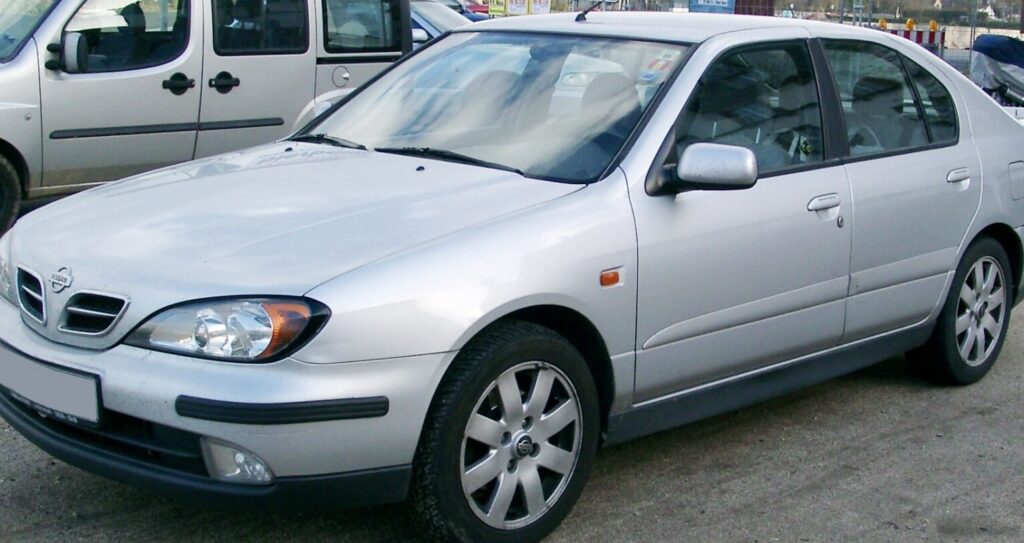
The Nissan Primera (P12) 2.0 i 16V CVT, produced from April 2002 to March 2007, marked a significant step forward in Nissan’s mid-size family car offerings. This hatchback variant, belonging to the second generation of the Primera, was primarily targeted at the European market, providing a balance of practicality, comfort, and relatively modern technology. It occupied a mid-range position within the P12 lineup, positioned between the more economical 1.6L models and the more performance-focused 2.2 dCi diesel variants. The P12 generation was designed to address criticisms leveled at the previous Primera, with a focus on improved build quality and a more refined driving experience.
Powertrain & Engine Architecture
At the core of the Primera 2.0 i 16V CVT lies the QR20DE engine, a 1998cc inline-four cylinder gasoline engine. This engine incorporates multi-point fuel injection and a double overhead camshaft (DOHC) valvetrain, contributing to its relatively smooth power delivery. The QR20DE is generally known for its robust design, although it can experience timing chain wear with higher mileage. The engine generates 140 horsepower at 6000 rpm and 192 Nm (141.61 lb-ft) of torque at 4000 rpm. This engine is coupled with a Continuously Variable Transmission (CVT). Nissan’s early CVTs, such as the one found in the P12 Primera, were engineered to deliver smooth, stepless gear changes, prioritizing fuel efficiency and comfort over outright performance. Unlike conventional automatic transmissions with fixed gear ratios, the CVT allows the engine to operate at its most efficient rpm for any given speed.
Driving Characteristics
The 2.0 i 16V CVT Primera delivers a comfortable and refined driving experience, but it isn’t particularly sporty. The CVT, while smooth, can feel somewhat disconnected, with the engine often maintaining a constant rpm during acceleration. This “rubber band” effect is a typical characteristic of early CVTs. Acceleration to 60 mph takes approximately 10.4 seconds, and the top speed reaches 118.68 mph. Compared to the manual transmission versions of the 2.0L Primera, the CVT sacrifices some responsiveness in favor of improved fuel economy. The CVT also differs significantly from the more powerful 2.2 dCi diesel models, which offer considerably more torque and quicker acceleration. The suspension is tuned for comfort, providing a reasonably compliant ride, but it doesn’t offer the same level of handling precision as some of its competitors.
Equipment & Trim Levels
The 2.0 i 16V CVT Primera typically came standard with a reasonable array of features. These included air conditioning, power windows and mirrors, central locking, an integrated stereo system, and ABS brakes. Higher trim levels, often designated with suffixes like ‘SE’ or ‘Sport’, added features such as alloy wheels, upgraded upholstery, climate control, and a sunroof. Interior materials were generally of good quality for the price point, though they didn’t quite reach the luxury levels of more premium brands. The dashboard layout was functional and user-friendly, with logically arranged controls.
Chassis & Braking
The Primera P12 employs a front-wheel-drive layout with a double wishbone suspension system at the front and a coil spring arrangement at the rear. This suspension configuration strikes a good balance between ride comfort and handling. Braking is provided by ventilated discs at the front and solid discs at the rear. ABS (Anti-lock Braking System) is standard, enhancing safety during emergency braking situations. The steering is rack and pinion with hydraulic power assistance, offering a reasonably light and precise feel.
Market Reception & Comparison
The Nissan Primera P12 2.0 i 16V CVT was generally well-received by automotive critics as a practical and comfortable family car. However, the CVT transmission was a point of debate for some, with certain reviewers finding it lacking in responsiveness. Fuel economy was a strong suit, with the combined cycle figure of 32.1 UK mpg being competitive for its class. Compared to rivals like the Ford Mondeo and Vauxhall Vectra, the Primera offered a slightly more refined driving experience and a reputation for reliability. However, it didn’t quite match the Mondeo’s dynamic handling or the Vectra’s spaciousness.
Legacy
The QR20DE engine, when properly maintained, has proven to be a relatively reliable unit. The CVT transmission, however, is often the first component to require attention on higher-mileage vehicles. Regular fluid changes are crucial for CVT longevity. Today, the P12 Primera 2.0 i 16V CVT can be found on the used car market at very affordable prices. It represents a good value proposition for buyers seeking a comfortable and practical family car, but potential buyers should be aware of the potential CVT maintenance costs. The P12 Primera, while not a particularly iconic model, played a role in establishing Nissan as a credible competitor in the European mid-size car segment.