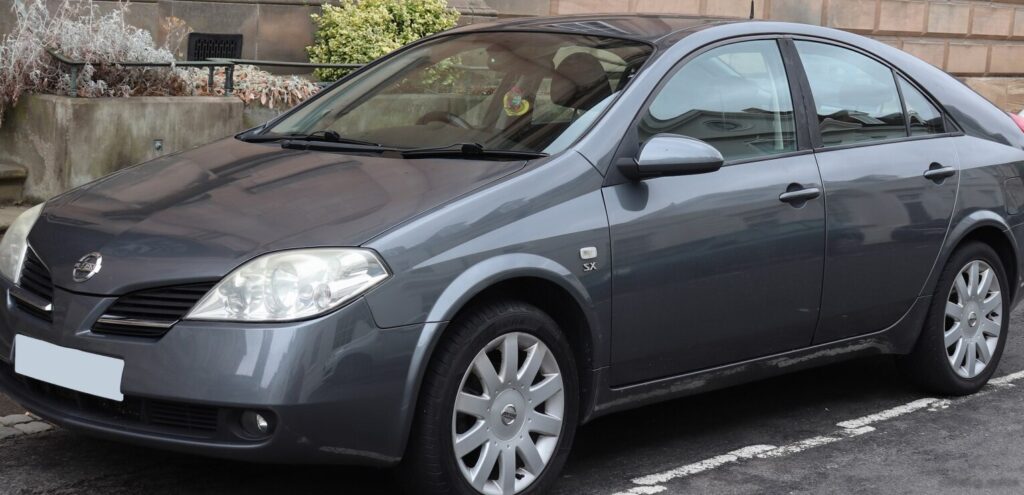
The Nissan Primera (P12) 2.2 dCi, produced from March 2003 to April 2006, represented a significant offering in the mid-size family car segment, particularly within the European market. This hatchback variant, part of the broader P12 Primera generation, aimed to provide a blend of practicality, comfort, and modern diesel technology. The 2.2 dCi model occupied a position in the lineup geared towards drivers prioritizing fuel efficiency and torque for long-distance driving, rather than outright performance. It served as a more economical alternative to the petrol-powered versions and a more refined option compared to lower-spec diesel trims.
Technical Specifications
| Brand | Nissan |
| Model | Primera |
| Generation | Primera Hatch (P12) |
| Type (Engine) | 2.2 dCi (138 Hp) |
| Start of production | March, 2003 |
| End of production | April, 2006 |
| Powertrain Architecture | Internal Combustion engine |
| Body type | Hatchback |
| Seats | 5 |
| Doors | 5 |
| Fuel consumption (urban) | 8.1 l/100 km (29 US mpg) |
| Fuel consumption (extra urban) | 5 l/100 km (47 US mpg) |
| Fuel Type | Diesel |
| Acceleration 0 – 100 km/h | 10 sec |
| Acceleration 0 – 62 mph | 10 sec |
| Acceleration 0 – 60 mph | 9.5 sec |
| Maximum speed | 203 km/h (126.14 mph) |
| Weight-to-power ratio | 10.5 kg/Hp |
| Weight-to-torque ratio | 4.6 kg/Nm |
| Power | 138 Hp @ 4000 rpm |
| Torque | 314 Nm @ 2000 rpm (231.59 lb.-ft. @ 2000 rpm) |
| Engine layout | Front, Transverse |
| Engine Model/Code | YD22DDTi |
| Engine displacement | 2184 cm3 (133.28 cu. in.) |
| Number of cylinders | 4 |
| Engine configuration | Inline |
| Cylinder Bore | 86 mm (3.39 in.) |
| Piston Stroke | 94 mm (3.7 in.) |
| Compression ratio | 18:1 |
| Number of valves per cylinder | 4 |
| Fuel injection system | Diesel Commonrail |
| Engine aspiration | Turbocharger, Intercooler |
| Engine oil capacity | 5.4 l (5.71 US qt | 4.75 UK qt) |
| Coolant | 9.5 l (10.04 US qt | 8.36 UK qt) |
| Kerb Weight | 1450 kg (3196.7 lbs.) |
| Max. weight | 1940 kg (4276.97 lbs.) |
| Max load | 490 kg (1080.27 lbs.) |
| Trunk (boot) space – minimum | 450 l (15.89 cu. ft.) |
| Trunk (boot) space – maximum | 1812 l (63.99 cu. ft.) |
| Fuel tank capacity | 62 l (16.38 US gal | 13.64 UK gal) |
| Length | 4565 mm (179.72 in.) |
| Width | 1760 mm (69.29 in.) |
| Height | 1480 mm (58.27 in.) |
| Wheelbase | 2680 mm (105.51 in.) |
| Front track | 1530 mm (60.24 in.) |
| Rear (Back) track | 1535 mm (60.43 in.) |
| Drivetrain Architecture | The Internal combustion engine (ICE) drives the front wheels of the vehicle. |
| Drive wheel | Front wheel drive |
| Number of gears and type of gearbox | 6 gears, manual transmission |
| Front suspension | Double wishbone |
| Rear suspension | Coil spring |
| Front brakes | Ventilated discs |
| Rear brakes | Disc |
| Assisting systems | ABS (Anti-lock braking system) |
| Steering type | Steering rack and pinion |
| Power steering | Hydraulic Steering |
| Tires size | 205/60 R16 |
Powertrain & Engine Architecture
The heart of the Primera 2.2 dCi was the YD22DDTi engine, a 2.2-liter inline-four cylinder diesel. This engine utilized a common rail direct injection system, a technology that allowed for precise fuel delivery and improved combustion efficiency. The turbocharger with intercooler further enhanced performance by forcing more air into the cylinders, boosting power output. The engine produced 138 horsepower at 4000 rpm and a substantial 314 Nm (231.59 lb-ft) of torque at just 2000 rpm. This torque peak, available at relatively low engine speeds, was a key characteristic of the engine, providing strong pulling power for everyday driving and effortless highway cruising. The engine featured a compression ratio of 18:1, indicative of its diesel design. The 6-speed manual transmission was the standard offering, chosen for its efficiency and driver engagement.
Driving Characteristics
The 2.2 dCi Primera offered a composed and refined driving experience. The high torque output meant that the car felt responsive in most situations, with ample power for overtaking and climbing hills. While not a sports car, the 2.2 dCi provided sufficient acceleration – 0-60 mph in around 9.5 seconds – for comfortable and confident driving. The six-speed gearbox was well-matched to the engine’s characteristics, allowing drivers to select the optimal gear for various driving conditions. Compared to the lower-powered 1.6L petrol variants, the 2.2 dCi offered significantly more torque and better fuel economy. However, it lacked the higher-revving nature and slightly quicker acceleration of the petrol engines. Compared to other diesel variants in the Primera range, the 2.2 dCi represented a step up in power and refinement, offering a more premium driving experience.
Equipment & Trim Levels
The Primera 2.2 dCi typically came equipped with a respectable level of standard features. These included air conditioning, power windows, central locking, and an integrated audio system. Higher trim levels, such as the SE and S, added features like alloy wheels, climate control, a trip computer, and upgraded interior trim. Interior upholstery was generally cloth, with leather options available as an extra. Safety features included ABS brakes, front and side airbags, and a vehicle stability control system. Optional extras could include a sunroof, parking sensors, and a navigation system.
Chassis & Braking
The Primera P12 utilized a front-wheel-drive layout with a double wishbone suspension setup at the front and a coil spring arrangement at the rear. This suspension configuration aimed to provide a balance between ride comfort and handling. The 2.2 dCi models, being heavier than their petrol counterparts, often featured slightly stiffer suspension components to maintain stability. Braking was handled by ventilated discs at the front and solid discs at the rear, providing adequate stopping power for the vehicle’s weight and performance. The hydraulic power steering offered a light and responsive feel.
Market Reception & Comparison
The Nissan Primera 2.2 dCi was generally well-received by automotive critics as a practical and efficient family car. Its strong fuel economy and comfortable ride were frequently praised. However, some reviewers noted that the engine could be somewhat noisy compared to some of its competitors. In terms of fuel economy, the 2.2 dCi offered a significant advantage over the petrol-powered Primera models, achieving around 47 mpg on the extra-urban cycle. Reliability was generally good, although, like all diesel engines, the common rail system and turbocharger required regular maintenance. Compared to rivals like the Ford Mondeo and Vauxhall Vectra, the Primera 2.2 dCi offered a competitive package in terms of price, equipment, and fuel efficiency.
Legacy
The Nissan Primera P12 2.2 dCi, while no longer in production, remains a relatively common sight on used car markets. The YD22DDTi engine, when properly maintained, has proven to be a durable and reliable unit. However, potential buyers should be aware of the potential for issues with the turbocharger and common rail system, particularly on higher-mileage examples. The Primera P12, in general, is remembered as a comfortable and practical family car that offered a good value proposition. Today, these vehicles represent an affordable option for those seeking a spacious and economical hatchback.