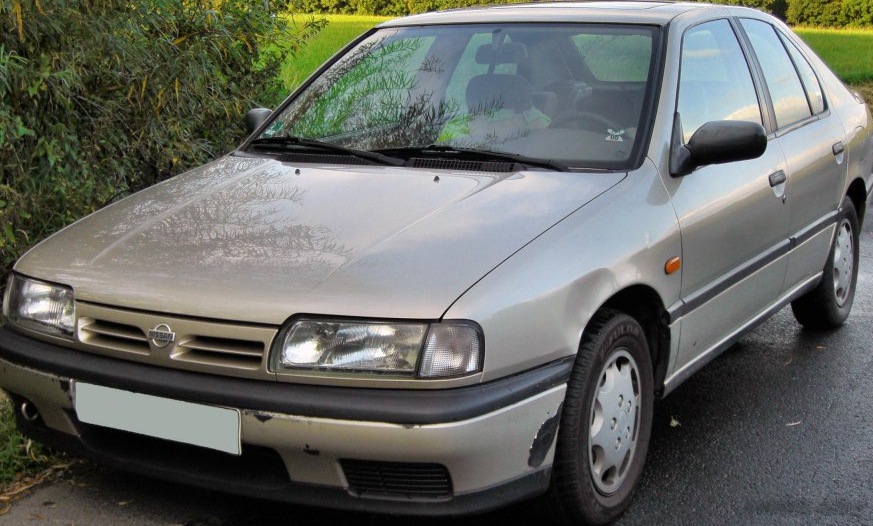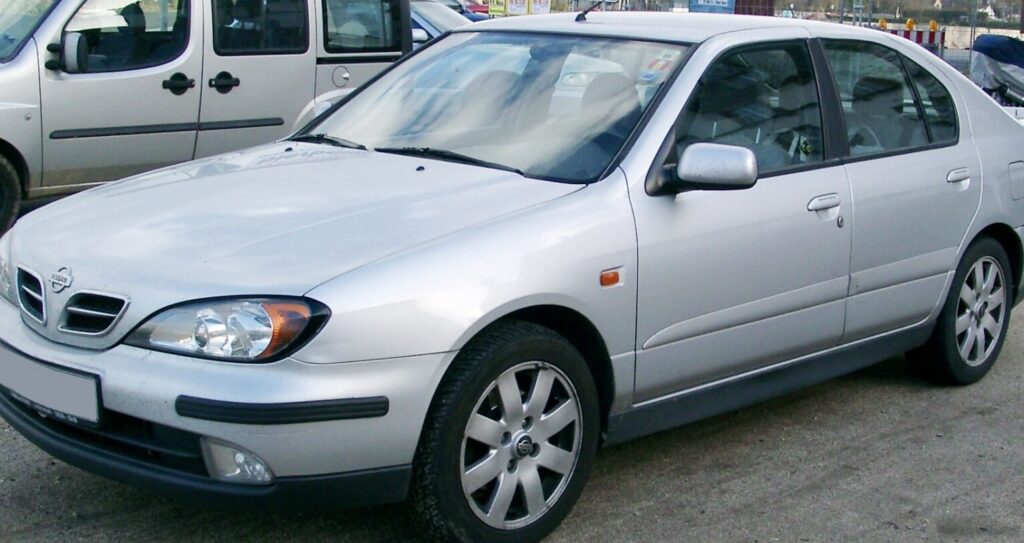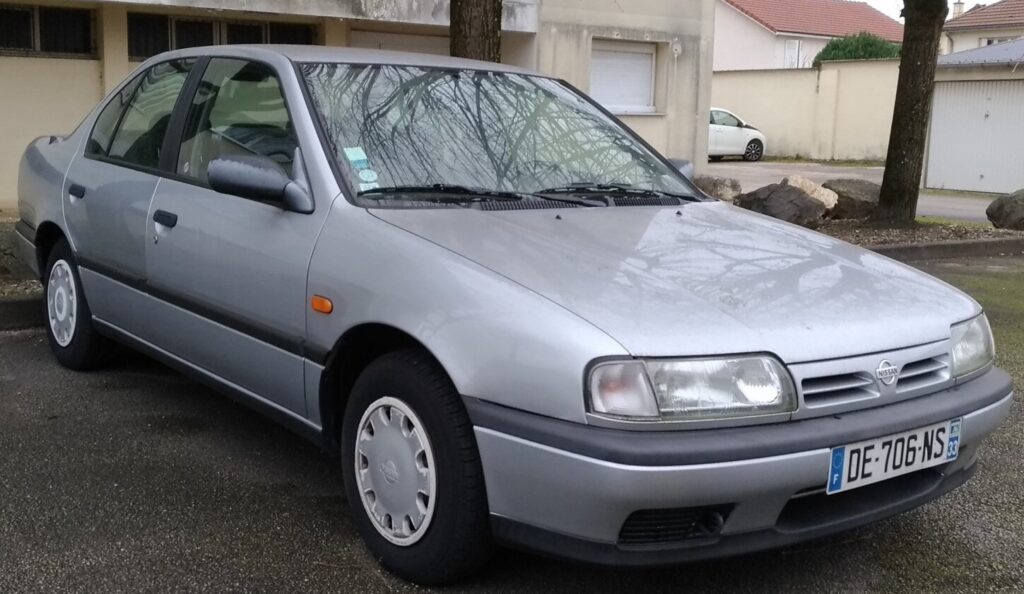
Technical Specifications
| Brand | Nissan |
| Model | Primera |
| Generation | Primera (P10) |
| Type (Engine) | 1.6 (90 Hp) |
| Start of production | 1990 |
| End of production | 1996 |
| Powertrain Architecture | Internal Combustion engine |
| Body type | Sedan |
| Seats | 5 |
| Doors | 4 |
| Fuel consumption (urban) | 9.8 l/100 km (24 US mpg, 28.8 UK mpg, 10.2 km/l) |
| Fuel consumption (extra urban) | 6.5 l/100 km (36.2 US mpg, 43.5 UK mpg, 15.4 km/l) |
| Fuel consumption (combined) | 7.1 l/100 km (33.1 US mpg, 39.8 UK mpg, 14.1 km/l) |
| Fuel Type | Petrol (Gasoline) |
| Acceleration 0 – 100 km/h | 11.9 sec |
| Acceleration 0 – 62 mph | 11.9 sec |
| Acceleration 0 – 60 mph | 11.3 sec |
| Maximum speed | 180 km/h (111.85 mph) |
| Weight-to-power ratio | 12.8 kg/Hp, 78.2 Hp/tonne |
| Weight-to-torque ratio | 8.5 kg/Nm, 118.2 Nm/tonne |
| Power | 90 Hp @ 6000 rpm |
| Power per litre | 56.4 Hp/l |
| Torque | 136 Nm @ 4000 rpm (100.31 lb.-ft. @ 4000 rpm) |
| Engine layout | Front, Transverse |
| Engine Model/Code | GA16DS |
| Engine displacement | 1597 cm3 (97.45 cu. in.) |
| Number of cylinders | 4 |
| Engine configuration | Inline |
| Cylinder Bore | 76 mm (2.99 in.) |
| Piston Stroke | 88 mm (3.46 in.) |
| Compression ratio | 9.8:1 |
| Number of valves per cylinder | 4 |
| Fuel injection system | Multi-port manifold injection |
| Engine aspiration | Naturally aspirated engine |
| Valvetrain | DOHC |
| Engine oil capacity | 3.2 l (3.38 US qt | 2.82 UK qt) |
| Coolant capacity | 6.4 l (6.76 US qt | 5.63 UK qt) |
| Kerb Weight | 1151 kg (2537.52 lbs.) |
| Max. weight | 1630 kg (3593.53 lbs.) |
| Max load | 479 kg (1056.01 lbs.) |
| Trunk (boot) space – minimum | 480 l (16.95 cu. ft.) |
| Fuel tank capacity | 60 l (15.85 US gal | 13.2 UK gal) |
| Length | 4400 mm (173.23 in.) |
| Width | 1700 mm (66.93 in.) |
| Height | 1390 mm (54.72 in.) |
| Wheelbase | 2550 mm (100.39 in.) |
| Front track | 1470 mm (57.87 in.) |
| Rear (Back) track | 1460 mm (57.48 in.) |
| Minimum turning circle | 11 m (36.09 ft.) |
| Drivetrain Architecture | The Internal combustion engine (ICE) drives the front wheels of the vehicle. |
| Drive wheel | Front wheel drive |
| Number of gears and type of gearbox | 5 gears, manual transmission |
| Front suspension | Double wishbone |
| Rear suspension | Double wishbone |
| Front brakes | Ventilated discs |
| Rear brakes | Drum |
| Assisting systems | ABS (Anti-lock braking system) |
| Steering type | Steering rack and pinion |
| Power steering | Hydraulic Steering |
| Tires size | 165/80 R13 |
Introduction
The Nissan Primera (P10) was a compact executive car produced by Nissan between 1990 and 1996. Positioned as a competitor to the Ford Mondeo, Vauxhall/Opel Vectra, and Toyota Camry, the P10 Primera represented Nissan’s attempt to establish a stronger foothold in the European mid-size car market. The 1.6-liter (90 hp) variant, equipped with an automatic transmission, served as the entry-level model in many European markets, offering a balance of affordability and practicality. It was built on the Nissan H platform, also known as the 1HX0/A3 platform, shared with other Nissan models of the era. This particular engine and transmission combination aimed to appeal to buyers prioritizing comfort and ease of use over outright performance.
Powertrain & Engine Architecture
The Primera 1.6 utilized the GA16DS engine, a 1.6-liter inline-four cylinder gasoline engine. This engine featured a single overhead camshaft (SOHC) design, although some later versions incorporated a dual overhead camshaft (DOHC) configuration. The 90 horsepower output was achieved through multi-port fuel injection and a compression ratio of 9.8:1. The GA16DS engine was known for its relative simplicity and durability, making it a reliable powerplant. The automatic transmission paired with this engine was typically a four-speed unit, designed for smooth shifting and ease of driving. While not particularly sporty, the transmission was well-suited to the engine’s torque characteristics. The GA16DS engine was a naturally aspirated engine, meaning it did not employ a turbocharger or supercharger to force air into the cylinders.
Driving Characteristics
The 1.6L automatic Primera offered a comfortable, if not exhilarating, driving experience. With 90 horsepower, acceleration was modest, taking approximately 11.9 seconds to reach 62 mph (100 km/h). The four-speed automatic transmission, while providing convenience, did contribute to a slight reduction in fuel efficiency compared to the manual transmission version. Gear ratios were optimized for fuel economy and smooth cruising rather than rapid acceleration. In real-world conditions, the car felt adequate for everyday driving, including commuting and highway travel, but struggled with quick overtaking maneuvers or steep inclines. Compared to the more powerful 2.0L variants, the 1.6L automatic Primera lacked the punch needed for a more engaging driving experience. However, it provided a more relaxed and refined ride, particularly in urban environments.
Equipment & Trim Levels
The 1.6L automatic Primera typically came with a reasonable level of standard equipment, though it was generally less lavish than the higher-spec models. Standard features often included power steering, central locking, electric front windows, and an AM/FM radio. Interior upholstery was typically cloth, and the dashboard featured a functional, if somewhat dated, design. Optional extras available for this trim level could include air conditioning, alloy wheels, and a sunroof. The trim level often dictated the quality of the cloth upholstery and the presence of additional convenience features. The focus was on providing a comfortable and practical interior without excessive luxury.
Chassis & Braking
The Primera P10 featured a fully independent suspension system, with double wishbones at both the front and rear. This suspension setup provided a comfortable ride and decent handling characteristics. The 1.6L models typically used ventilated disc brakes at the front and drum brakes at the rear. While the braking system was adequate for normal driving conditions, it lacked the stopping power of the larger disc brakes found on the higher-spec models. The car’s weight distribution was relatively balanced, contributing to predictable handling. Stabilizer bars were fitted to both the front and rear axles to reduce body roll during cornering.
Market Reception & Comparison
The 1.6L automatic Primera received mixed reviews from automotive critics. While praised for its comfort, reliability, and affordability, it was often criticized for its lack of performance. Compared to the 2.0L and 2.0L SRi models, the 1.6L automatic felt underpowered. Fuel economy was generally considered to be good for its class, but not exceptional. The automatic transmission, while convenient, was seen as detracting from the driving experience. In terms of reliability, the Primera P10 was generally regarded as a dependable car, with the GA16DS engine proving to be particularly robust. However, some owners reported issues with the automatic transmission over the long term. Compared to rivals like the Ford Mondeo, the Primera offered a more refined ride but lacked the Mondeo’s sporty handling.
Legacy
The Nissan Primera P10 1.6 automatic has become a relatively affordable and accessible classic car in the used market. The GA16DS engine is known for its longevity and relatively low maintenance costs. While not a particularly sought-after model, it remains a viable option for buyers looking for a reliable and comfortable family car. Parts availability is generally good, although some specific components may be becoming increasingly difficult to find. The car’s simple mechanical design makes it relatively easy to maintain and repair for those with some mechanical aptitude. Today, the Primera P10 1.6 automatic represents a snapshot of 1990s Japanese automotive engineering, offering a blend of practicality, reliability, and affordability.