Technical Specifications
| Brand | Nissan |
| Model | Primera |
| Generation | Primera (P12) |
| Type (Engine) | 1.6 i 16V (109 Hp) |
| Start of production | March, 2003 |
| End of production | March, 2007 |
| Powertrain Architecture | Internal Combustion engine |
| Body type | Sedan |
| Seats | 5 |
| Doors | 4 |
| Fuel consumption (urban) | 9.3 l/100 km (25.3 US mpg) |
| Fuel consumption (extra urban) | 6 l/100 km (39.2 US mpg) |
| Fuel consumption (combined) | 7.2 l/100 km (32.7 US mpg) |
| Fuel Type | Petrol (Gasoline) |
| Acceleration 0 – 100 km/h | 12.6 sec |
| Acceleration 0 – 62 mph | 12.6 sec |
| Acceleration 0 – 60 mph | 12 sec |
| Maximum speed | 190 km/h (118.06 mph) |
| Weight-to-power ratio | 11.9 kg/Hp |
| Weight-to-torque ratio | 8.9 kg/Nm |
| Power | 109 Hp @ 6000 rpm |
| Power per litre | 68.3 Hp/l |
| Torque | 146 Nm @ 4000 rpm (107.68 lb.-ft. @ 4000 rpm) |
| Engine layout | Front, Transverse |
| Engine Model/Code | QG16DE |
| Engine displacement | 1596 cm3 (97.39 cu. in.) |
| Number of cylinders | 4 |
| Engine configuration | Inline |
| Cylinder Bore | 76 mm (2.99 in.) |
| Piston Stroke | 88 mm (3.46 in.) |
| Compression ratio | 9.8:1 |
| Number of valves per cylinder | 4 |
| Fuel injection system | Multi-port manifold injection |
| Engine aspiration | Naturally aspirated engine |
| Valvetrain | DOHC |
| Engine oil capacity | 2.9 l (3.06 US qt | 2.55 UK qt) |
| Coolant | 6.7 l (7.08 US qt | 5.9 UK qt) |
| Kerb Weight | 1300 kg (2866.01 lbs.) |
| Trunk (boot) space – minimum | 450 l (15.89 cu. ft.) |
| Fuel tank capacity | 62 l (16.38 US gal | 13.64 UK gal) |
| Length | 4565 mm (179.72 in.) |
| Width | 1760 mm (69.29 in.) |
| Height | 1480 mm (58.27 in.) |
| Wheelbase | 2680 mm (105.51 in.) |
| Front track | 1530 mm (60.24 in.) |
| Rear (Back) track | 1535 mm (60.43 in.) |
| Drivetrain Architecture | The Internal combustion engine (ICE) drives the front wheels of the vehicle. |
| Drive wheel | Front wheel drive |
| Number of gears and type of gearbox | 5 gears, manual transmission |
| Front suspension | Double wishbone |
| Rear suspension | Coil spring |
| Front brakes | Ventilated discs |
| Rear brakes | Disc |
| Assisting systems | ABS (Anti-lock braking system) |
| Steering type | Steering rack and pinion |
| Power steering | Hydraulic Steering |
| Tires size | 205/60 R16 |
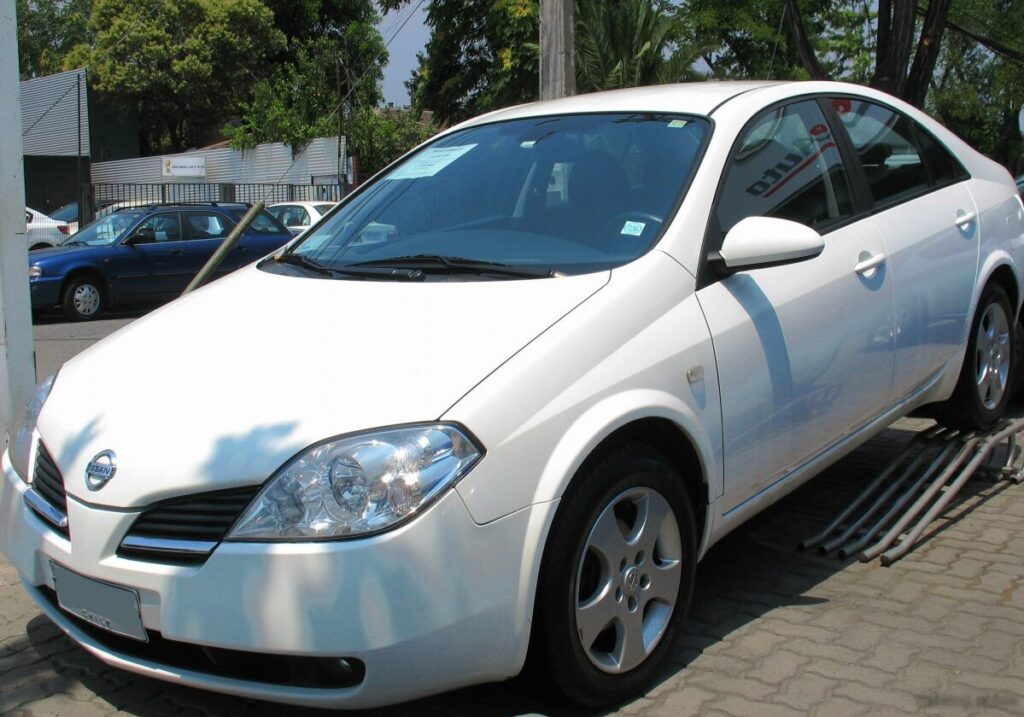
The Nissan Primera (P12) 1.6 i 16V, produced from March 2003 to March 2007, served as the entry-level model within the P12 Primera lineup, a mid-size family sedan primarily targeted at the European market. Positioned as a more economical alternative to the 2.0-liter variants, the 1.6L offered a blend of fuel efficiency and practicality for daily commuting and family use. The P12 generation, built on the Nissan FF-L platform, aimed to deliver a comfortable and reliable driving experience, competing with established rivals such as the Ford Mondeo, Vauxhall Vectra, and Peugeot 406. This specific engine and transmission combination was engineered to appeal to buyers prioritizing value and lower operating costs.
Powertrain & Engine Architecture
The Nissan Primera 1.6 i 16V is powered by the QG16DE engine, a 1.6-liter inline-four cylinder engine. This engine belongs to Nissan’s QG series, recognized for its straightforward design and emphasis on dependability. The QG16DE features a dual overhead camshaft (DOHC) valvetrain with four valves per cylinder, contributing to its respectable power output for its displacement. Fuel delivery is managed by a multi-port fuel injection system, ensuring precise fuel metering for optimal combustion efficiency. The engine generates 109 horsepower at 6000 rpm and 146 Nm (107.68 lb-ft) of torque at 4000 rpm. The engine is mounted transversely, powering the front wheels. The P12 Primera 1.6 i 16V was exclusively offered with a 5-speed manual transmission, designed to maximize fuel economy and provide a reasonably engaging driving experience.
Driving Characteristics
The 1.6L Primera, producing 109 hp, wasn’t engineered for high-performance driving. Acceleration from 0-60 mph took approximately 12 seconds, and its top speed hovered around 118 mph. However, the engine proved adequate for everyday driving scenarios, providing sufficient power for merging onto highways and passing slower vehicles. The 5-speed manual transmission allowed drivers to maintain the engine within its optimal power range, maximizing both efficiency and responsiveness. Compared to the 2.0L Primera models, the 1.6L felt noticeably less powerful, especially when carrying a full load or ascending steep hills. The gear ratios were optimized for fuel economy, which could result in the engine feeling somewhat strained at higher speeds. Nevertheless, the lighter weight of the 1.6L variant, compared to its larger-engined counterparts, contributed to slightly improved handling and fuel efficiency.
Equipment & Trim Levels
The 1.6 i 16V typically represented the base trim level in the Primera P12 range. Standard features generally included power steering, central locking, electric front windows, and an ABS anti-lock braking system. Interior upholstery was typically cloth, and the dashboard featured a functional, though somewhat basic, design. Optional extras, depending on the market, could include air conditioning, alloy wheels, a CD player, and upgraded interior trim. The emphasis was on providing a well-equipped, practical vehicle at an accessible price point. Higher trim levels, such as the 2.0L models, offered features like leather upholstery, automatic climate control, and more sophisticated audio systems.
Chassis & Braking
The Primera P12 featured a front independent suspension with double wishbones, delivering a comfortable ride and respectable handling characteristics. The rear suspension utilized a coil spring setup. Braking was provided by ventilated discs on the front wheels and solid discs on the rear. The ABS system enhanced braking control, particularly in challenging weather conditions. The chassis was designed to prioritize comfort and stability over sporty handling, aligning with the car’s intended role as a family sedan. Stabilizer bars were fitted to both the front and rear axles to minimize body roll during cornering.
Market Reception & Comparison
The Nissan Primera 1.6 i 16V was generally well-received by automotive critics as a sensible and practical family car. Its fuel economy, averaging around 32.7 US mpg in combined driving, was a significant advantage. However, some reviewers pointed out that the engine lacked the refinement and power of its competitors, particularly the Ford Mondeo and Vauxhall Vectra. Compared to the higher-specification Primera 2.0L models, the 1.6L offered a more affordable entry point but at the cost of performance and certain features. Reliability was generally considered good, although some owners reported minor issues with the electrical system.
Legacy
The QG16DE engine, powering the Primera 1.6 i 16V, proved to be a relatively durable and reliable unit. While not renowned for exceptional performance, it offered years of dependable service with proper maintenance. Today, used examples of the P12 Primera 1.6 i 16V are relatively affordable and can represent a good value for buyers seeking a practical and economical family car. However, potential buyers should be mindful of the car’s age and potential for wear and tear, particularly on suspension components and the braking system. The Primera P12, while not a particularly iconic model, remains a testament to Nissan’s commitment to building reliable and functional vehicles.