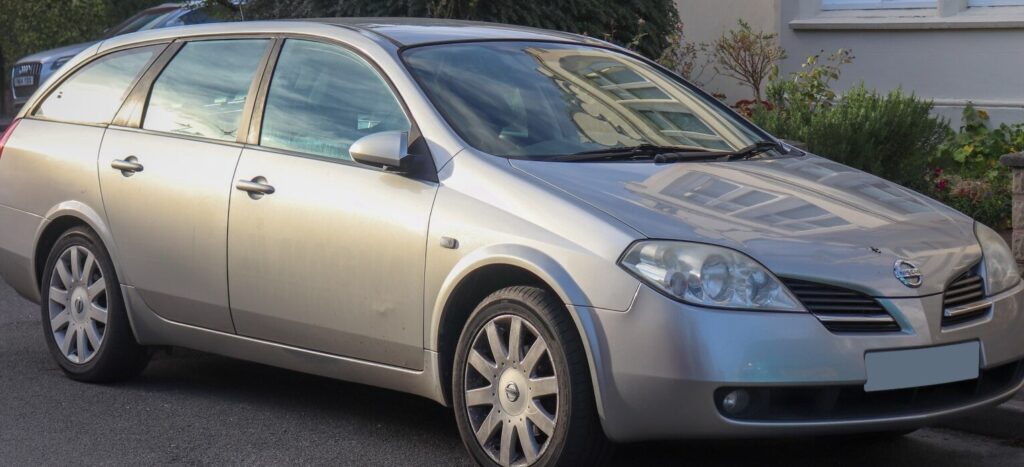
The Nissan Primera Wagon (P12) 1.9 dCi, produced from 2003 to 2007, represented a significant offering in the European market for those seeking a practical and efficient estate car. Positioned as a mid-range trim within the P12 Primera Wagon lineup, it bridged the gap between the lower-powered gasoline engines and the more expensive, higher-specification models. The P12 generation, launched in 2002, aimed to modernize Nissan’s presence in the competitive D-segment, offering a blend of comfort, space, and technology. This particular variant, with its 1.9-liter diesel engine and six-speed manual transmission, was designed to appeal to drivers prioritizing fuel economy and torque for long-distance journeys and hauling loads.
Technical Specifications
| Brand | Nissan |
| Model | Primera |
| Generation | Primera Wagon (P12) |
| Type (Engine) | 1.9 dCi (120 Hp) |
| Start of production | 2003 |
| End of production | 2007 |
| Powertrain Architecture | Internal Combustion engine |
| Body type | Station wagon (estate) |
| Seats | 5 |
| Doors | 5 |
| Fuel consumption (urban) | 7.3 l/100 km (32.2 US mpg) |
| Fuel consumption (extra urban) | 4.8 l/100 km (49 US mpg) |
| Fuel Type | Diesel |
| Acceleration 0 – 100 km/h | 11.1 sec |
| Acceleration 0 – 62 mph | 11.1 sec |
| Acceleration 0 – 60 mph | 10.5 sec |
| Maximum speed | 195 km/h (121.17 mph) |
| Weight-to-power ratio | 12.2 kg/Hp |
| Weight-to-torque ratio | 5.4 kg/Nm |
| Power | 120 Hp @ 4000 rpm |
| Torque | 270 Nm @ 2000 rpm (199.14 lb.-ft. @ 2000 rpm) |
| Engine layout | Front, Transverse |
| Engine Model/Code | F9Q |
| Engine displacement | 1870 cm3 (114.11 cu. in.) |
| Number of cylinders | 4 |
| Engine configuration | Inline |
| Cylinder Bore | 80 mm (3.15 in.) |
| Piston Stroke | 93 mm (3.66 in.) |
| Compression ratio | 19:1 |
| Number of valves per cylinder | 2 |
| Fuel injection system | Diesel Commonrail |
| Engine aspiration | Turbocharger, Intercooler |
| Engine oil capacity | 4.66 l (4.92 US qt | 4.1 UK qt) |
| Coolant capacity | 6.5 l (6.87 US qt | 5.72 UK qt) |
| Kerb Weight | 1465 kg (3229.77 lbs.) |
| Max. weight | 1995 kg (4398.22 lbs.) |
| Max load | 530 kg (1168.45 lbs.) |
| Trunk (boot) space – minimum | 465 l (16.42 cu. ft.) |
| Trunk (boot) space – maximum | 1670 l (58.98 cu. ft.) |
| Fuel tank capacity | 62 l (16.38 US gal | 13.64 UK gal) |
| Length | 4675 mm (184.06 in.) |
| Width | 1760 mm (69.29 in.) |
| Height | 1480 mm (58.27 in.) |
| Wheelbase | 2680 mm (105.51 in.) |
| Front track | 1530 mm (60.24 in.) |
| Rear track | 1535 mm (60.43 in.) |
| Drivetrain Architecture | Front wheel drive |
| Number of gears | 6 |
| Gearbox type | Manual transmission |
| Front suspension | Double wishbone |
| Rear suspension | Coil spring |
| Front brakes | Ventilated discs |
| Rear brakes | Disc |
| Assisting systems | ABS (Anti-lock braking system) |
| Steering type | Steering rack and pinion |
| Power steering | Hydraulic |
| Tires size | 205/60 R16 |
Powertrain & Engine Architecture
The heart of the Primera Wagon 1.9 dCi was the F9Q engine, a 1.9-liter inline-four cylinder diesel. This engine was a mainstay in Renault-Nissan vehicles of the era, known for its robustness and relatively good fuel efficiency. The F9Q utilized a common rail direct injection system, delivering fuel directly into the cylinders at extremely high pressure for optimized combustion. A turbocharger with an intercooler was employed to boost power output and improve torque across a wider rev range. The engine featured two valves per cylinder and a compression ratio of 19:1, contributing to its efficiency. Paired with this engine was a six-speed manual transmission, offering a good balance between fuel economy and driver control. The transmission’s gear ratios were tuned to maximize the engine’s torque, providing strong acceleration in everyday driving situations.
Driving Characteristics
The 120 horsepower and 270 Nm (199 lb-ft) of torque delivered by the 1.9 dCi engine provided a respectable, if not exhilarating, driving experience. Acceleration from 0 to 60 mph took around 10.5 seconds, and the car had a top speed of 195 km/h (121 mph). Compared to the higher-output 2.0-liter petrol versions, the dCi offered significantly more torque at lower engine speeds, making it more effortless for overtaking and carrying loads. However, it lacked the responsiveness and higher-revving nature of the gasoline engines. The six-speed manual transmission allowed drivers to keep the engine in its optimal power band, enhancing performance. The gear ratios were well-matched, providing smooth shifts and contributing to good fuel economy. The ride quality was generally comfortable, typical of the Primera, but the added weight of the diesel engine and its components could be felt in the handling, making it slightly less agile than its petrol counterparts.
Equipment & Trim Levels
The 1.9 dCi variant of the Primera Wagon typically came equipped with a reasonable level of standard features. These included air conditioning, power windows, central locking, an integrated stereo system, and ABS brakes. Interior upholstery was usually cloth, with a functional and durable design. Optional extras included alloy wheels, a sunroof, upgraded audio systems, and parking sensors. The trim level sat comfortably in the mid-range of the Primera Wagon lineup, offering a good balance of features and affordability. It was aimed at buyers who prioritized practicality and fuel economy over outright luxury.
Chassis & Braking
The Primera Wagon 1.9 dCi utilized a front-wheel-drive layout with a double wishbone suspension setup at the front and a coil spring arrangement at the rear. This suspension configuration provided a comfortable ride and decent handling characteristics. The front brakes were ventilated discs, offering good stopping power, while the rear brakes were solid discs. ABS (Anti-lock Braking System) was standard, enhancing safety during emergency braking situations. The steering was rack and pinion with hydraulic power assistance, providing a responsive and precise feel.
Market Reception & Comparison
The Nissan Primera Wagon 1.9 dCi was generally well-received by automotive critics as a practical and economical estate car. It was praised for its fuel efficiency, spacious interior, and comfortable ride. However, some reviewers noted that the engine could be somewhat noisy and lacked the refinement of some of its competitors. Compared to other diesel estate cars in its class, such as the Ford Mondeo Estate TDCi and the Volkswagen Passat Estate TDI, the Primera offered a competitive package in terms of price and features. Its fuel economy was comparable to its rivals, and its reliability was generally considered to be good.
Legacy
The Nissan Primera Wagon 1.9 dCi has proven to be a relatively reliable vehicle in the used car market. The F9Q engine, while not without its quirks, is known for its durability when properly maintained. Common issues include turbocharger wear and potential problems with the fuel injection system. However, these issues are generally well-documented and can be addressed with preventative maintenance. Today, the Primera Wagon 1.9 dCi represents a good value proposition for buyers seeking an affordable and practical estate car. Its spacious interior, fuel efficiency, and relatively low running costs make it a sensible choice for families and individuals who need a versatile vehicle.