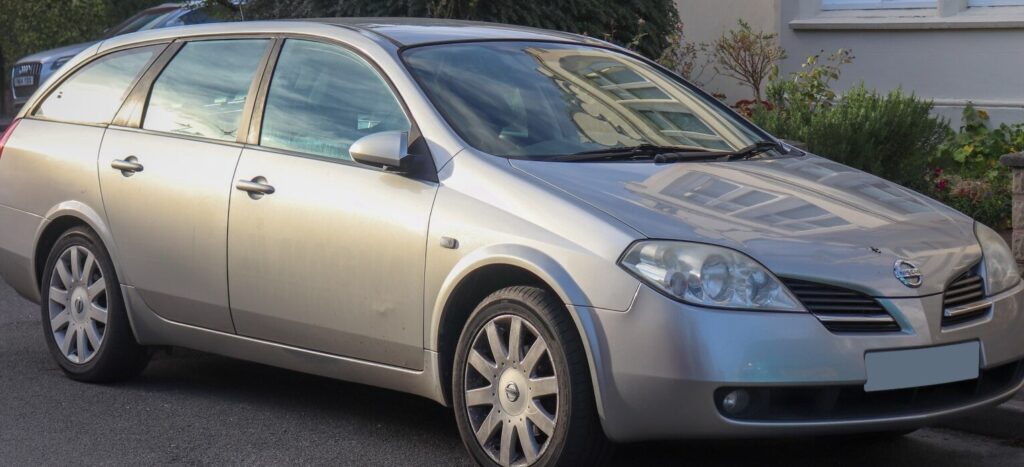
The Nissan Primera Wagon (P12) 2.0 i 16V, produced between 2002 and 2007, represented a significant offering in the European and Asian markets as a practical and relatively upscale family vehicle. Positioned as a mid-range trim within the P12 Primera Wagon lineup, it slotted between the lower-powered 1.6L models and the more performance-oriented 2.2L variants. The P12 generation, built on the Nissan FF-L platform, aimed to provide a comfortable and spacious alternative to traditional hatchbacks and sedans, capitalizing on the growing popularity of station wagons (estates) for family transport. This particular 2.0L engine and manual transmission combination was a popular choice, balancing fuel efficiency with adequate performance for everyday driving.
Technical Specifications
| Brand | Nissan |
| Model | Primera |
| Generation | Primera Wagon (P12) |
| Type (Engine) | 2.0 i 16V (140 Hp) |
| Start of production | 2002 |
| End of production | 2007 |
| Powertrain Architecture | Internal Combustion engine |
| Body type | Station wagon (estate) |
| Seats | 5 |
| Doors | 5 |
| Fuel consumption (urban) | 11.7 l/100 km (20.1 US mpg, 24.1 UK mpg, 8.5 km/l) |
| Fuel consumption (extra urban) | 6.7 l/100 km (35.1 US mpg, 42.2 UK mpg, 14.9 km/l) |
| Fuel consumption (combined) | 8.5 l/100 km (27.7 US mpg, 33.2 UK mpg, 11.8 km/l) |
| Fuel Type | Petrol (Gasoline) |
| Acceleration 0 – 100 km/h | 9.6 sec |
| Acceleration 0 – 62 mph | 9.6 sec |
| Acceleration 0 – 60 mph | 9.1 sec |
| Maximum speed | 204 km/h (126.76 mph) |
| Weight-to-power ratio | 9.9 kg/Hp, 101.1 Hp/tonne |
| Weight-to-torque ratio | 7.2 kg/Nm, 138.6 Nm/tonne |
| Power | 140 Hp @ 6000 rpm |
| Power per litre | 70.1 Hp/l |
| Torque | 192 Nm @ 4000 rpm (141.61 lb.-ft. @ 4000 rpm) |
| Engine layout | Front, Transverse |
| Engine Model/Code | QR20DE |
| Engine displacement | 1998 cm3 (121.93 cu. in.) |
| Number of cylinders | 4 |
| Engine configuration | Inline |
| Cylinder Bore | 89 mm (3.5 in.) |
| Piston Stroke | 80.3 mm (3.16 in.) |
| Compression ratio | 9.9:1 |
| Number of valves per cylinder | 4 |
| Fuel injection system | Multi-port manifold injection |
| Engine aspiration | Naturally aspirated engine |
| Valvetrain | DOHC |
| Engine oil capacity | 3.9 l (4.12 US qt | 3.43 UK qt) |
| Kerb Weight | 1385 kg (3053.4 lbs.) |
| Max. weight | 1940 kg (4276.97 lbs.) |
| Max load | 555 kg (1223.57 lbs.) |
| Trunk (boot) space – minimum | 465 l (16.42 cu. ft.) |
| Trunk (boot) space – maximum | 1670 l (58.98 cu. ft.) |
| Fuel tank capacity | 62 l (16.38 US gal | 13.64 UK gal) |
| Length | 4675 mm (184.06 in.) |
| Width | 1760 mm (69.29 in.) |
| Height | 1480 mm (58.27 in.) |
| Wheelbase | 2675 mm (105.31 in.) |
| Front track | 1530 mm (60.24 in.) |
| Rear (Back) track | 1535 mm (60.43 in.) |
| Drivetrain Architecture | The Internal combustion engine (ICE) drives the front wheels of the vehicle. |
| Drive wheel | Front wheel drive |
| Number of gears and type of gearbox | 6 gears, manual transmission |
| Front suspension | Double wishbone |
| Rear suspension | Coil spring |
| Front brakes | Ventilated discs |
| Rear brakes | Disc |
| Assisting systems | ABS (Anti-lock braking system) |
| Steering type | Steering rack and pinion |
| Power steering | Hydraulic Steering |
| Tires size | 205/65 R16 |
| Wheel rims size | 16 |
Powertrain & Engine Architecture
The heart of the Primera Wagon 2.0 i 16V is the QR20DE engine, a 1.998-liter inline-four cylinder gasoline engine. This engine is part of Nissan’s QR engine family, known for its relatively simple design and durability. The QR20DE utilizes a dual overhead camshaft (DOHC) valvetrain with four valves per cylinder, contributing to its respectable power output. Fuel delivery is managed by a multi-port fuel injection system, providing precise fuel metering for optimal combustion. The engine’s 9.9:1 compression ratio strikes a balance between performance and fuel efficiency. Paired with this engine is a six-speed manual transmission, offering drivers precise control over gear selection. This transmission was chosen for its smooth shifting and ability to maximize the engine’s power band.
Driving Characteristics
The 2.0L engine, producing 140 horsepower, provided adequate performance for the Primera Wagon. Acceleration from 0 to 60 mph took approximately 9.1 seconds, making it competitive with other wagons in its class. The six-speed manual transmission allowed drivers to keep the engine in its optimal power range, providing responsive acceleration. While not a sports car, the Primera Wagon 2.0 i 16V offered a comfortable and composed driving experience. Compared to the 1.6L models, the 2.0L provided noticeably more power, especially when fully loaded with passengers and cargo. However, it didn’t possess the outright performance of the 2.2L variants. The gear ratios were well-matched for both city and highway driving, offering a good balance between fuel economy and responsiveness.
Equipment & Trim Levels
The 2.0 i 16V trim typically included features such as air conditioning, power windows, power door locks, and a basic audio system. Higher trim levels offered options like alloy wheels, a sunroof, and upgraded interior upholstery. Interior materials were generally of good quality for the price point, with a focus on practicality and durability. The dashboard layout was functional and easy to use, with clearly labeled controls. Optional extras included a CD changer, navigation system, and leather seats. Safety features included ABS brakes and front airbags, although the availability of side airbags varied depending on the market.
Chassis & Braking
The Primera Wagon featured a double wishbone front suspension and a coil spring rear suspension, providing a comfortable ride and stable handling. The front brakes were ventilated discs, offering good stopping power, while the rear brakes were solid discs. The steering was rack and pinion with hydraulic power assistance, providing precise and responsive steering feel. The car rode on 205/65 R16 tires, which offered a good balance between grip and ride comfort. The chassis was designed to provide a stable and predictable driving experience, even when carrying a full load.
Market Reception & Comparison
The Nissan Primera Wagon 2.0 i 16V was generally well-received by automotive critics. It was praised for its spacious interior, comfortable ride, and good fuel economy. However, some critics noted that the interior styling was somewhat conservative compared to some of its rivals. Compared to other wagons in its class, such as the Ford Focus Estate and the Volkswagen Passat Wagon, the Primera offered a competitive level of equipment and performance at a reasonable price. Fuel economy was comparable to other 2.0L gasoline engines, averaging around 27.7 US mpg in combined driving. Reliability was generally good, although some owners reported minor issues with the electrical system.
Legacy
The QR20DE engine proved to be a reliable and durable powerplant, and many Primera Wagons with this engine are still on the road today. The P12 Primera Wagon, while not a groundbreaking vehicle, established Nissan as a serious contender in the European and Asian wagon market. The 2.0 i 16V variant remains a popular choice in the used car market, offering a good balance of practicality, reliability, and affordability. Its relatively simple mechanical design makes it easier and less expensive to maintain compared to more complex modern vehicles. The Primera Wagon 2.0 i 16V represents a solid and dependable family vehicle from a bygone era.