Technical Specifications
| Brand | Nissan |
| Model | Primera |
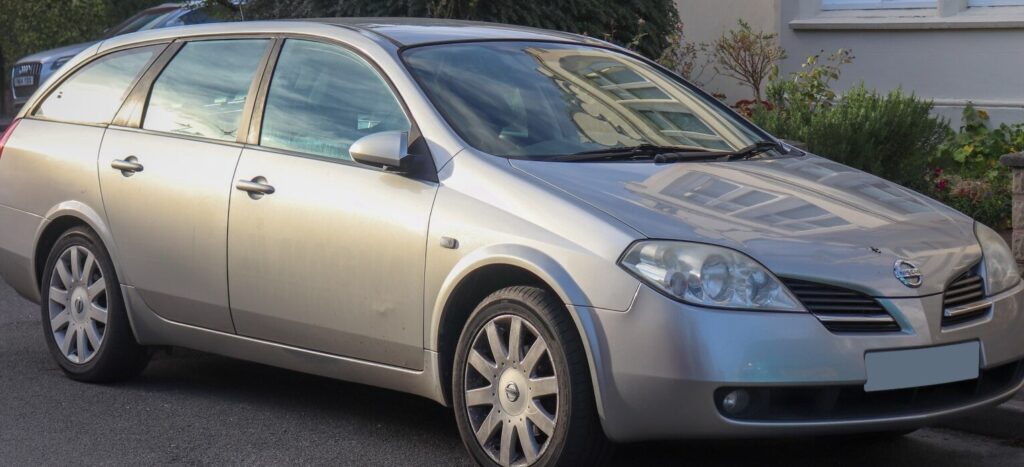
| Generation | Primera Wagon (P12) |
| Type (Engine) | 2.0 i 16V (140 Hp) CVT |
| Start of production | 2002 |
| End of production | 2007 |
| Powertrain Architecture | Internal Combustion engine |
| Body type | Station wagon (estate) |
| Seats | 5 |
| Doors | 5 |
| Fuel consumption (urban) | 11.9 l/100 km (19.8 US mpg, 23.7 UK mpg, 8.4 km/l) |
| Fuel consumption (extra urban) | 7 l/100 km (33.6 US mpg, 40.4 UK mpg, 14.3 km/l) |
| Fuel consumption (combined) | 8.8 l/100 km (26.7 US mpg, 32.1 UK mpg, 11.4 km/l) |
| Fuel Type | Petrol (Gasoline) |
| Acceleration 0 – 100 km/h | 10.9 sec |
| Acceleration 0 – 62 mph | 10.9 sec |
| Acceleration 0 – 60 mph | 10.4 sec |
| Maximum speed | 191 km/h (118.68 mph) |
| Weight-to-power ratio | 9.9 kg/Hp, 101.1 Hp/tonne |
| Weight-to-torque ratio | 7.2 kg/Nm, 138.6 Nm/tonne |
| Power | 140 Hp @ 6000 rpm |
| Power per litre | 70.1 Hp/l |
| Torque | 192 Nm @ 4000 rpm (141.61 lb.-ft. @ 4000 rpm) |
| Engine layout | Front, Transverse |
| Engine Model/Code | QR20DE |
| Engine displacement | 1998 cm3 (121.93 cu. in.) |
| Number of cylinders | 4 |
| Engine configuration | Inline |
| Cylinder Bore | 89 mm (3.5 in.) |
| Piston Stroke | 80.3 mm (3.16 in.) |
| Compression ratio | 9.9:1 |
| Number of valves per cylinder | 4 |
| Fuel injection system | Multi-port manifold injection |
| Engine aspiration | Naturally aspirated engine |
| Valvetrain | DOHC |
| Engine oil capacity | 3.9 l (4.12 US qt | 3.43 UK qt) |
| Kerb Weight | 1385 kg (3053.4 lbs.) |
| Max. weight | 1940 kg (4276.97 lbs.) |
| Max load | 555 kg (1223.57 lbs.) |
| Trunk (boot) space – minimum | 465 l (16.42 cu. ft.) |
| Trunk (boot) space – maximum | 1670 l (58.98 cu. ft.) |
| Fuel tank capacity | 62 l (16.38 US gal | 13.64 UK gal) |
| Length | 4675 mm (184.06 in.) |
| Width | 1760 mm (69.29 in.) |
| Height | 1480 mm (58.27 in.) |
| Wheelbase | 2675 mm (105.31 in.) |
| Front track | 1530 mm (60.24 in.) |
| Rear (Back) track | 1535 mm (60.43 in.) |
| Drivetrain Architecture | The Internal combustion engine (ICE) drives the front wheels of the vehicle. |
| Drive wheel | Front wheel drive |
| Number of gears and type of gearbox | automatic transmission CVT |
| Front suspension | Double wishbone |
| Rear suspension | Coil spring |
| Front brakes | Ventilated discs |
| Rear brakes | Disc |
| Assisting systems | ABS (Anti-lock braking system) |
| Steering type | Steering rack and pinion |
| Power steering | Hydraulic Steering |
| Tires size | 205/65 R16 |
| Wheel rims size | 16 |
The P12 Primera Wagon, launched in 2002, was Nissan’s attempt to capture a larger share of the European and Asian family car market. Building upon the success of the preceding P11 Primera, the P12 offered increased space, improved refinement, and a more modern design. The 2.0 i 16V CVT variant was positioned as a sensible choice for buyers prioritizing comfort and fuel economy over outright performance. It sat below the more powerful 2.0 Visia and above the base 1.6-liter models in the Primera Wagon range.
Powertrain & Engine Architecture
At the heart of the Primera Wagon 2.0 i 16V CVT lies the QR20DE engine, a 1998cc inline-four cylinder powerplant. This engine featured multi-port fuel injection and a double overhead camshaft (DOHC) valvetrain, contributing to its relatively smooth operation and decent power output. The QR20DE was known for its reliability and was used in a variety of Nissan vehicles during this period. The engine’s 9.9:1 compression ratio was a compromise between performance and fuel efficiency. Paired with this engine was a Continuously Variable Transmission (CVT). Nissan’s CVT offered seamless gear changes and contributed to improved fuel economy compared to a traditional automatic transmission. However, early CVTs sometimes received criticism for a “rubber band” feel during acceleration, where engine RPM would rise without a corresponding increase in vehicle speed. This was a characteristic of early CVT technology, and Nissan refined the system in later iterations.
Driving Characteristics
The 140 horsepower and 192 Nm (141.61 lb-ft) of torque delivered by the 2.0-liter engine and CVT combination provided adequate, but not exhilarating, performance. Acceleration from 0-60 mph took around 10.4 seconds, and top speed was approximately 118.68 mph. The CVT’s programming prioritized fuel efficiency, resulting in a somewhat relaxed driving experience. While the CVT eliminated harsh gear shifts, it could feel less responsive than a traditional automatic or manual transmission, particularly during quick overtaking maneuvers. The gear ratios were optimized for cruising, making the Primera Wagon a comfortable long-distance vehicle. Compared to the manual transmission versions of the 2.0-liter Primera, the CVT offered smoother operation but sacrificed some responsiveness. The CVT’s ability to keep the engine in its optimal power band did, however, contribute to a feeling of effortless cruising.
Equipment & Trim Levels
The 2.0 i 16V CVT Primera Wagon typically came equipped with a reasonable level of standard features. These included air conditioning, power windows, central locking, an integrated stereo system, and ABS brakes. Higher trim levels added features such as alloy wheels, climate control, a sunroof, and upgraded upholstery. Interior materials were generally of good quality for the price point, with a focus on practicality and durability. The dashboard layout was functional and easy to use, although some critics found the design somewhat bland. Optional extras included a navigation system and leather seats. The overall interior ambiance was geared towards providing a comfortable and practical space for families.
Chassis & Braking
The Primera Wagon’s chassis featured a double wishbone front suspension and a coil spring rear suspension. This setup provided a comfortable ride quality, absorbing bumps and imperfections in the road effectively. The steering was hydraulic power-assisted, offering a reasonable level of feedback. Braking duties were handled by ventilated discs at the front and solid discs at the rear. ABS was standard, enhancing safety during emergency braking situations. The suspension tuning was geared towards comfort rather than sporty handling, making the Primera Wagon a stable and predictable vehicle. The relatively soft suspension settings contributed to the car’s comfortable ride, but also meant it wasn’t particularly engaging to drive on winding roads.
Market Reception & Comparison
The Nissan Primera Wagon 2.0 i 16V CVT was generally well-received by automotive critics as a practical and comfortable family car. It was praised for its spacious interior, smooth ride, and fuel efficiency. However, some reviewers criticized the CVT for its lack of responsiveness and the engine for being somewhat underpowered. Compared to rivals such as the Ford Mondeo Estate and the Volkswagen Passat Wagon, the Primera Wagon offered a competitive package in terms of price and features. The 1.8L models offered better fuel economy, while the higher-output 2.0L variants provided more spirited performance. Reliability was generally good, although some owners reported minor issues with the CVT over time, often related to fluid maintenance. The Primera Wagon offered a compelling alternative to more established European brands.
Legacy
The Nissan Primera Wagon, while not a sales chart-topper, established Nissan as a credible contender in the European and Asian estate car market. The QR20DE engine proved to be a durable and reliable unit, and many examples are still on the road today. The CVT, while initially met with some skepticism, became increasingly common in Nissan vehicles and has undergone significant improvements in subsequent generations. In the used car market, the P12 Primera Wagon 2.0 i 16V CVT represents a good value proposition for buyers seeking a spacious, comfortable, and reliable family vehicle. Maintenance costs are generally reasonable, and parts availability is still relatively good. The Primera Wagon remains a practical and affordable option for those needing a versatile estate car.