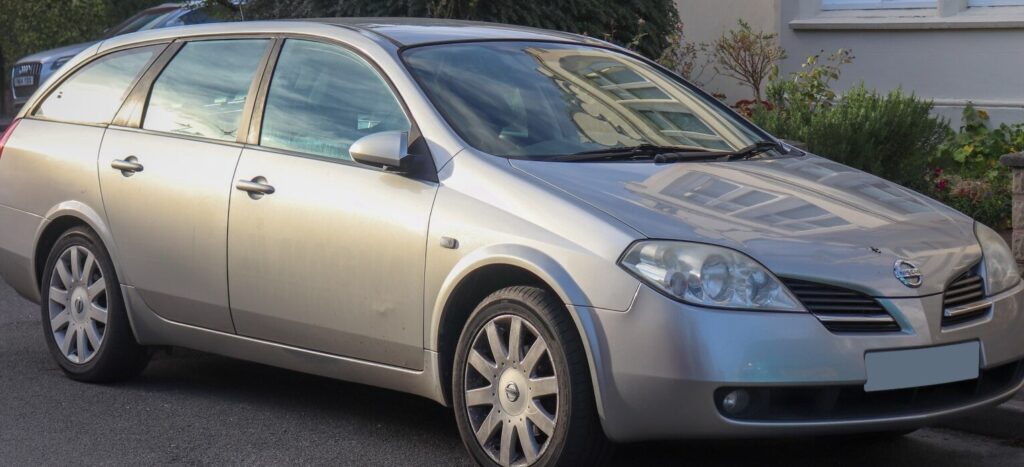
The Nissan Primera Wagon (P12) 2.5 i 16V, produced between 2002 and 2007, represented a significant offering in the European and Asian markets as a practical and relatively upscale family vehicle. Positioned as a mid-to-high trim level within the P12 Primera Wagon range, it provided a blend of performance and comfort aimed at buyers seeking a spacious estate car with a more powerful engine option. The P12 generation, launched in 2002, was a substantial redesign of the Primera, moving it further upmarket and emphasizing interior space and refinement. This 2.5-liter variant was particularly notable for offering a naturally aspirated engine in a segment increasingly dominated by turbocharged alternatives.
Technical Specifications
| Brand | Nissan |
| Model | Primera |
| Generation | Primera Wagon (P12) |
| Type (Engine) | 2.5 i 16V (170 Hp) |
| Start of production | 2002 |
| End of production | 2007 |
| Powertrain Architecture | Internal Combustion engine |
| Body type | Station wagon (estate) |
| Seats | 5 |
| Doors | 5 |
| Fuel consumption (combined) | 7.7 l/100 km (30.5 US mpg, 36.7 UK mpg, 13 km/l) |
| Fuel Type | Petrol (Gasoline) |
| Maximum speed | 220 km/h (136.7 mph) |
| Weight-to-power ratio | 8.2 kg/Hp, 121.4 Hp/tonne |
| Weight-to-torque ratio | 5.7 kg/Nm, 175 Nm/tonne |
| Power | 170 Hp @ 5600 rpm |
| Power per litre | 68.3 Hp/l |
| Torque | 245 Nm @ 4000 rpm (180.7 lb.-ft. @ 4000 rpm) |
| Engine layout | Front, Transverse |
| Engine Model/Code | QR25DD |
| Engine displacement | 2488 cm3 (151.83 cu. in.) |
| Number of cylinders | 4 |
| Engine configuration | Inline |
| Cylinder Bore | 89 mm (3.5 in.) |
| Piston Stroke | 100 mm (3.94 in.) |
| Compression ratio | 10.5:1 |
| Number of valves per cylinder | 4 |
| Fuel injection system | Multi-port manifold injection |
| Engine aspiration | Naturally aspirated engine |
| Valvetrain | DOHC |
| Engine oil capacity | 5.1 l (5.39 US qt | 4.49 UK qt) |
| Kerb Weight | 1400 kg (3086.47 lbs.) |
| Max. weight | 1675 kg (3692.74 lbs.) |
| Max load | 275 kg (606.27 lbs.) |
| Trunk (boot) space – minimum | 465 l (16.42 cu. ft.) |
| Fuel tank capacity | 62 l (16.38 US gal | 13.64 UK gal) |
| Length | 4675 mm (184.06 in.) |
| Width | 1760 mm (69.29 in.) |
| Height | 1480 mm (58.27 in.) |
| Wheelbase | 2680 mm (105.51 in.) |
| Front track | 1530 mm (60.24 in.) |
| Rear (Back) track | 1535 mm (60.43 in.) |
| Drivetrain Architecture | The Internal combustion engine (ICE) drives the front wheels of the vehicle. |
| Drive wheel | Front wheel drive |
| Front suspension | Double wishbone |
| Rear suspension | Coil spring |
| Front brakes | Ventilated discs |
| Rear brakes | Disc |
| Assisting systems | ABS (Anti-lock braking system) |
| Steering type | Steering rack and pinion |
| Power steering | Hydraulic Steering |
| Tires size | 205/65 R16 |
Powertrain & Engine Architecture
The heart of the Primera Wagon 2.5 i 16V is the QR25DD engine, a 2.5-liter inline-four cylinder powerplant. This engine is a naturally aspirated design, meaning it doesn’t rely on a turbocharger or supercharger for forced induction. It features multi-port fuel injection, delivering fuel directly into the intake ports, and a double overhead camshaft (DOHC) valvetrain for optimized airflow and efficient combustion. The QR25DD boasts a compression ratio of 10.5:1, contributing to its respectable power output. The engine was known for its smooth operation and relatively linear power delivery. The transmission paired with this engine was a four-speed automatic, a common choice for buyers prioritizing convenience over ultimate performance. While not the most modern transmission in terms of gear count, it was generally considered reliable and well-suited to the engine’s characteristics.
Driving Characteristics
The 170 horsepower and 180.7 lb-ft of torque produced by the QR25DD engine provided the Primera Wagon with adequate performance for everyday driving and long-distance cruising. Acceleration was respectable, though not particularly brisk, with a 0-60 mph time estimated around 9-10 seconds. The four-speed automatic transmission, while smooth, did result in noticeable gear changes and wasn’t as responsive as more modern automatic gearboxes. Compared to the lower-powered 1.6L and 1.8L variants, the 2.5 i 16V offered a significant improvement in both acceleration and mid-range torque, making overtaking maneuvers easier and less stressful. However, it lacked the punch of the later turbocharged options available in other markets. The steering was light and precise, contributing to a comfortable driving experience, and the suspension provided a good balance between ride comfort and handling.
Equipment & Trim Levels
The 2.5 i 16V Primera Wagon typically came well-equipped, reflecting its position as a higher-end trim level. Standard features often included air conditioning, power windows and mirrors, central locking, an integrated audio system, and alloy wheels. Higher-spec models could be equipped with options such as leather upholstery, a sunroof, and a more advanced navigation system. Interior trim generally featured a dark color scheme with woodgrain accents, aiming for a sophisticated and comfortable cabin environment. Safety features like ABS and front airbags were standard.
Chassis & Braking
The Primera Wagon utilized a front-wheel-drive layout with a double wishbone suspension setup at the front and a coil spring arrangement at the rear. This suspension configuration provided a comfortable ride and decent handling characteristics. Braking duties were handled by ventilated discs at the front and solid discs at the rear, coupled with an Anti-lock Braking System (ABS) for enhanced safety. The chassis was designed to provide a stable and predictable driving experience, prioritizing comfort and practicality over outright sportiness.
Market Reception & Comparison
The Nissan Primera Wagon 2.5 i 16V was generally well-received by automotive critics as a practical and comfortable family car. It was praised for its spacious interior, smooth engine, and refined ride quality. However, some reviewers noted that the four-speed automatic transmission felt dated compared to the five or six-speed automatics offered by competitors. Fuel economy was considered reasonable for a vehicle of its size and engine displacement, averaging around 30.5 US mpg in combined driving. Compared to the lower-powered Primera Wagon variants, the 2.5 i 16V offered a noticeable performance advantage, but at a higher price point. It competed with other mid-size estate cars such as the Ford Mondeo Wagon, Volkswagen Passat Wagon, and Peugeot 406 SW.
Legacy
The QR25DD engine, while not known for being particularly groundbreaking, proved to be a reliable and durable powerplant. Primera Wagons equipped with this engine have generally maintained good reliability ratings, and many examples are still on the road today. The four-speed automatic transmission, while not the most efficient, is also considered relatively robust. In the used car market, the 2.5 i 16V Primera Wagon represents a good value proposition for buyers seeking a spacious, comfortable, and reliable estate car. Its relatively simple mechanical design makes it easier and less expensive to maintain compared to more complex modern vehicles. While it may not offer the latest technology or the highest performance, it remains a practical and dependable choice for those needing a versatile family vehicle.