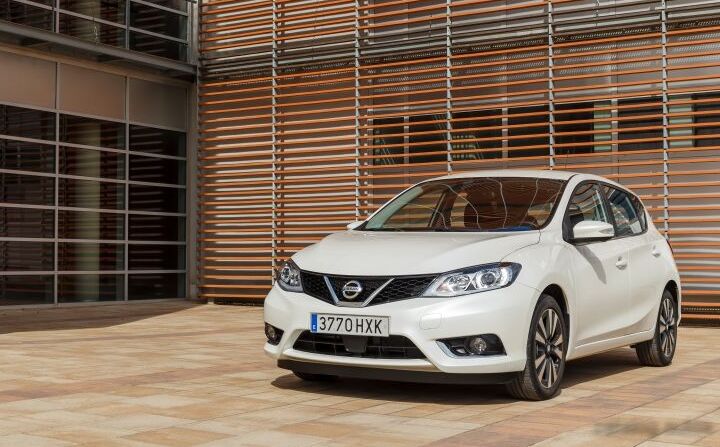
The Nissan Pulsar C13 1.2 DIG-T, produced from October 2014 to June 2018, represented Nissan’s entry into the competitive European compact hatchback segment. Positioned as a practical and fuel-efficient option, the 1.2 DIG-T variant offered a balance between affordability and modern technology. It was part of the C13 series, which aimed to replace the Tiida in many European markets and offered a more contemporary design and driving experience. This model competed directly with vehicles like the Volkswagen Golf, Ford Focus, and Opel Astra.
Technical Specifications
| Brand | Nissan |
| Model | Pulsar |
| Generation | Pulsar (C13) |
| Type (Engine) | 1.2 DIG-T (115 Hp) |
| Start of production | October, 2014 |
| End of production | June, 2018 |
| Powertrain Architecture | Internal Combustion engine |
| Body type | Hatchback |
| Seats | 5 |
| Doors | 5 |
| Fuel consumption (urban) | 6.3 l/100 km (37.3 US mpg, 44.8 UK mpg, 15.9 km/l) |
| Fuel consumption (extra urban) | 4.3 l/100 km (54.7 US mpg, 65.7 UK mpg, 23.3 km/l) |
| Fuel consumption (combined) | 5 l/100 km (47 US mpg, 56.5 UK mpg, 20 km/l) |
| CO2 emissions | 117 g/km |
| Fuel Type | Petrol (Gasoline) |
| Acceleration 0 – 100 km/h | 10.7 sec |
| Acceleration 0 – 62 mph | 10.7 sec |
| Acceleration 0 – 60 mph | 10.2 sec |
| Maximum speed | 190 km/h (118.06 mph) |
| Emission standard | Euro 6 |
| Weight-to-power ratio | 10.3 kg/Hp, 96.6 Hp/tonne |
| Weight-to-torque ratio | 6.3 kg/Nm, 159.7 Nm/tonne |
| Power | 115 Hp @ 4500 rpm |
| Power per litre | 96.1 Hp/l |
| Torque | 190 Nm @ 2000 rpm (140.14 lb.-ft. @ 2000 rpm) |
| Engine layout | Front, Transverse |
| Engine Model/Code | HRA2DDT |
| Engine displacement | 1197 cm3 (73.05 cu. in.) |
| Number of cylinders | 4 |
| Engine configuration | Inline |
| Cylinder Bore | 72.2 mm (2.84 in.) |
| Piston Stroke | 73.1 mm (2.88 in.) |
| Number of valves per cylinder | 4 |
| Fuel injection system | Direct injection |
| Engine aspiration | Turbocharger, Intercooler |
| Engine oil capacity | 4.63 l (4.89 US qt | 4.07 UK qt) |
| Kerb Weight | 1190-1304 kg (2623.5 – 2874.83 lbs.) |
| Max. weight | 1750 kg (3858.09 lbs.) |
| Max load | 446-560 kg (983.26 – 1234.59 lbs.) |
| Trunk (boot) space – minimum | 385 l (13.6 cu. ft.) |
| Trunk (boot) space – maximum | 1395 l (49.26 cu. ft.) |
| Fuel tank capacity | 46 l (12.15 US gal | 10.12 UK gal) |
| Max. roof load | 75 kg (165.35 lbs.) |
| Permitted trailer load with brakes (12%) | 1200 kg (2645.55 lbs.) |
| Permitted trailer load without brakes | 632 kg (1393.32 lbs.) |
| Permitted towbar download | 75 kg (165.35 lbs.) |
| Length | 4387 mm (172.72 in.) |
| Width | 1768 mm (69.61 in.) |
| Height | 1520 mm (59.84 in.) |
| Wheelbase | 2700 mm (106.3 in.) |
| Front track | 1540/1530 mm (60.63 in.) |
| Rear (Back) track | 1540/1530 mm (60.63 in.) |
| Ride height (ground clearance) | 156 mm (6.14 in.) |
| Minimum turning circle (turning diameter) | 10.2 m (33.46 ft.) |
| Drivetrain Architecture | The Internal combustion engine (ICE) drives the front wheels of the vehicle. |
| Drive wheel | Front wheel drive |
| Number of gears and type of gearbox | 6 gears, manual transmission |
| Front suspension | Independent type McPherson |
| Rear suspension | Semi-independent, coil spring |
| Front brakes | Ventilated discs |
| Assisting systems | ABS (Anti-lock braking system) |
| Steering type | Steering rack and pinion |
| Tires size | 195/60 R16; 205/50 R17 |
| Wheel rims size | 6.5J x 16; 6.5J x 17 |
INTRODUCTION
The Nissan Pulsar C13 1.2 DIG-T, launched in 2014, was a key component of Nissan’s strategy to regain market share in the European compact car segment. Built on the V-Platform (also known as the C13 platform), it offered a modern alternative to established rivals. The 1.2 DIG-T variant served as a core offering, providing a balance of fuel efficiency and acceptable performance for everyday driving. It was designed to appeal to buyers seeking a practical, reliable, and reasonably priced hatchback.
Powertrain & Engine Architecture
At the heart of the Pulsar 1.2 DIG-T lies the HRA2DDT engine, a 1.2-liter, inline-four cylinder gasoline engine. This engine is a member of Nissan’s DIG-T (Direct Injection Gasoline Turbocharged) family. It features direct fuel injection, which improves combustion efficiency and power delivery. The engine utilizes a single-scroll turbocharger with an intercooler to boost power output. The engine’s valvetrain employs dual continuously variable valve timing (CVVT) on both intake and exhaust valves, optimizing performance across the rev range. The 115 horsepower and 190 Nm (140 lb-ft) of torque are delivered through a six-speed manual transmission, which was the standard offering for this variant. The engine’s design prioritizes fuel economy and reduced emissions, meeting Euro 6 standards.
Driving Characteristics
The 1.2 DIG-T Pulsar offered a comfortable, if not particularly sporty, driving experience. With 115 horsepower, acceleration from 0-62 mph took approximately 10.7 seconds. While not a performance leader, the turbocharger provided a noticeable boost in power during overtaking maneuvers. The six-speed manual transmission was well-matched to the engine, offering smooth gear changes. Compared to higher-powered Pulsar variants, such as those equipped with the 1.6 DIG-T engine, the 1.2 DIG-T felt less responsive. However, it excelled in urban driving and on the highway, where its fuel efficiency was most apparent. The gear ratios were tuned for economy, meaning the engine could feel strained when pushed hard. The steering was light and precise, making it easy to maneuver in tight spaces.
Equipment & Trim Levels
The 1.2 DIG-T Pulsar typically came with a reasonable level of standard equipment. Base models included air conditioning, power windows, a basic audio system with USB connectivity, and stability control. Higher trim levels, such as Visia, Acenta, and Tekna, added features like alloy wheels, a touchscreen infotainment system with navigation, automatic climate control, and parking sensors. Interior upholstery was typically cloth, with higher trims offering partial leather options. Optional extras included a panoramic sunroof, keyless entry, and a rear-view camera. The dashboard layout was functional and user-friendly, although the interior materials were generally of average quality.
Chassis & Braking
The Pulsar C13 utilized a McPherson strut front suspension and a semi-independent coil spring rear suspension. This setup provided a comfortable ride, absorbing bumps and imperfections in the road effectively. Front brakes were ventilated discs, while rear brakes were typically drums on lower trim levels and discs on higher trims. Anti-lock Braking System (ABS) was standard across the range. The chassis was designed to provide a good balance between handling and ride comfort. Stabilizer bars were fitted to both the front and rear axles to reduce body roll during cornering. The weight of the vehicle, ranging from 1190 to 1304 kg, influenced the handling characteristics, making it feel slightly less agile than some of its lighter competitors.
Market Reception & Comparison
The Nissan Pulsar 1.2 DIG-T received mixed reviews from automotive critics. It was praised for its fuel efficiency, comfortable ride, and spacious interior. However, it was often criticized for its uninspiring driving dynamics and relatively bland styling. Compared to the 1.6 DIG-T variant, the 1.2 DIG-T offered significantly better fuel economy but lacked the same level of performance. Against rivals like the Volkswagen Golf and Ford Focus, the Pulsar offered a competitive price point but didn’t quite match their overall refinement or driving experience. Reliability reports generally indicated good dependability, with few major issues reported with the 1.2 DIG-T engine and transmission.
Legacy
The Nissan Pulsar C13 1.2 DIG-T has established itself as a reliable and affordable used car option. The 1.2 DIG-T engine has proven to be relatively durable, with proper maintenance. Common issues are typically related to wear and tear items, such as brakes and suspension components. The availability of spare parts is generally good, and maintenance costs are reasonable. While it may not be the most exciting car to drive, the Pulsar 1.2 DIG-T remains a practical and economical choice for buyers seeking a dependable compact hatchback.