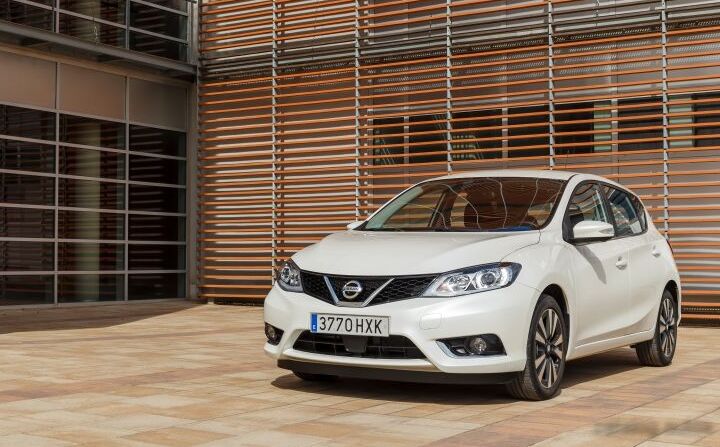
The Nissan Pulsar (C13) 1.2 DIG-T with the Xtronic continuously variable transmission (CVT) was a front-wheel-drive hatchback produced from October 2014 to June 2018. Positioned as a mainstream, affordable option within the Pulsar range, it aimed to provide a balance of fuel efficiency and reasonable performance. The C13 generation Pulsar represented Nissan’s attempt to re-enter the competitive European compact hatchback segment, offering a practical and well-equipped vehicle. This particular 1.2 DIG-T Xtronic variant served as an entry point into the Pulsar lineup, appealing to buyers prioritizing economy and ease of driving over outright performance.
Technical Specifications
| Brand | Nissan |
| Model | Pulsar |
| Generation | Pulsar (C13) |
| Type (Engine) | 1.2 DIG-T (115 Hp) Xtronic |
| Start of production | October, 2014 |
| End of production | June, 2018 |
| Powertrain Architecture | Internal Combustion engine |
| Body type | Hatchback |
| Seats | 5 |
| Doors | 5 |
| Fuel consumption (urban) | 6.2 l/100 km (37.9 US mpg, 45.6 UK mpg, 16.1 km/l) |
| Fuel consumption (extra urban) | 4.5 l/100 km (52.3 US mpg, 62.8 UK mpg, 22.2 km/l) |
| Fuel consumption (combined) | 5.1 l/100 km (46.1 US mpg, 55.4 UK mpg, 19.6 km/l) |
| CO2 emissions | 119 g/km |
| Fuel Type | Petrol (Gasoline) |
| Acceleration 0 – 100 km/h | 12.7 sec |
| Acceleration 0 – 62 mph | 12.7 sec |
| Acceleration 0 – 60 mph | 12.1 sec |
| Maximum speed | 185 km/h (114.95 mph) |
| Emission standard | Euro 6 |
| Weight-to-power ratio | 10.5 kg/Hp, 95.4 Hp/tonne |
| Weight-to-torque ratio | 7.3 kg/Nm, 136.9 Nm/tonne |
| Power | 115 Hp @ 5200 rpm |
| Power per litre | 96.1 Hp/l |
| Torque | 165 Nm @ 1750 rpm (121.7 lb.-ft. @ 1750 rpm) |
| Engine layout | Front, Transverse |
| Engine Model/Code | HRA2DDT |
| Engine displacement | 1197 cm3 (73.05 cu. in.) |
| Number of cylinders | 4 |
| Engine configuration | Inline |
| Cylinder Bore | 72.2 mm (2.84 in.) |
| Piston Stroke | 73.1 mm (2.88 in.) |
| Number of valves per cylinder | 4 |
| Fuel injection system | Direct injection |
| Engine aspiration | Turbocharger, Intercooler |
| Engine oil capacity | 4.63 l (4.89 US qt | 4.07 UK qt) |
| Kerb Weight | 1205-1323 kg (2656.57 – 2916.72 lbs.) |
| Max. weight | 1750 kg (3858.09 lbs.) |
| Max load | 427-545 kg (941.37 – 1201.52 lbs.) |
| Trunk (boot) space – minimum | 385 l (13.6 cu. ft.) |
| Trunk (boot) space – maximum | 1395 l (49.26 cu. ft.) |
| Fuel tank capacity | 46 l (12.15 US gal | 10.12 UK gal) |
| Max. roof load | 75 kg (165.35 lbs.) |
| Permitted trailer load with brakes (12%) | 500 kg (1102.31 lbs.) |
| Permitted trailer load without brakes | 500 kg (1102.31 lbs.) |
| Permitted towbar download | 75 kg (165.35 lbs.) |
| Length | 4387 mm (172.72 in.) |
| Width | 1768 mm (69.61 in.) |
| Height | 1520 mm (59.84 in.) |
| Wheelbase | 2700 mm (106.3 in.) |
| Front track | 1540/1530 mm (60.63 in.) |
| Rear (Back) track | 1540/1530 mm (60.63 in.) |
| Ride height (ground clearance) | 156 mm (6.14 in.) |
| Minimum turning circle (turning diameter) | 10.2 m (33.46 ft.) |
| Drivetrain Architecture | The Internal combustion engine (ICE) drives the front wheels of the vehicle. |
| Drive wheel | Front wheel drive |
| Front suspension | Independent type McPherson |
| Rear suspension | Semi-independent, coil spring |
| Front brakes | Ventilated discs |
| Assisting systems | ABS (Anti-lock braking system) |
| Steering type | Steering rack and pinion |
| Tires size | 195/60 R16; 205/50 R17 |
| Wheel rims size | 6.5J x 16; 6.5J x 17 |
Powertrain & Engine Architecture
The heart of this Pulsar variant is the HRA2DDT, a 1.2-liter inline-four cylinder gasoline engine. This engine belongs to Nissan’s DIG-T (Direct Injection Gasoline Turbocharged) family, utilizing direct fuel injection and a turbocharger with an intercooler to enhance power and efficiency. The engine produces 115 horsepower at 5200 rpm and 165 Nm (121.7 lb-ft) of torque at 1750 rpm. The Xtronic CVT, a continuously variable transmission, is paired with this engine. Unlike traditional automatic transmissions with fixed gear ratios, the CVT provides a seamless and theoretically infinite number of ratios, optimizing engine speed for efficiency or power as needed. The engine’s design prioritizes fuel economy and reduced emissions, meeting Euro 6 standards.
Driving Characteristics
The 1.2 DIG-T Xtronic Pulsar offers a comfortable and undemanding driving experience. Acceleration from 0-60 mph takes around 12.1 seconds, and 0-100 km/h in 12.7 seconds, making it adequate for everyday driving but not particularly sporty. The CVT contributes to smooth acceleration, but can sometimes feel less responsive than a traditional automatic or manual transmission, particularly during quick overtaking maneuvers. The CVT’s programming often holds the engine at a specific RPM to maximize efficiency, which can result in a droning sound under hard acceleration. Compared to the higher-output 1.6 DIG-T variants, this 1.2L engine provides less overall power, but offers significantly better fuel economy. The weight of the vehicle, ranging from 1205 to 1323 kg, impacts the overall performance, making it feel less nimble than lighter competitors.
Equipment & Trim Levels
The 1.2 DIG-T Xtronic trim typically included standard features such as air conditioning, a touchscreen infotainment system with Bluetooth connectivity, alloy wheels, and a suite of safety features including ABS, ESP (Electronic Stability Program), and multiple airbags. Higher trim levels, such as Tekna, added features like automatic climate control, parking sensors, a rearview camera, and Nissan’s Safety Shield technology, which includes features like lane departure warning and blind spot monitoring. Interior upholstery was generally cloth, with options for partial leather trim on higher-spec models. The dashboard layout was functional and straightforward, prioritizing ease of use.
Chassis & Braking
The Pulsar C13 utilizes an independent McPherson strut suspension at the front and a semi-independent coil spring suspension at the rear. This setup provides a comfortable ride quality, absorbing bumps and imperfections in the road surface effectively. Front brakes are ventilated discs, while rear brakes are typically drums on lower trim levels and discs on higher-spec models. The steering is rack and pinion, providing reasonably precise control. Stabilizer bars are fitted to both the front and rear axles to reduce body roll during cornering.
Market Reception & Comparison
The Nissan Pulsar 1.2 DIG-T Xtronic was generally well-received by critics as a practical and economical hatchback. However, it faced stiff competition from established rivals like the Volkswagen Golf, Ford Focus, and Vauxhall Astra. The Pulsar’s fuel economy of around 5.1 l/100 km (46.1 US mpg) was a key selling point, but its performance was considered adequate rather than exciting. Reliability reports have been generally positive, with few major issues reported with the 1.2 DIG-T engine or Xtronic CVT. Compared to the 1.6 DIG-T models, the 1.2L offered lower running costs but less driving enjoyment.
Legacy
The Nissan Pulsar C13, including the 1.2 DIG-T Xtronic variant, has established a reputation as a reliable and affordable used car. The 1.2-liter engine and CVT transmission have proven to be relatively durable, with proper maintenance. While not a particularly sought-after model among enthusiasts, it remains a sensible choice for buyers seeking a practical and economical hatchback. The Pulsar’s relatively simple technology and robust build quality contribute to its long-term reliability, making it a viable option in the used car market today.