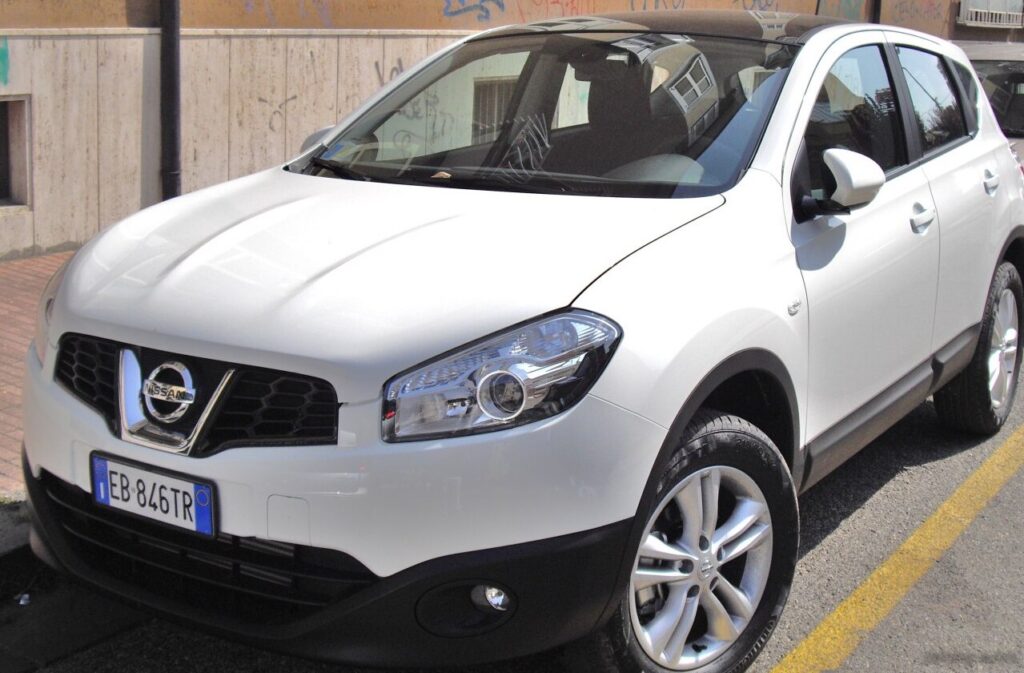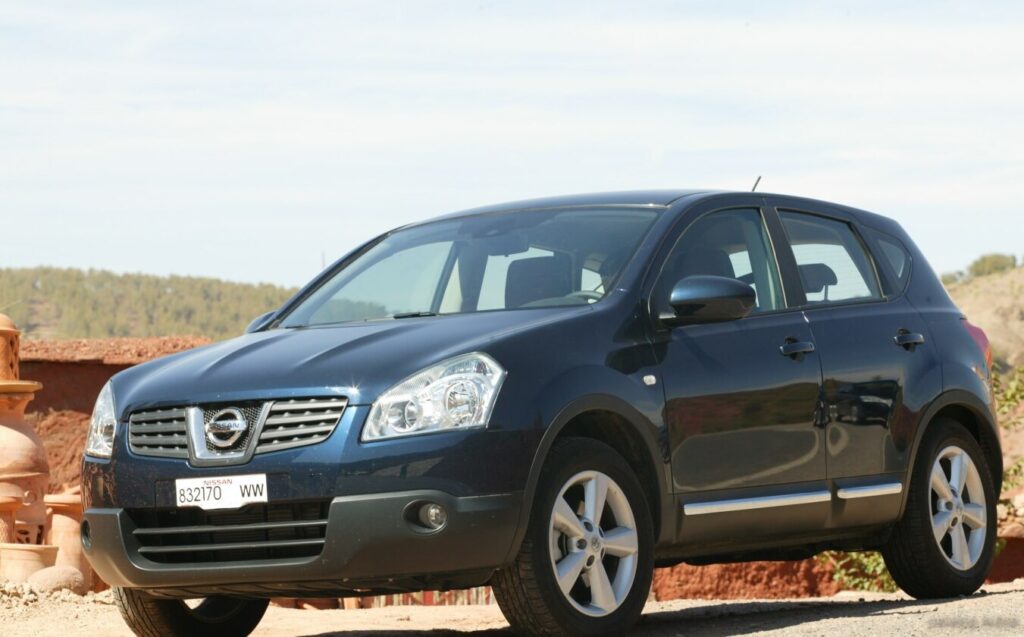
The Nissan Qashqai (known as the Dualis in some markets) represented Nissan’s entry into the burgeoning compact crossover segment in Europe. Introduced in 2007, the first generation Qashqai, internally designated the J10, aimed to blend the practicality of a hatchback with the elevated driving position and styling of an SUV. The 1.6-liter (114 hp) variant, produced from 2007 to 2010, served as the entry point to the Qashqai range, offering a balance of affordability and fuel efficiency. This model was particularly significant in markets where smaller displacement engines were favored due to tax regulations and fuel costs.
Technical Specifications
| Brand | Nissan |
| Model | Qashqai |
| Generation | Qashqai I (J10) |
| Type (Engine) | 1.6 (114 Hp) |
| Start of production | 2007 |
| End of production | 2010 |
| Powertrain Architecture | Internal Combustion engine |
| Body type | SUV, Crossover |
| Seats | 5 |
| Doors | 5 |
| Fuel consumption (urban) | 8.4 l/100 km (28 US mpg, 33.6 UK mpg, 11.9 km/l) |
| Fuel consumption (extra urban) | 5.7 l/100 km (41.3 US mpg, 49.6 UK mpg, 17.5 km/l) |
| Fuel consumption (combined) | 6.7 l/100 km (35.1 US mpg, 42.2 UK mpg, 14.9 km/l) |
| CO2 emissions | 162 g/km |
| Fuel Type | Petrol (Gasoline) |
| Acceleration 0 – 100 km/h | 12 sec |
| Acceleration 0 – 62 mph | 12 sec |
| Acceleration 0 – 60 mph | 11.4 sec |
| Maximum speed | 175 km/h (108.74 mph) |
| Emission standard | Euro 4 |
| Weight-to-power ratio | 11.4 kg/Hp, 87.9 Hp/tonne |
| Weight-to-torque ratio | 8.1 kg/Nm, 123.4 Nm/tonne |
| Power | 114 Hp @ 6000 rpm |
| Power per litre | 71.3 Hp/l |
| Torque | 160 Nm @ 4400 rpm (118.01 lb.-ft. @ 4400 rpm) |
| Engine layout | Front, Transverse |
| Engine Model/Code | HR16DE |
| Engine displacement | 1598 cm3 (97.52 cu. in.) |
| Number of cylinders | 4 |
| Engine configuration | Inline |
| Cylinder Bore | 78 mm (3.07 in.) |
| Piston Stroke | 83.6 mm (3.29 in.) |
| Number of valves per cylinder | 4 |
| Fuel injection system | Multi-port manifold injection |
| Engine aspiration | Naturally aspirated engine |
| Valvetrain | DOHC |
| Engine oil capacity | 4.3 l (4.54 US qt | 3.78 UK qt) |
| Coolant | 6.4 l (6.76 US qt | 5.63 UK qt) |
| Kerb Weight | 1297 kg (2859.4 lbs.) |
| Max. weight | 1830 kg (4034.46 lbs.) |
| Max load | 533 kg (1175.06 lbs.) |
| Trunk (boot) space – minimum | 410 l (14.48 cu. ft.) |
| Trunk (boot) space – maximum | 1513 l (53.43 cu. ft.) |
| Fuel tank capacity | 65 l (17.17 US gal | 14.3 UK gal) |
| Max. roof load | 75 kg (165.35 lbs.) |
| Permitted trailer load with brakes (12%) | 1200 kg (2645.55 lbs.) |
| Permitted trailer load without brakes | 685 kg (1510.17 lbs.) |
| Permitted towbar download | 75 kg (165.35 lbs.) |
| Length | 4315 mm (169.88 in.) |
| Width | 1780 mm (70.08 in.) |
| Height | 1605 mm (63.19 in.) |
| Wheelbase | 2630 mm (103.54 in.) |
| Front track | 1540 mm (60.63 in.) |
| Rear (Back) track | 1545 mm (60.83 in.) |
| Ride height (ground clearance) | 200 mm (7.87 in.) |
| Minimum turning circle (turning diameter) | 10.6 m (34.78 ft.) |
| Approach angle | 19.2° |
| Departure angle | 30.2° |
| Ramp-over (brakeover) angle | 17.0° |
| Wading depth | 350 mm (13.78 in.) |
| Drivetrain Architecture | The Internal combustion engine (ICE) drives the front wheels of the vehicle. |
| Drive wheel | Front wheel drive |
| Number of gears and type of gearbox | 5 gears, manual transmission |
| Front suspension | Independent, type McPherson with coil spring and anti-roll bar |
| Rear suspension | Independent multi-link spring suspension with stabilizer |
| Front brakes | Disc |
| Rear brakes | Disc |
| Assisting systems | ABS (Anti-lock braking system) |
| Steering type | Steering rack and pinion |
| Power steering | Electric Steering |
| Tires size | 215/65 R16; 215/60 R17 |
| Wheel rims size | 5.5J x 16; 6.5J x 17 |
INTRODUCTION
The Nissan Qashqai J10 1.6, launched in 2007, was a key component of Nissan’s strategy to capture a significant share of the European crossover market. Built on the Nissan C platform (shared with the Renault Mégane II), the Qashqai offered a more affordable and accessible alternative to traditional SUVs. The 1.6-liter engine variant was positioned as the entry-level model, appealing to buyers prioritizing fuel economy and lower running costs. It was a popular choice for urban commuters and families seeking a versatile and practical vehicle.
Powertrain & Engine Architecture
The heart of the Qashqai 1.6 is the HR16DE engine, a 1.6-liter inline-four cylinder gasoline engine. This engine utilizes multi-point fuel injection and a double overhead camshaft (DOHC) valvetrain. The HR16DE is known for its relatively simple design and robust construction. It produces 114 horsepower at 6000 rpm and 160 Nm (118 lb-ft) of torque at 4400 rpm. The engine is transversely mounted in the front of the vehicle. The Qashqai 1.6 was typically paired with a five-speed manual transmission, although a continuously variable transmission (CVT) was offered as an option in some markets. The CVT aimed to improve fuel efficiency and provide smoother acceleration, but the manual transmission remained the more common choice due to its lower cost and perceived reliability.
Driving Characteristics
The 1.6-liter engine, while adequate for everyday driving, wasn’t known for its blistering performance. Acceleration from 0 to 60 mph took around 11.4 seconds, and the top speed was approximately 108.74 mph. The engine felt somewhat strained when accelerating hard or climbing hills, requiring frequent downshifts with the manual transmission. The gear ratios were tuned for fuel efficiency rather than outright performance. Compared to the higher-powered 2.0-liter engine option, the 1.6 felt noticeably slower and less responsive. However, the 1.6 offered a more relaxed and economical driving experience, particularly in urban environments.
Equipment & Trim Levels
The Qashqai 1.6 typically came with a reasonable level of standard equipment, including air conditioning, power steering, electric front windows, and a basic audio system. Higher trim levels, such as the Visia, Acenta, and Tekna, added features like alloy wheels, climate control, rear parking sensors, and a more advanced audio system with Bluetooth connectivity. Interior upholstery was typically cloth, with options for upgraded materials on higher trims. The dashboard layout was functional and straightforward, with a focus on ease of use.
Chassis & Braking
The Qashqai J10 featured independent suspension all around, with a McPherson strut setup at the front and a multi-link system at the rear. This suspension configuration provided a comfortable ride quality, absorbing bumps and imperfections in the road surface effectively. The steering was light and precise, making it easy to maneuver in tight spaces. Braking was handled by disc brakes on all four wheels, with ABS (Anti-lock Braking System) as standard. The Qashqai’s chassis was designed to provide a stable and secure driving experience, with minimal body roll in corners.
Market Reception & Comparison
The Qashqai 1.6 was generally well-received by critics, who praised its practicality, comfortable ride, and fuel efficiency. However, some reviewers noted the engine’s lack of power, particularly when fully loaded or driving on hilly terrain. Compared to the 2.0-liter Qashqai, the 1.6 offered significantly lower running costs but at the expense of performance. The 1.9 dCi diesel variant provided a compelling alternative for those prioritizing fuel economy and torque. The Qashqai 1.6’s main competitors included the Renault Kadjar, Suzuki SX4, and various other compact crossovers.
Legacy
The Nissan Qashqai J10 1.6 has proven to be a relatively reliable vehicle, with the HR16DE engine generally exhibiting good longevity. Common issues include occasional problems with the throttle body and catalytic converter. The Qashqai’s popularity has ensured a good supply of used examples on the market, making it an affordable and practical option for budget-conscious buyers. While not the most exciting vehicle to drive, the Qashqai 1.6 remains a popular choice for those seeking a versatile and economical crossover.