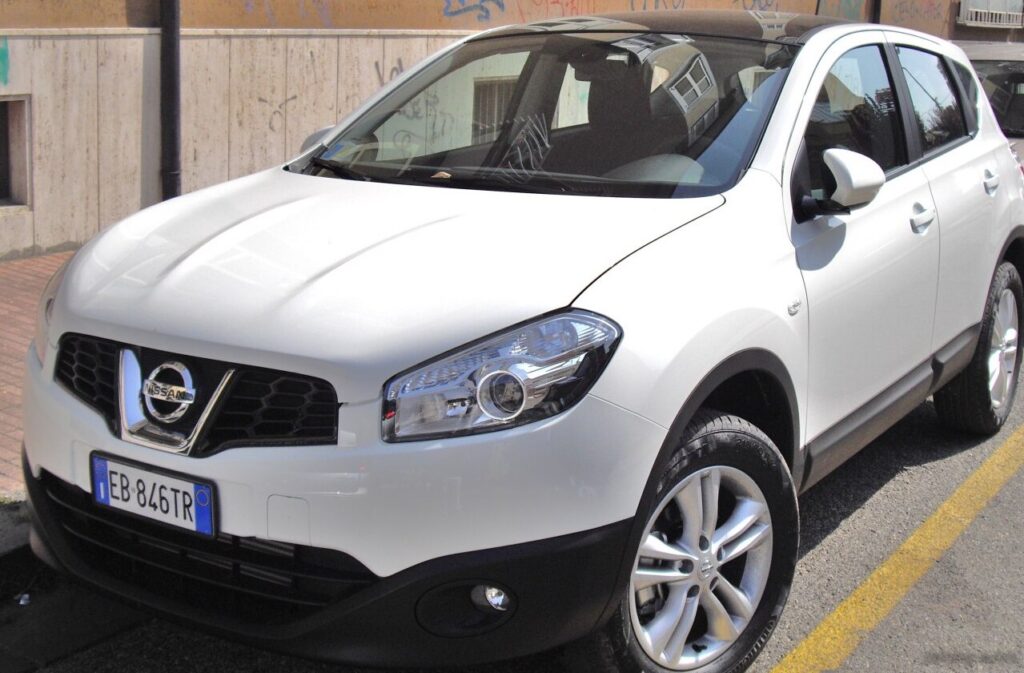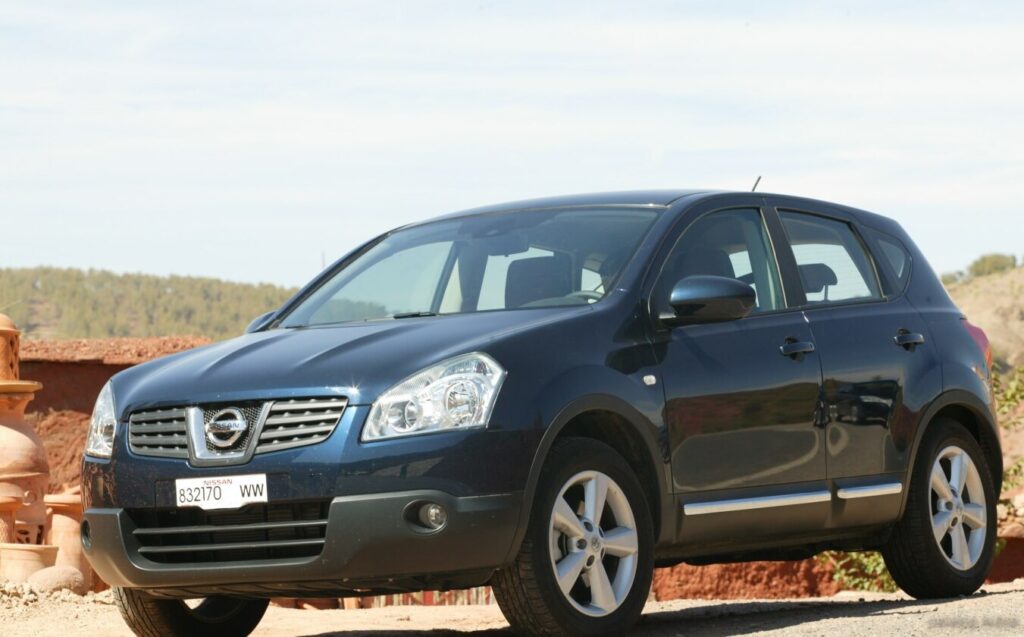
The Nissan Qashqai (known as the Dualis in some markets) was a groundbreaking vehicle when it launched in 2007, effectively creating the compact crossover segment. The first generation, designated the J10, ran from 2007 to 2010 and was a significant departure for Nissan, moving away from traditional hatchback and sedan designs. The 2.0-liter (141 hp) CVT variant occupied a mid-range position in the Qashqai lineup, offering a balance between performance and fuel efficiency, aimed at buyers seeking a comfortable and practical family vehicle. This model was primarily sold in Europe and other international markets, with limited availability in North America.
Technical Specifications
| Brand | Nissan |
| Model | Qashqai |
| Generation | Qashqai I (J10) |
| Type (Engine) | 2.0 (141 Hp) CVT |
| Start of production | 2007 |
| End of production | 2010 |
| Powertrain Architecture | Internal Combustion engine |
| Body type | SUV, Crossover |
| Seats | 5 |
| Doors | 5 |
| Fuel consumption (urban) | 10.4 l/100 km (22.6 US mpg, 27.2 UK mpg, 9.6 km/l) |
| Fuel consumption (extra urban) | 6.4 l/100 km (36.8 US mpg, 44.1 UK mpg, 15.6 km/l) |
| Fuel consumption (combined) | 7.9 l/100 km (29.8 US mpg, 35.8 UK mpg, 12.7 km/l) |
| CO2 emissions | 189 g/km |
| Fuel Type | Petrol (Gasoline) |
| Acceleration 0 – 100 km/h | 10.7 sec |
| Acceleration 0 – 62 mph | 10.7 sec |
| Acceleration 0 – 60 mph | 10.2 sec |
| Maximum speed | 180 km/h (111.85 mph) |
| Emission standard | Euro 4 |
| Weight-to-power ratio | 9.8 kg/Hp, 102.3 Hp/tonne |
| Weight-to-torque ratio | 7 kg/Nm, 142.2 Nm/tonne |
| Power | 141 Hp @ 6000 rpm |
| Power per litre | 70.6 Hp/l |
| Torque | 196 Nm @ 4800 rpm (144.56 lb.-ft. @ 4800 rpm) |
| Engine layout | Front, Transverse |
| Engine Model/Code | MR20DE |
| Engine displacement | 1997 cm3 (121.86 cu. in.) |
| Number of cylinders | 4 |
| Engine configuration | Inline |
| Cylinder Bore | 84 mm (3.31 in.) |
| Piston Stroke | 90.1 mm (3.55 in.) |
| Compression ratio | 10:1 |
| Number of valves per cylinder | 4 |
| Fuel injection system | Multi-port manifold injection |
| Engine aspiration | Naturally aspirated engine |
| Valvetrain | DOHC |
| Engine oil capacity | 4.4 l (4.65 US qt | 3.87 UK qt) |
| Coolant | 7.4 l (7.82 US qt | 6.51 UK qt) |
| Kerb Weight | 1378 kg (3037.97 lbs.) |
| Max. weight | 1960 kg (4321.06 lbs.) |
| Max load | 582 kg (1283.09 lbs.) |
| Trunk (boot) space – minimum | 410 l (14.48 cu. ft.) |
| Trunk (boot) space – maximum | 1513 l (53.43 cu. ft.) |
| Fuel tank capacity | 65 l (17.17 US gal | 14.3 UK gal) |
| Max. roof load | 75 kg (165.35 lbs.) |
| Permitted trailer load with brakes (12%) | 1200 kg (2645.55 lbs.) |
| Permitted trailer load without brakes | 685 kg (1510.17 lbs.) |
| Permitted towbar download | 75 kg (165.35 lbs.) |
| Length | 4315 mm (169.88 in.) |
| Width | 1780 mm (70.08 in.) |
| Height | 1605 mm (63.19 in.) |
| Wheelbase | 2630 mm (103.54 in.) |
| Front track | 1540 mm (60.63 in.) |
| Rear (Back) track | 1545 mm (60.83 in.) |
| Ride height (ground clearance) | 200 mm (7.87 in.) |
| Minimum turning circle (turning diameter) | 10.6 m (34.78 ft.) |
| Approach angle | 19.2° |
| Departure angle | 30.2° |
| Ramp-over (brakeover) angle | 17.0° |
| Wading depth | 350 mm (13.78 in.) |
| Drivetrain Architecture | The Internal combustion engine (ICE) drives the front wheels of the vehicle. |
| Drive wheel | Front wheel drive |
| Number of gears and type of gearbox | 1 gears, automatic transmission CVT |
| Front suspension | Independent, type McPherson with coil spring and anti-roll bar |
| Rear suspension | Independent multi-link spring suspension with stabilizer |
| Front brakes | Ventilated discs |
| Rear brakes | Disc |
| Assisting systems | ABS (Anti-lock braking system) |
| Steering type | Steering rack and pinion |
| Power steering | Electric Steering |
| Tires size | 215/65 R16; 215/60 R17 |
| Wheel rims size | 5.5J x 16; 6.5J x 17 |
INTRODUCTION
The Nissan Qashqai J10 2.0 CVT, produced between 2007 and 2010, represented a key offering in Nissan’s expanding crossover range. Built on the Nissan C platform (shared with the Renault Mégane II and other models), the Qashqai aimed to bridge the gap between traditional hatchbacks and larger SUVs. The 2.0-liter engine with a Continuously Variable Transmission (CVT) was positioned as a comfortable and refined option, appealing to families and drivers prioritizing ease of use over outright performance. It was a popular choice in Europe, where the compact crossover segment was rapidly gaining traction.
Powertrain & Engine Architecture
The heart of this Qashqai variant is the MR20DE 2.0-liter inline-four cylinder engine. This engine is a naturally aspirated unit featuring multi-point fuel injection and a double overhead camshaft (DOHC) valvetrain. The MR20DE is known for its relative reliability and smooth operation. The engine produces 141 horsepower at 6000 rpm and 196 Nm (144.56 lb-ft) of torque at 4800 rpm. Paired with this engine is a CVT (Continuously Variable Transmission), offering seamless gear changes and contributing to improved fuel economy. Nissan’s CVT design at the time utilized a belt and pulley system, providing a wide range of gear ratios to optimize engine efficiency and responsiveness. Unlike traditional automatic transmissions with fixed gears, the CVT continuously adjusts the gear ratio to keep the engine operating in its most efficient range.
Driving Characteristics
The 2.0-liter CVT Qashqai offered a comfortable and relaxed driving experience. While not particularly sporty, the CVT provided smooth acceleration and eliminated the shift shock often associated with traditional automatics. Acceleration from 0-60 mph took around 10.2 seconds, which was adequate for everyday driving but noticeably slower than versions equipped with a manual transmission or the more powerful 2.0-liter engine found in some markets. The CVT’s programming prioritized fuel efficiency, meaning the engine would often hold a lower RPM during gentle acceleration. However, pressing the accelerator firmly would cause the CVT to “downshift” (adjust the pulley ratio) and provide a more responsive feel. The steering was light and easy, making it well-suited for urban environments. The suspension provided a comfortable ride, absorbing bumps and imperfections in the road effectively.
Equipment & Trim Levels
The 2.0 CVT Qashqai typically came equipped with a reasonable level of standard features. These included air conditioning, power windows and mirrors, a CD player with auxiliary input, and ABS brakes. Higher trim levels, such as the Tekna, added features like alloy wheels, climate control, parking sensors, and a more sophisticated audio system. Interior upholstery was typically cloth, with options for leather in higher trims. Dashboard design was functional and modern for its time, with a clear instrument cluster and logically arranged controls. Optional extras included satellite navigation, a sunroof, and heated front seats.
Chassis & Braking
The Qashqai J10 utilized an independent McPherson strut suspension setup at the front and an independent multi-link suspension at the rear. This configuration provided a good balance between ride comfort and handling. Front brakes were ventilated discs, while rear brakes were solid discs. ABS (Anti-lock Braking System) was standard, enhancing safety during emergency braking situations. The Qashqai’s chassis was designed to provide a stable and predictable driving experience, with a focus on comfort rather than outright sportiness. Stabilizer bars were fitted to both the front and rear axles to reduce body roll during cornering.
Market Reception & Comparison
The Qashqai 2.0 CVT was generally well-received by automotive critics. It was praised for its comfortable ride, spacious interior, and fuel efficiency. However, some reviewers noted that the CVT could feel somewhat sluggish during hard acceleration, and the overall driving experience lacked the engagement of more sporty competitors. Compared to the 1.6-liter petrol and 1.9 dCi diesel variants, the 2.0 CVT offered more power and refinement, but at the cost of slightly higher fuel consumption. The diesel model was favored by those prioritizing fuel economy, while the 1.6 petrol was the entry-level option. The 2.0 CVT struck a balance between the two, appealing to buyers seeking a comfortable and capable crossover.
Legacy
The Nissan Qashqai J10, including the 2.0 CVT variant, proved to be a highly successful model for Nissan, establishing the brand as a major player in the crossover segment. The MR20DE engine, when properly maintained, is known for its durability and longevity. However, like all CVTs, the transmission requires regular fluid changes to prevent premature wear. On the used car market, the Qashqai J10 2.0 CVT remains a popular choice, offering a practical and affordable option for families and individuals seeking a comfortable and reliable crossover. Its enduring appeal is a testament to its well-rounded design and the overall quality of the Nissan brand.