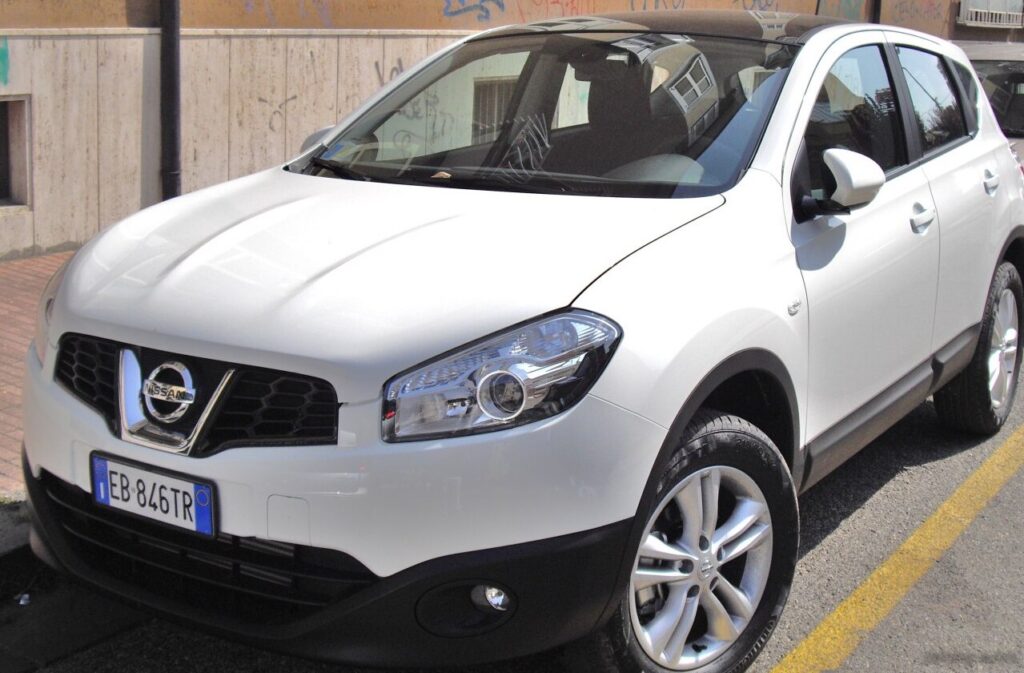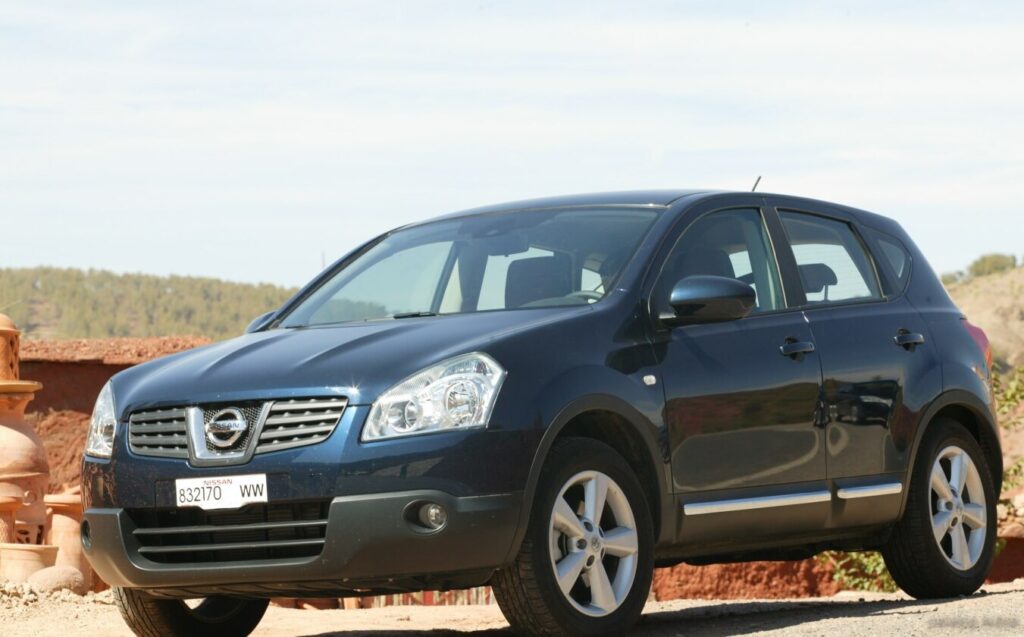
The Nissan Qashqai (known as the Dualis in some markets) represented Nissan’s entry into the burgeoning compact crossover segment in Europe. Introduced in 2007, the first generation Qashqai, internally designated the J10, aimed to blend the practicality of a hatchback with the elevated driving position and styling of an SUV. The 2.0 dCi 150 hp variant, produced from 2007 to 2010, was a key engine option, positioned as a mid-range offering that balanced performance with fuel efficiency. It played a significant role in establishing the Qashqai as a popular choice for families and individuals seeking a versatile and modern vehicle.
Technical Specifications
| Brand | Nissan |
| Model | Qashqai |
| Generation | Qashqai I (J10) |
| Type (Engine) | 2.0 dCi (150 Hp) |
| Start of production | 2007 |
| End of production | 2010 |
| Powertrain Architecture | Internal Combustion engine |
| Body type | SUV, Crossover |
| Seats | 5 |
| Doors | 5 |
| Fuel consumption (urban) | 8.6 l/100 km (27.4 US mpg, 32.8 UK mpg, 11.6 km/l) |
| Fuel consumption (extra urban) | 5.5 l/100 km (42.8 US mpg, 51.4 UK mpg, 18.2 km/l) |
| Fuel consumption (combined) | 6.6 l/100 km (35.6 US mpg, 42.8 UK mpg, 15.2 km/l) |
| CO2 emissions | 174 g/km |
| Fuel Type | Diesel |
| Acceleration 0 – 100 km/h | 10.5 sec |
| Acceleration 0 – 62 mph | 10.5 sec |
| Acceleration 0 – 60 mph | 10 sec |
| Maximum speed | 191 km/h (118.68 mph) |
| Emission standard | Euro 4 |
| Weight-to-power ratio | 9.6 kg/Hp, 103.8 Hp/tonne |
| Weight-to-torque ratio | 4.5 kg/Nm, 221.5 Nm/tonne |
| Power | 150 Hp @ 4000 rpm |
| Power per litre | 75.2 Hp/l |
| Torque | 320 Nm @ 2000 rpm (236.02 lb.-ft. @ 2000 rpm) |
| Engine layout | Front, Transverse |
| Engine Model/Code | M9R |
| Engine displacement | 1995 cm3 (121.74 cu. in.) |
| Number of cylinders | 4 |
| Engine configuration | Inline |
| Cylinder Bore | 84 mm (3.31 in.) |
| Piston Stroke | 90 mm (3.54 in.) |
| Number of valves per cylinder | 4 |
| Fuel injection system | Diesel Commonrail |
| Engine aspiration | Turbocharger, Intercooler |
| Valvetrain | OHC |
| Engine oil capacity | 7.4 l (7.82 US qt | 6.51 UK qt) |
| Coolant | 8.4 l (8.88 US qt | 7.39 UK qt) |
| Kerb Weight | 1445 kg (3185.68 lbs.) |
| Max. weight | 2085 kg (4596.64 lbs.) |
| Max load | 640 kg (1410.96 lbs.) |
| Trunk (boot) space – minimum | 410 l (14.48 cu. ft.) |
| Trunk (boot) space – maximum | 1513 l (53.43 cu. ft.) |
| Fuel tank capacity | 65 l (17.17 US gal | 14.3 UK gal) |
| Max. roof load | 75 kg (165.35 lbs.) |
| Permitted trailer load with brakes (12%) | 1400 kg (3086.47 lbs.) |
| Permitted trailer load without brakes | 740 kg (1631.42 lbs.) |
| Permitted towbar download | 75 kg (165.35 lbs.) |
| Length | 4315 mm (169.88 in.) |
| Width | 1780 mm (70.08 in.) |
| Height | 1605 mm (63.19 in.) |
| Wheelbase | 2630 mm (103.54 in.) |
| Front track | 1540 mm (60.63 in.) |
| Rear (Back) track | 1545 mm (60.83 in.) |
| Ride height (ground clearance) | 200 mm (7.87 in.) |
| Minimum turning circle | 10.6 m (34.78 ft.) |
| Approach angle | 19.2° |
| Departure angle | 30.2° |
| Ramp-over angle | 17.0° |
| Wading depth | 350 mm (13.78 in.) |
| Drivetrain Architecture | Front wheel drive |
| Number of gears and type of gearbox | 6 gears, manual transmission |
| Front suspension | Independent, type McPherson with coil spring and anti-roll bar |
| Rear suspension | Independent multi-link spring suspension with stabilizer |
| Front brakes | Ventilated discs |
| Rear brakes | Disc |
| Assisting systems | ABS (Anti-lock braking system) |
| Steering type | Steering rack and pinion |
| Power steering | Electric Steering |
| Tires size | 215/65 R16; 215/60 R17 |
| Wheel rims size | 5.5J x 16; 6.5J x 17 |
INTRODUCTION
The Nissan Qashqai J10 2.0 dCi 150 hp, launched in 2007, was a significant model within the Qashqai range. It occupied a middle ground in the lineup, offering a step up in performance from the 1.6 dCi engine while remaining more affordable than the top-tier options. Built on the Nissan/Renault CMF (Common Module Family) platform, the Qashqai aimed to provide a comfortable and practical driving experience with a focus on fuel efficiency. This variant was particularly popular in European markets where diesel engines were favored for their economy and torque.
Powertrain & Engine Architecture
The heart of the Qashqai 2.0 dCi is the M9R engine, a 1995cc inline-four cylinder diesel. This engine utilizes a second-generation common rail direct injection system, delivering fuel at extremely high pressure for improved combustion efficiency and reduced emissions. The M9R engine features a single overhead camshaft (OHC) design and is equipped with a turbocharger and intercooler to boost power output. The 150 hp version of the M9R was a refinement of earlier iterations, offering improved refinement and responsiveness. The engine’s torque output of 320 Nm (236 lb-ft) at 2000 rpm provided strong pulling power, making it suitable for both urban driving and highway cruising. The Qashqai 2.0 dCi typically came paired with a six-speed manual transmission, although a continuously variable transmission (CVT) was also available as an option. The CVT aimed to improve fuel economy and provide smoother acceleration, but was often criticized for its ‘rubber band’ feel and lack of driver engagement.
Driving Characteristics
The Qashqai 2.0 dCi 150 hp offered a noticeable improvement in performance compared to the lower-powered engine options. Acceleration from 0-60 mph took around 10 seconds, which was respectable for a crossover of its size. The engine’s strong torque delivery meant that it felt responsive in everyday driving situations, with ample power for overtaking and climbing hills. The six-speed manual transmission allowed drivers to make the most of the engine’s powerband, while the optional CVT provided a more relaxed driving experience. However, the CVT often felt less connected to the engine, and some drivers preferred the more direct feel of the manual gearbox. The Qashqai’s suspension provided a comfortable ride, absorbing bumps and imperfections in the road well. The steering was light and easy to use, making it well-suited for urban driving.
Equipment & Trim Levels
The Qashqai 2.0 dCi 150 hp was typically offered in mid-range trim levels, such as Acenta and Tekna. Standard equipment often included air conditioning, electric windows, a CD player, and alloy wheels. Higher trim levels added features such as climate control, a panoramic sunroof, leather upholstery, and a navigation system. Safety features included ABS, electronic brakeforce distribution (EBD), and front and side airbags. Optional extras included parking sensors, a rear-view camera, and a premium sound system.
Chassis & Braking
The Qashqai J10 featured independent suspension all around, with a McPherson strut setup at the front and a multi-link setup at the rear. This provided a good balance between ride comfort and handling. The front brakes were ventilated discs, while the rear brakes were solid discs. ABS (Anti-lock Braking System) was standard, providing enhanced braking performance in emergency situations. The Qashqai’s chassis was designed to provide a stable and predictable driving experience, with minimal body roll in corners.
Market Reception & Comparison
The Nissan Qashqai 2.0 dCi 150 hp was generally well-received by critics and buyers alike. It was praised for its comfortable ride, spacious interior, and fuel efficiency. Compared to other crossovers in its class, such as the Renault Kadjar and the Kia Sportage, the Qashqai offered a compelling combination of practicality, style, and value. The 2.0 dCi engine was considered a good compromise between performance and economy, although some reviewers noted that the CVT transmission could feel sluggish. Fuel economy was a strong point, with combined figures of around 35.6 US mpg.
Legacy
The Nissan Qashqai J10 2.0 dCi 150 hp remains a popular choice in the used car market. The M9R engine is generally considered to be reliable, although it is important to ensure that it has been properly maintained. Common issues include turbocharger failure and injector problems, but these are relatively rare. The Qashqai’s spacious interior and comfortable ride continue to appeal to buyers looking for a practical and versatile crossover. Its success paved the way for the second-generation Qashqai, which built upon the strengths of the original model and further cemented its position as a leading player in the compact crossover segment.