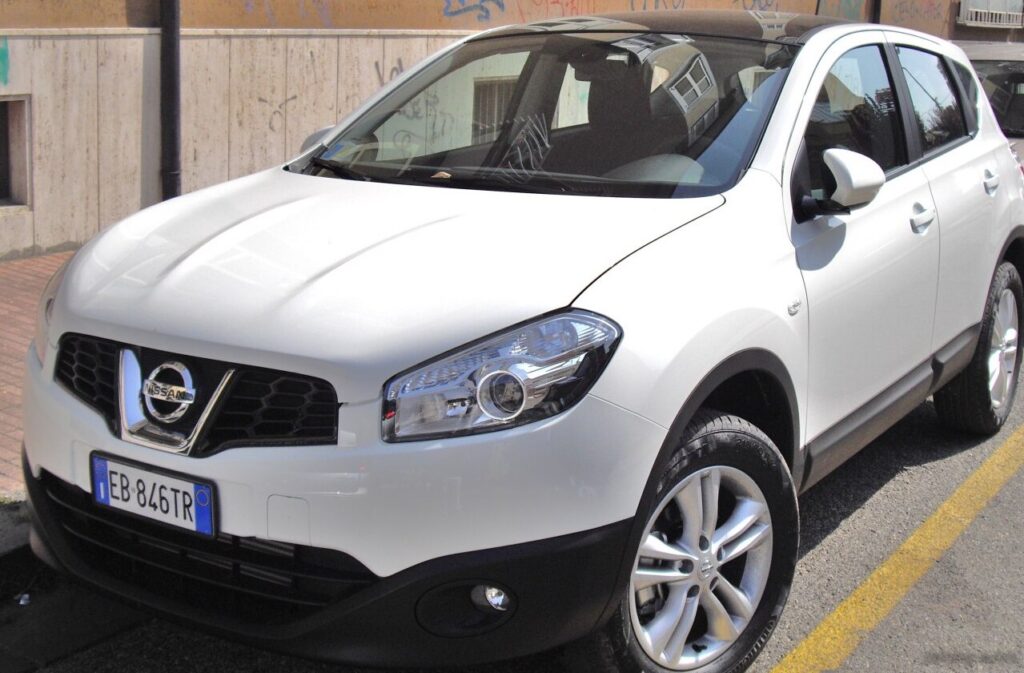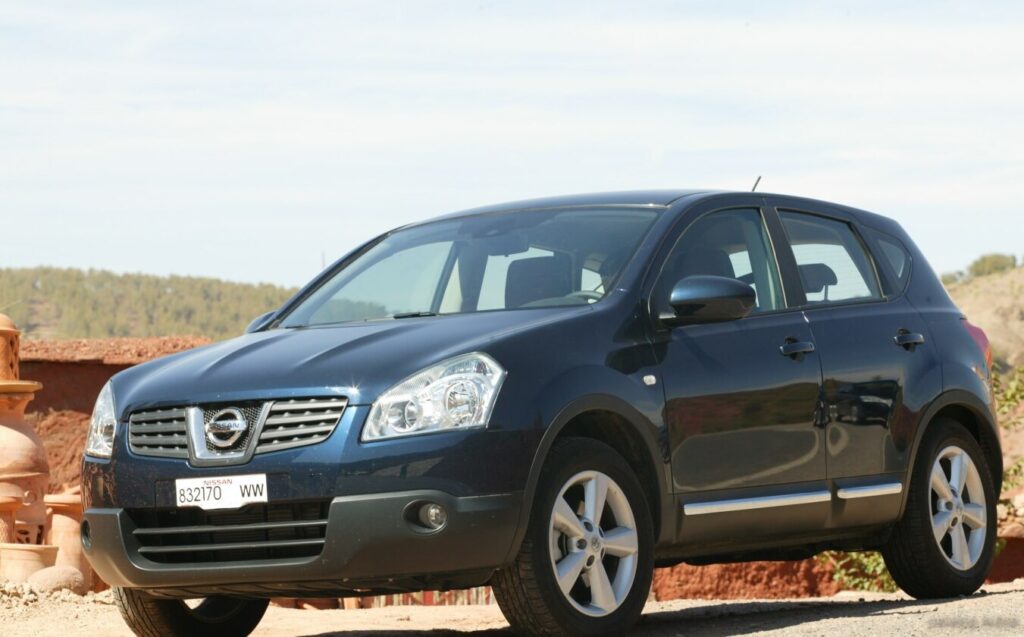
The Nissan Qashqai (known as the Dualis in some markets) represented Nissan’s entry into the burgeoning compact crossover segment in 2007. The J10 series, the first generation, was designed to bridge the gap between traditional hatchbacks and larger SUVs, offering a more practical and fuel-efficient alternative. Production of the 2.0 dCi 150 hp 4×4 variant ran from 2007 to 2010, and it occupied a mid-to-high position within the Qashqai lineup, appealing to buyers seeking enhanced performance and all-weather capability. This model was particularly significant in the European market, where demand for compact crossovers with diesel engines and all-wheel drive was strong.
Technical Specifications
| Brand | Nissan |
| Model | Qashqai |
| Generation | Qashqai I (J10) |
| Type (Engine) | 2.0 dCi (150 Hp) 4×4 |
| Start of production | 2007 |
| End of production | 2010 |
| Powertrain Architecture | Internal Combustion engine |
| Body type | SUV, Crossover |
| Seats | 5 |
| Doors | 5 |
| Fuel consumption (urban) | 8.7 l/100 km (27 US mpg, 32.5 UK mpg, 11.5 km/l) |
| Fuel consumption (extra urban) | 5.9 l/100 km (39.9 US mpg, 47.9 UK mpg, 16.9 km/l) |
| Fuel consumption (combined) | 6.9 l/100 km (34.1 US mpg, 40.9 UK mpg, 14.5 km/l) |
| CO2 emissions | 184 g/km |
| Fuel Type | Diesel |
| Acceleration 0 – 100 km/h | 10.9 sec |
| Acceleration 0 – 62 mph | 10.9 sec |
| Acceleration 0 – 60 mph | 10.4 sec |
| Maximum speed | 190 km/h (118.06 mph) |
| Emission standard | Euro 4 |
| Weight-to-power ratio | 10 kg/Hp, 100.5 Hp/tonne |
| Weight-to-torque ratio | 4.7 kg/Nm, 214.3 Nm/tonne |
| Power | 150 Hp @ 4000 rpm |
| Torque | 320 Nm @ 2000 rpm (236.02 lb.-ft. @ 2000 rpm) |
| Engine layout | Front, Transverse |
| Engine Model/Code | M9R |
| Engine displacement | 1995 cm3 (121.74 cu. in.) |
| Number of cylinders | 4 |
| Engine configuration | Inline |
| Cylinder Bore | 84 mm (3.31 in.) |
| Piston Stroke | 90 mm (3.54 in.) |
| Number of valves per cylinder | 4 |
| Fuel injection system | Diesel Commonrail |
| Engine aspiration | Turbocharger, Intercooler |
| Valvetrain | OHC |
| Engine oil capacity | 7.4 l (7.82 US qt | 6.51 UK qt) |
| Coolant | 8.4 l (8.88 US qt | 7.39 UK qt) |
| Kerb Weight | 1493 kg (3291.5 lbs.) |
| Max. weight | 2085 kg (4596.64 lbs.) |
| Max load | 592 kg (1305.14 lbs.) |
| Trunk (boot) space – minimum | 410 l (14.48 cu. ft.) |
| Trunk (boot) space – maximum | 1513 l (53.43 cu. ft.) |
| Fuel tank capacity | 65 l (17.17 US gal | 14.3 UK gal) |
| Max. roof load | 75 kg (165.35 lbs.) |
| Permitted trailer load with brakes (12%) | 1400 kg (3086.47 lbs.) |
| Permitted trailer load without brakes | 740 kg (1631.42 lbs.) |
| Permitted towbar download | 75 kg (165.35 lbs.) |
| Length | 4315 mm (169.88 in.) |
| Width | 1780 mm (70.08 in.) |
| Height | 1605 mm (63.19 in.) |
| Wheelbase | 2630 mm (103.54 in.) |
| Front track | 1540 mm (60.63 in.) |
| Rear (Back) track | 1545 mm (60.83 in.) |
| Ride height (ground clearance) | 200 mm (7.87 in.) |
| Minimum turning circle (turning diameter) | 10.6 m (34.78 ft.) |
| Approach angle | 19.2° |
| Departure angle | 30.2° |
| Ramp-over (brakeover) angle | 17.0° |
| Wading depth | 350 mm (13.78 in.) |
| Drive wheel | All wheel drive (4×4) |
| Number of gears and type of gearbox | 6 gears, manual transmission |
| Front suspension | Independent, type McPherson with coil spring and anti-roll bar |
| Rear suspension | Independent multi-link spring suspension with stabilizer |
| Front brakes | Ventilated discs |
| Rear brakes | Disc |
| Assisting systems | ABS (Anti-lock braking system) |
| Steering type | Steering rack and pinion |
| Power steering | Electric Steering |
| Tires size | 215/65 R16; 215/60 R17 |
| Wheel rims size | 5.5J x 16; 6.5J x 17 |
Powertrain & Engine Architecture
The heart of the Qashqai 2.0 dCi 4×4 is the M9R engine, a 2.0-liter inline-four cylinder diesel. This engine was a product of the Renault-Nissan Alliance and was widely used in various models across both brands. The M9R featured a cast iron block and aluminum cylinder head, incorporating a turbocharger with an intercooler to boost power and efficiency. Fuel was delivered via a second-generation common rail direct injection system, allowing for precise fuel metering and improved combustion. The engine utilized an overhead camshaft (OHC) valvetrain with four valves per cylinder. The 150 horsepower output was achieved at 4000 rpm, while the substantial 320 Nm (236 lb-ft) of torque was available from just 2000 rpm, providing strong low-end and mid-range acceleration. The engine was paired with a six-speed manual transmission, optimized for both fuel economy and drivability.
Driving Characteristics
The 2.0 dCi 4×4 Qashqai offered a noticeable step up in performance compared to the lower-powered 1.6 dCi variants. The increased torque made overtaking and hill climbing significantly easier. While not a sports car, the Qashqai provided adequate acceleration, reaching 60 mph in around 10.4 seconds. The all-wheel-drive system, Nissan’s electronically controlled 4×4, provided enhanced traction in slippery conditions, making it a capable vehicle for year-round use. The six-speed gearbox was well-matched to the engine’s characteristics, offering smooth shifts and allowing the driver to keep the engine in its optimal power band. Compared to the 1.6 dCi, the 2.0 dCi felt more relaxed on the highway, with less need for frequent gear changes.
Equipment & Trim Levels
The 2.0 dCi 4×4 typically came with a generous level of standard equipment. This included air conditioning, electric windows and mirrors, a CD player with auxiliary input, and alloy wheels. Higher trim levels, such as the Tekna, added features like automatic climate control, rain-sensing wipers, a panoramic sunroof, and leather upholstery. Safety features included ABS, electronic brakeforce distribution (EBD), and multiple airbags. Optional extras included satellite navigation, parking sensors, and a premium sound system.
Chassis & Braking
The Qashqai J10 utilized a McPherson strut front suspension and a multi-link rear suspension, providing a comfortable ride and good handling characteristics. The all-wheel-drive system added to the vehicle’s stability, particularly in adverse weather conditions. The braking system consisted of ventilated discs on the front wheels and solid discs on the rear. ABS was standard, providing enhanced braking control. The steering was electrically assisted, offering a light and precise feel.
Market Reception & Comparison
The Qashqai 2.0 dCi 4×4 was generally well-received by automotive critics. It was praised for its spacious interior, comfortable ride, and strong performance. The all-wheel-drive system was seen as a valuable asset, particularly in regions with harsh winters. Compared to other compact crossovers, such as the Volkswagen Tiguan and the Mitsubishi Outlander, the Qashqai offered a competitive combination of price, features, and fuel economy. The 2.0 dCi engine provided better performance than the smaller 1.6 dCi, but it also came with slightly higher running costs.
Legacy
The Nissan Qashqai J10, particularly the 2.0 dCi 4×4 variant, proved to be a popular and reliable vehicle. The M9R engine, while not without its potential issues (such as timing chain wear), generally proved durable with regular maintenance. Today, used examples of the Qashqai J10 are readily available and represent a relatively affordable entry point into the compact crossover segment. The 2.0 dCi 4×4 remains a desirable option for buyers seeking a practical, capable, and fuel-efficient vehicle.