Technical Specifications
| Brand | Nissan |
| Model | Qashqai |
| Generation | Qashqai I (J10, facelift 2010) |
| Type (Engine) | 1.6 (117 Hp) |
| Start of production | 2010 |
| End of production | 2014 |
| Powertrain Architecture | Internal Combustion engine |
| Body type | SUV, Crossover |
| Seats | 5 |
| Doors | 5 |
| Fuel consumption (urban) | 7.9 l/100 km (29.8 US mpg, 35.8 UK mpg, 12.7 km/l) |
| Fuel consumption (extra urban) | 5.2 l/100 km (45.2 US mpg, 54.3 UK mpg, 19.2 km/l) |
| Fuel consumption (combined) | 6.2 l/100 km (37.9 US mpg, 45.6 UK mpg, 16.1 km/l) |
| CO2 emissions | 144 g/km |
| Fuel Type | Petrol (Gasoline) |
| Acceleration 0 – 100 km/h | 11.9 sec |
| Acceleration 0 – 62 mph | 11.9 sec |
| Acceleration 0 – 60 mph | 11.3 sec |
| Maximum speed | 181 km/h (112.47 mph) |
| Emission standard | Euro 5 |
| Weight-to-power ratio | 11.1 kg/Hp, 90.2 Hp/tonne |
| Weight-to-torque ratio | 8.2 kg/Nm, 121.8 Nm/tonne |
| Power | 117 Hp @ 6000 rpm |
| Power per litre | 73.2 Hp/l |
| Torque | 158 Nm @ 4400 rpm (116.53 lb.-ft. @ 4400 rpm) |
| Engine layout | Front, Transverse |
| Engine Model/Code | HR16DE |
| Engine displacement | 1598 cm3 (97.52 cu. in.) |
| Number of cylinders | 4 |
| Cylinder Bore | 78 mm (3.07 in.) |
| Piston Stroke | 83.5 mm (3.29 in.) |
| Compression ratio | 10.7:1 |
| Number of valves per cylinder | 4 |
| Fuel injection system | Multi-port manifold injection |
| Engine aspiration | Naturally aspirated engine |
| Engine oil capacity | 4.3 l (4.54 US qt | 3.78 UK qt) |
| Coolant | 6.4 l (6.76 US qt | 5.63 UK qt) |
| Kerb Weight | 1297-1392 kg (2859.4 – 3068.83 lbs.) |
| Max. weight | 1830 kg (4034.46 lbs.) |
| Max load | 438-533 kg (965.62 – 1175.06 lbs.) |
| Trunk (boot) space – minimum | 410 l (14.48 cu. ft.) |
| Trunk (boot) space – maximum | 1513 l (53.43 cu. ft.) |
| Fuel tank capacity | 65 l (17.17 US gal | 14.3 UK gal) |
| Max. roof load | 75 kg (165.35 lbs.) |
| Permitted trailer load with brakes (12%) | 1200 kg (2645.55 lbs.) |
| Permitted trailer load without brakes | 685 kg (1510.17 lbs.) |
| Permitted towbar download | 75 kg (165.35 lbs.) |
| Length | 4330 mm (170.47 in.) |
| Width | 1780 mm (70.08 in.) |
| Width including mirrors | 2120 mm (83.46 in.) |
| Height | 1615-1622 mm (63.58 – 63.86 in.) |
| Wheelbase | 2630 mm (103.54 in.) |
| Front track | 1540 mm (60.63 in.) |
| Rear (Back) track | 1550 mm (61.02 in.) |
| Minimum turning circle | 10.6 m (34.78 ft.) |
| Drivetrain Architecture | The Internal combustion engine (ICE) drives the front wheels of the vehicle. |
| Drive wheel | Front wheel drive |
| Number of gears and type of gearbox | 5 gears, manual transmission |
| Front suspension | Independent, type McPherson with coil spring and anti-roll bar |
| Rear suspension | Independent multi-link spring suspension with stabilizer |
| Front brakes | Ventilated discs |
| Rear brakes | Disc |
| Assisting systems | ABS (Anti-lock braking system) |
| Steering type | Steering rack and pinion |
| Power steering | Electric Steering |
| Tires size | 215/65 R16; 215/60 R17; 215/55 R18 |
| Wheel rims size | 6.5J x 16; 6.5J x 17; 6.5J x 18 |
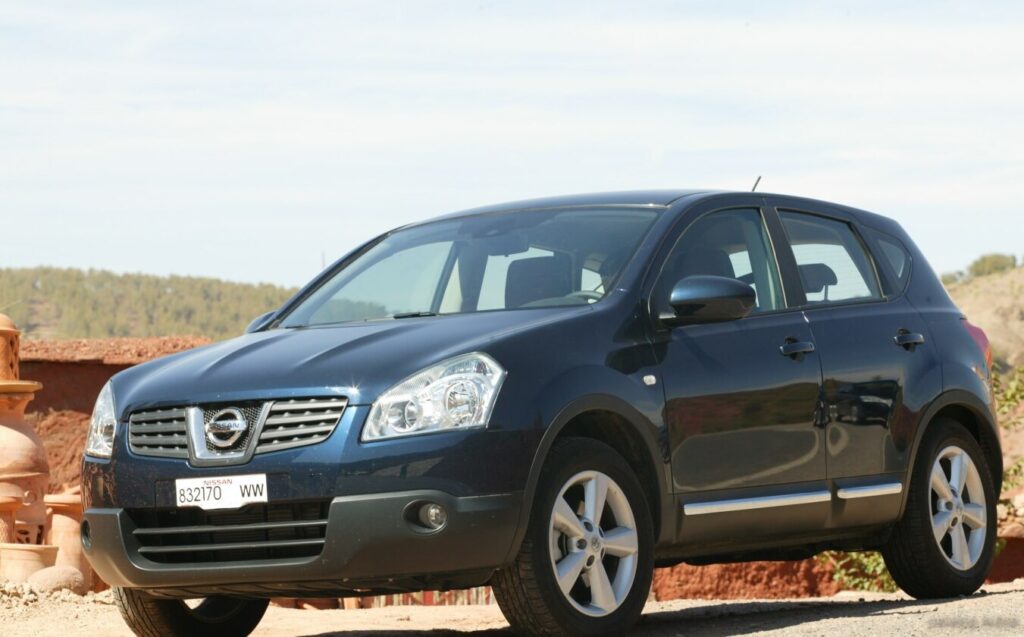
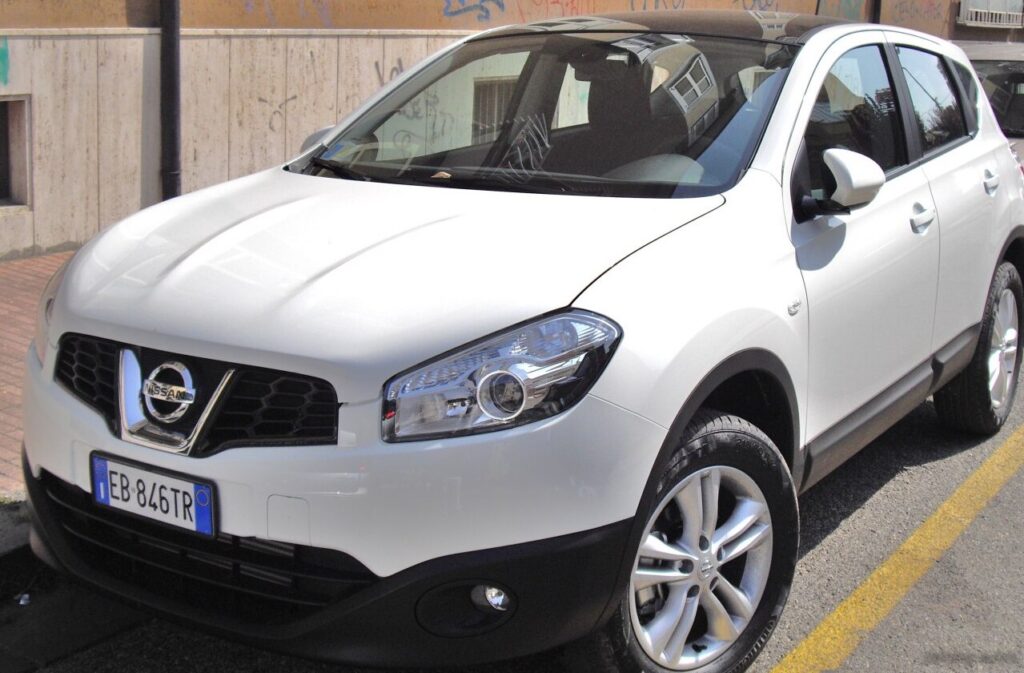
The Nissan Qashqai I (J10) facelift, launched in 2010, brought revised styling, improved interior materials, and updated engine options to Nissan’s popular crossover. The 1.6-liter engine, producing 117 horsepower, was positioned as the entry point to the Qashqai range. It aimed to attract buyers seeking a practical and affordable family vehicle with reasonable fuel economy. This variant was typically offered with a five-speed manual transmission, though a continuously variable transmission (CVT) was also available in some markets. The Qashqai, unlike many of its Japanese competitors, was designed and engineered primarily for the European market, and production was concentrated in the UK and Spain.
Powertrain & Engine Architecture
The 1.6-liter engine in the Qashqai is designated the HR16DE. This is a naturally aspirated, four-cylinder engine with a displacement of 1598cc. It features multi-point fuel injection and a double overhead camshaft (DOHC) valvetrain with four valves per cylinder. The HR16DE is known for its relatively simple design and robust construction. The engine’s 117 horsepower peak is achieved at 6000 rpm, while its 158 Nm (116.53 lb-ft) of torque is delivered at 4400 rpm. The five-speed manual transmission used in this variant offers a conventional gear layout, prioritizing fuel efficiency over sporty acceleration. The optional CVT, while providing smoother acceleration, was sometimes criticized for its “rubber band” feel and perceived lack of responsiveness.
Driving Characteristics
The Qashqai 1.6 (117 hp) offered a comfortable, if not particularly exhilarating, driving experience. Acceleration from 0-60 mph took around 11.3 seconds, making it slower than higher-powered Qashqai variants like the 1.5 dCi diesel or the 2.0-liter petrol. The engine felt adequate for everyday driving, but struggled when fully loaded or tackling steep inclines. The five-speed manual transmission was well-matched to the engine’s characteristics, providing reasonable control and allowing the driver to keep the engine in its optimal power band. The steering was light and precise, making the Qashqai easy to maneuver in urban environments. Overall, the driving experience was geared towards comfort and practicality rather than performance.
Equipment & Trim Levels
The 1.6-liter Qashqai typically came equipped with a reasonable level of standard equipment. This included air conditioning, electric front windows, a CD player with auxiliary input, and ABS brakes. Higher trim levels, such as Visia, Acenta, and Tekna, added features like alloy wheels, climate control, rear parking sensors, and a touchscreen infotainment system. Interior upholstery was typically cloth, with options for upgraded materials on higher trims. Safety features included multiple airbags and stability control. Optional extras included a panoramic sunroof, leather seats, and a navigation system.
Chassis & Braking
The Qashqai’s chassis featured independent suspension all around, with a McPherson strut setup at the front and a multi-link arrangement at the rear. This provided a comfortable ride quality, absorbing bumps and imperfections in the road surface effectively. Front brakes were ventilated discs, while rear brakes were solid discs. The steering was rack and pinion with electric power assistance. The Qashqai’s weight, ranging from 1297 to 1392 kg (2859.4 – 3068.83 lbs.), contributed to its moderate handling characteristics. Stabilizer bars were fitted to both the front and rear axles to reduce body roll during cornering.
Market Reception & Comparison
The Qashqai 1.6 (117 hp) was generally well-received by critics as a practical and affordable crossover. However, some reviewers noted its lack of outright performance compared to other engines in the range. Fuel economy was a strong point, with combined figures around 37.9 US mpg. Compared to the 1.5 dCi diesel, the 1.6-liter petrol offered less torque and lower fuel economy, but was generally cheaper to purchase. The 2.0-liter petrol provided more power but at the expense of fuel efficiency. The Qashqai competed with other compact crossovers such as the Kia Sportage, Hyundai ix35, and Renault Kadjar.
Legacy
The Nissan Qashqai I, including the 1.6-liter variant, proved to be a highly successful model for Nissan, establishing the brand as a major player in the European crossover market. The HR16DE engine, while not known for being particularly groundbreaking, is generally considered to be a reliable unit with relatively low maintenance costs. Used examples of the Qashqai 1.6 are still readily available today, offering a budget-friendly option for buyers seeking a practical and versatile family vehicle. Common issues reported with these vehicles include worn suspension components and occasional problems with the electronic parking brake. Overall, the Qashqai 1.6 remains a popular choice in the used car market due to its affordability, practicality, and relatively good reliability.