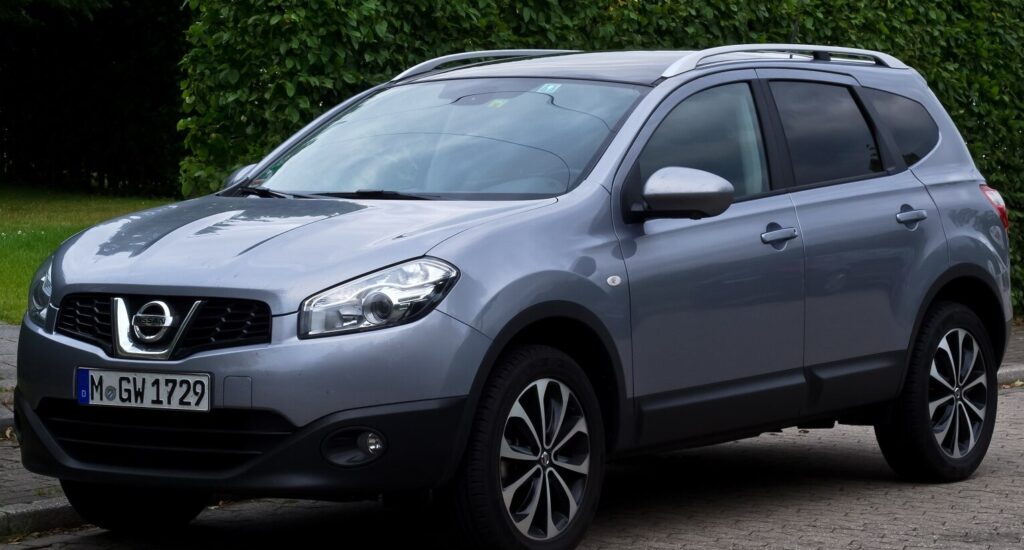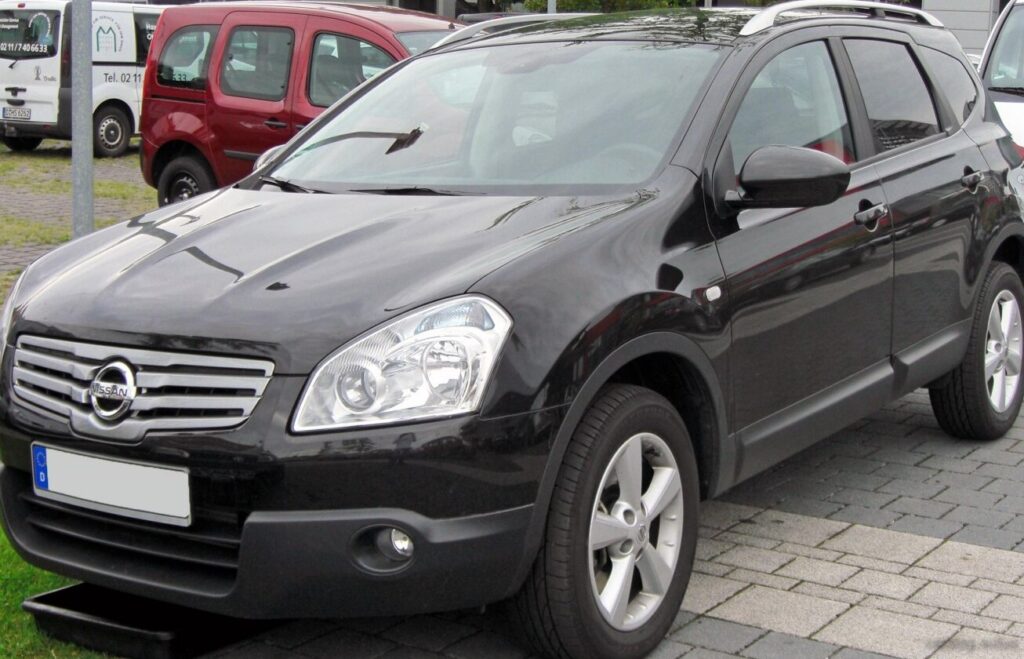
The Nissan Qashqai+2 (NJ10) 2.0 dCi 150 hp 4×4, produced from 2008 to 2010, represented a significant expansion of the popular Qashqai range. Designed to appeal to families needing more space, the “+2” variant added a third row of seats, increasing passenger capacity to seven. This model occupied a unique position within the Qashqai lineup, offering all-wheel drive capability and a more powerful diesel engine option for those seeking enhanced practicality and performance. It was primarily marketed in Europe, where compact crossovers with seven-seat options were gaining traction, offering a more affordable alternative to larger SUVs.
Technical Specifications
| Brand | Nissan |
| Model | Qashqai |
| Generation | Qashqai+2 I (NJ10) |
| Type (Engine) | 2.0 dCi (150 Hp) 4×4 |
| Start of production | 2008 |
| End of production | 2010 |
| Powertrain Architecture | Internal Combustion engine |
| Body type | SUV, Crossover |
| Seats | 7 |
| Doors | 5 |
| Fuel consumption (urban) | 8.9 l/100 km (26.4 US mpg, 31.7 UK mpg, 11.2 km/l) |
| Fuel consumption (extra urban) | 5.9 l/100 km (39.9 US mpg, 47.9 UK mpg, 16.9 km/l) |
| Fuel consumption (combined) | 7 l/100 km (33.6 US mpg, 40.4 UK mpg, 14.3 km/l) |
| CO2 emissions | 188 g/km |
| Fuel Type | Diesel |
| Acceleration 0 – 100 km/h | 11.3 sec |
| Acceleration 0 – 62 mph | 11.3 sec |
| Acceleration 0 – 60 mph | 10.7 sec |
| Maximum speed | 189 km/h (117.44 mph) |
| Emission standard | Euro 4 |
| Weight-to-power ratio | 11.3 kg/Hp, 88.4 Hp/tonne |
| Weight-to-torque ratio | 5.3 kg/Nm, 188.7 Nm/tonne |
| Power | 150 Hp @ 4000 rpm |
| Power per litre | 75.2 Hp/l |
| Torque | 320 Nm @ 2000 rpm (236.02 lb.-ft. @ 2000 rpm) |
| Engine layout | Front, Transverse |
| Engine Model/Code | M9R |
| Engine displacement | 1995 cm3 (121.74 cu. in.) |
| Number of cylinders | 4 |
| Engine configuration | Inline |
| Cylinder Bore | 84 mm (3.31 in.) |
| Piston Stroke | 90 mm (3.54 in.) |
| Compression ratio | 15.6:1 |
| Number of valves per cylinder | 4 |
| Fuel injection system | Diesel Commonrail |
| Engine aspiration | Turbocharger, Intercooler |
| Valvetrain | DOHC |
| Engine oil capacity | 7.4 l (7.82 US qt | 6.51 UK qt) |
| Coolant | 8.4 l (8.88 US qt | 7.39 UK qt) |
| Kerb Weight | 1696 kg (3739.04 lbs.) |
| Max. weight | 2320 kg (5114.72 lbs.) |
| Max load | 624 kg (1375.68 lbs.) |
| Trunk (boot) space – minimum | 130 l (4.59 cu. ft.) |
| Trunk (boot) space – maximum | 1520 l (53.68 cu. ft.) |
| Fuel tank capacity | 65 l (17.17 US gal | 14.3 UK gal) |
| Max. roof load | 75 kg (165.35 lbs.) |
| Permitted trailer load with brakes (12%) | 1400 kg (3086.47 lbs.) |
| Permitted trailer load without brakes | 750 kg (1653.47 lbs.) |
| Permitted towbar download | 75 kg (165.35 lbs.) |
| Length | 4530 mm (178.35 in.) |
| Width | 1780 mm (70.08 in.) |
| Height | 1645 mm (64.76 in.) |
| Wheelbase | 2765 mm (108.86 in.) |
| Front track | 1540 mm (60.63 in.) |
| Rear (Back) track | 1550 mm (61.02 in.) |
| Minimum turning circle | 11 m (36.09 ft.) |
| Drivetrain Architecture | All wheel drive (4×4). Internal Combustion engine. |
| Drive wheel | All wheel drive (4×4) |
| Number of gears and type of gearbox | 6 gears, manual transmission |
| Front suspension | Independent, type McPherson with coil spring and anti-roll bar |
| Rear suspension | Independent multi-link spring suspension with stabilizer |
| Front brakes | Ventilated discs |
| Rear brakes | Disc |
| Assisting systems | ABS (Anti-lock braking system) |
| Steering type | Steering rack and pinion |
| Power steering | Electric Steering |
| Tires size | 215/65 R16; 215/60 R17 |
| Wheel rims size | 5.5J x 16; 6.5J x 17 |
Powertrain & Engine Architecture
The heart of the Qashqai+2 2.0 dCi 4×4 is the M9R engine, a 2.0-liter inline-four cylinder diesel. This engine was a key component of Renault-Nissan’s alliance and was used in a variety of vehicles across both brands. The M9R features a cast iron block and aluminum cylinder head, incorporating a turbocharger with an intercooler to boost power and efficiency. Fuel is delivered via a second-generation common rail direct injection system, allowing for precise fuel metering and improved combustion. The engine produces 150 horsepower at 4000 rpm and 320 Nm (236 lb-ft) of torque at 2000 rpm. The all-wheel-drive system utilizes a viscous coupling to distribute torque between the front and rear axles as needed, providing enhanced traction in slippery conditions. The standard transmission was a six-speed manual gearbox, offering a good balance between fuel economy and driver control.
Driving Characteristics
The 2.0 dCi engine provided a noticeable performance upgrade over the lower-powered 1.5 dCi variants. While not a sports car, the Qashqai+2 2.0 dCi 4×4 offered adequate acceleration for everyday driving and highway cruising. The 0-60 mph time was around 10.7 seconds. The six-speed manual transmission allowed drivers to keep the engine in its optimal power band, while the all-wheel-drive system inspired confidence on varied road surfaces. The added weight of the third row of seats and the 4×4 system did slightly impact handling compared to the standard Qashqai, but the suspension remained reasonably well-controlled. The gear ratios were tuned for fuel efficiency, but still provided enough grunt for overtaking maneuvers.
Equipment & Trim Levels
The Qashqai+2 2.0 dCi 4×4 typically came with a reasonably well-equipped specification. Standard features included air conditioning, electric front and rear windows, remote central locking, and a CD player with auxiliary input. Higher trim levels, such as the Tekna, added features like automatic climate control, rain-sensing wipers, a panoramic sunroof, and leather upholstery. Safety features included ABS, electronic brakeforce distribution (EBD), and front and side airbags. Optional extras included satellite navigation, parking sensors, and a premium audio system.
Chassis & Braking
The Qashqai+2 utilized a McPherson strut front suspension and a multi-link rear suspension, providing a comfortable ride and decent handling. The all-wheel-drive system added to the vehicle’s weight, necessitating slightly firmer spring rates and dampers. Braking duties were handled by ventilated discs at the front and solid discs at the rear. ABS was standard, providing enhanced stopping power and stability in emergency braking situations. The steering was electrically assisted, offering a light and precise feel.
Market Reception & Comparison
The Qashqai+2 2.0 dCi 4×4 was generally well-received by automotive critics. It was praised for its practicality, spacious interior, and capable all-wheel-drive system. However, some reviewers noted that the third row of seats was best suited for children or short journeys. Compared to the 1.5 dCi variants, the 2.0 dCi offered significantly more power and torque, making it a better choice for those who frequently carried passengers or towed trailers. Fuel economy was respectable, averaging around 33.6 US mpg in combined driving. Reliability was generally good, although some owners reported issues with the diesel particulate filter (DPF).
Legacy
The Nissan Qashqai+2 2.0 dCi 4×4 remains a popular choice in the used car market. The M9R engine, while capable, requires regular maintenance, particularly regarding the DPF system. Vehicles with a well-documented service history are highly sought after. The Qashqai+2’s combination of practicality, space, and all-wheel-drive capability continues to appeal to families seeking a versatile and affordable crossover SUV. Its impact lies in demonstrating the viability of a seven-seat compact crossover, paving the way for similar models from other manufacturers.