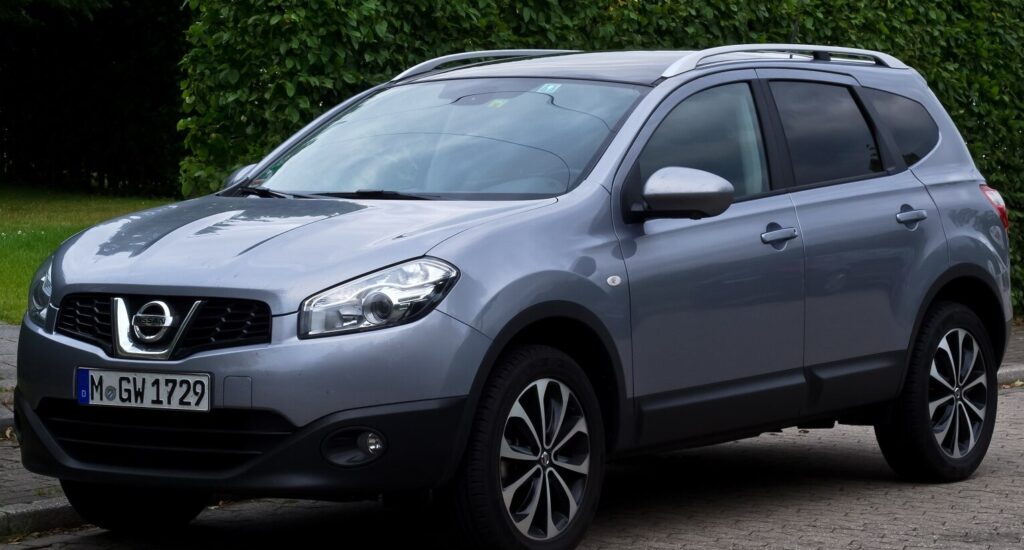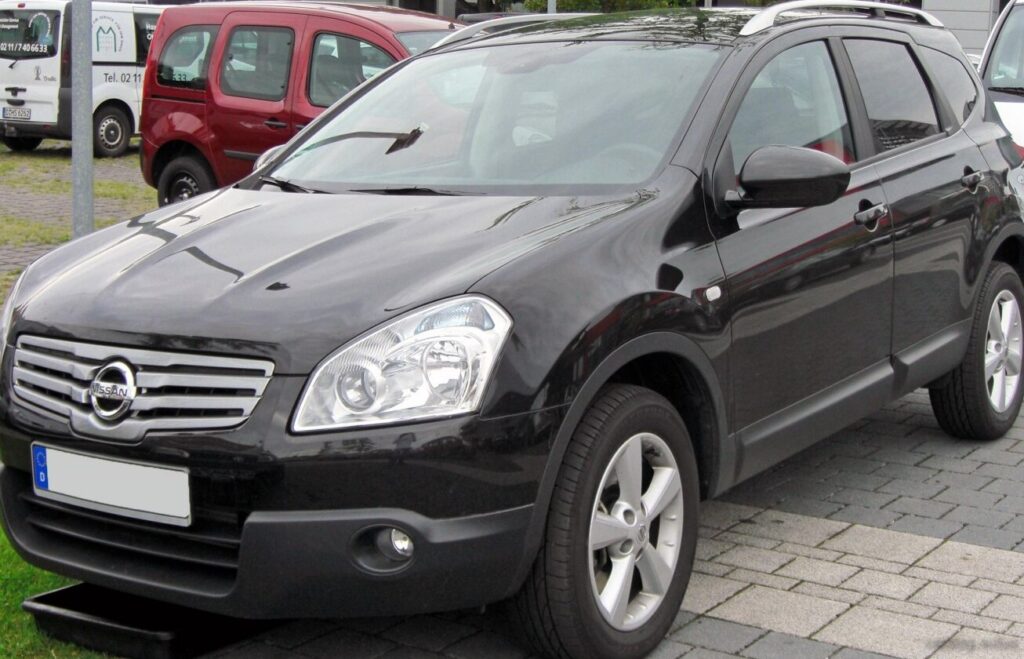
The Nissan Qashqai+2 (marketed as the Dualis+2 in some regions) was a compact crossover SUV produced by Nissan from 2008 to 2010. Representing an expansion of the original Qashqai lineup, the “+2” variant distinguished itself by offering optional seven-passenger seating, a feature relatively uncommon in its class at the time. This version, specifically the 2.0i (141 Hp) 4×4 CVT, occupied a mid-to-upper position within the Qashqai+2 range, appealing to buyers seeking all-wheel drive capability and the convenience of a continuously variable transmission. It was primarily sold in the European market, where the demand for compact SUVs with flexible seating arrangements was growing.
Technical Specifications
| Brand | Nissan |
| Model | Qashqai |
| Generation | Qashqai+2 I (NJ10) |
| Type (Engine) | 2.0i (141 Hp) 4×4 CVT |
| Start of production | 2008 |
| End of production | 2010 |
| Powertrain Architecture | Internal Combustion engine |
| Body type | SUV, Crossover |
| Seats | 7 |
| Doors | 5 |
| Fuel consumption (urban) | 10.9 l/100 km (21.6 US mpg, 25.9 UK mpg, 9.2 km/l) |
| Fuel consumption (extra urban) | 7 l/100 km (33.6 US mpg, 40.4 UK mpg, 14.3 km/l) |
| Fuel consumption (combined) | 8.5 l/100 km (27.7 US mpg, 33.2 UK mpg, 11.8 km/l) |
| CO2 emissions | 199 g/km |
| Fuel Type | Petrol (Gasoline) |
| Acceleration 0 – 100 km/h | 11.7 sec |
| Acceleration 0 – 62 mph | 11.7 sec |
| Acceleration 0 – 60 mph | 11.1 sec |
| Maximum speed | 177 km/h (109.98 mph) |
| Emission standard | Euro 4 |
| Weight-to-power ratio | 11.2 kg/Hp, 89.1 Hp/tonne |
| Weight-to-torque ratio | 8.1 kg/Nm, 123.8 Nm/tonne |
| Power | 141 Hp @ 6000 rpm |
| Torque | 196 Nm @ 4800 rpm (144.56 lb.-ft. @ 4800 rpm) |
| Engine layout | Front, Transverse |
| Engine Model/Code | MR20DE |
| Engine displacement | 1997 cm3 (121.86 cu. in.) |
| Number of cylinders | 4 |
| Engine configuration | Inline |
| Cylinder Bore | 84 mm (3.31 in.) |
| Piston Stroke | 90.1 mm (3.55 in.) |
| Compression ratio | 10.2:1 |
| Number of valves per cylinder | 4 |
| Fuel injection system | Multi-port manifold injection |
| Engine aspiration | Naturally aspirated engine |
| Valvetrain | DOHC |
| Engine oil capacity | 4.4 l (4.65 US qt | 3.87 UK qt) |
| Coolant | 8.6 l (9.09 US qt | 7.57 UK qt) |
| Kerb Weight | 1583 kg (3489.92 lbs.) |
| Max. weight | 2215 kg (4883.24 lbs.) |
| Max load | 632 kg (1393.32 lbs.) |
| Trunk (boot) space – minimum | 130 l (4.59 cu. ft.) |
| Trunk (boot) space – maximum | 1520 l (53.68 cu. ft.) |
| Fuel tank capacity | 65 l (17.17 US gal | 14.3 UK gal) |
| Max. roof load | 75 kg (165.35 lbs.) |
| Permitted trailer load with brakes (12%) | 1200 kg (2645.55 lbs.) |
| Permitted trailer load without brakes | 750 kg (1653.47 lbs.) |
| Permitted towbar download | 75 kg (165.35 lbs.) |
| Length | 4530 mm (178.35 in.) |
| Width | 1780 mm (70.08 in.) |
| Height | 1645 mm (64.76 in.) |
| Wheelbase | 2765 mm (108.86 in.) |
| Front track | 1540 mm (60.63 in.) |
| Rear (Back) track | 1550 mm (61.02 in.) |
| Minimum turning circle | 11 m (36.09 ft.) |
| Drive wheel | All wheel drive (4×4) |
| Number of gears and type of gearbox | 1 gears, automatic transmission CVT |
| Front suspension | Independent, type McPherson with coil spring and anti-roll bar |
| Rear suspension | Independent multi-link spring suspension with stabilizer |
| Front brakes | Ventilated discs |
| Rear brakes | Disc |
| Assisting systems | ABS (Anti-lock braking system) |
| Steering type | Steering rack and pinion |
| Power steering | Electric Steering |
| Tires size | 215/60 R17 |
| Wheel rims size | 6.5J x 17 |
Powertrain & Engine Architecture
The Qashqai+2 2.0i 4×4 CVT was powered by Nissan’s MR20DE 2.0-liter inline-four cylinder engine. This engine, a member of Nissan’s MR series, featured multi-point fuel injection and a double overhead camshaft (DOHC) valvetrain. The MR20DE produced 141 horsepower at 6000 rpm and 196 Nm (144.56 lb-ft) of torque at 4800 rpm. The engine’s design prioritized smooth operation and reasonable fuel efficiency over outright performance. The engine was transversely mounted in the front of the vehicle. Power was transmitted to all four wheels via Nissan’s Xtronic CVT (Continuously Variable Transmission). This CVT offered seamless gear changes and contributed to improved fuel economy compared to a traditional automatic transmission. The 4×4 system was an electronically controlled all-wheel drive system, primarily front-wheel drive but capable of automatically engaging the rear wheels when traction was lost.
Driving Characteristics
The 2.0i CVT powertrain delivered adequate, but not particularly exhilarating, performance. The CVT, while smooth, lacked the direct feel of a traditional automatic or manual transmission. Acceleration from 0-60 mph took approximately 11.1 seconds, and the top speed was 177 km/h (109.98 mph). The CVT’s programming was tuned for fuel efficiency, meaning the engine often operated at lower rpm, resulting in a somewhat subdued driving experience. Compared to the manual transmission versions of the Qashqai+2, the CVT offered greater convenience but sacrificed some responsiveness. The all-wheel drive system provided enhanced stability and traction, particularly in inclement weather conditions, but added weight and slightly reduced fuel economy.
Equipment & Trim Levels
The 2.0i 4×4 CVT trim typically included features such as air conditioning, power windows and mirrors, a CD player with auxiliary input, and alloy wheels. Higher trim levels added features like automatic climate control, a panoramic sunroof, leather upholstery, and a navigation system. The seven-passenger configuration featured folding third-row seats, providing flexibility for carrying passengers or cargo. Safety features included ABS brakes, front and side airbags, and electronic stability control.
Chassis & Braking
The Qashqai+2 utilized an independent McPherson strut suspension in the front and an independent multi-link suspension in the rear. This setup provided a comfortable ride quality, although it wasn’t particularly sporty. The front brakes were ventilated discs, while the rear brakes were solid discs. The steering was electrically assisted, providing light and easy steering feel. The vehicle’s weight, particularly with the all-wheel drive system and seven-passenger configuration, contributed to a slightly less agile handling experience compared to lighter, two-wheel drive models.
Market Reception & Comparison
The Qashqai+2 2.0i 4×4 CVT was generally well-received by automotive critics as a practical and versatile family vehicle. The combination of all-wheel drive, seven-passenger seating, and a CVT transmission appealed to buyers seeking a comfortable and convenient crossover SUV. However, some critics noted the engine’s lack of outright power and the CVT’s somewhat detached driving feel. Compared to other trims in the Qashqai+2 lineup, the 2.0i 4×4 CVT offered a balance of performance, fuel economy, and features. The 1.6L petrol and 1.5 dCi diesel variants were more fuel-efficient but offered less power, while the higher-spec trims were more expensive.
Legacy
The Nissan Qashqai+2, including the 2.0i 4×4 CVT variant, has proven to be a relatively reliable vehicle in the used car market. The MR20DE engine is known for its durability, and the CVT transmission, while requiring regular fluid changes, has generally held up well over time. Common issues reported by owners include minor electrical glitches and wear and tear on suspension components. Today, the Qashqai+2 remains a popular choice for families seeking an affordable and practical seven-passenger crossover SUV. Its blend of versatility, comfort, and reliability has ensured its continued presence on roads throughout Europe.