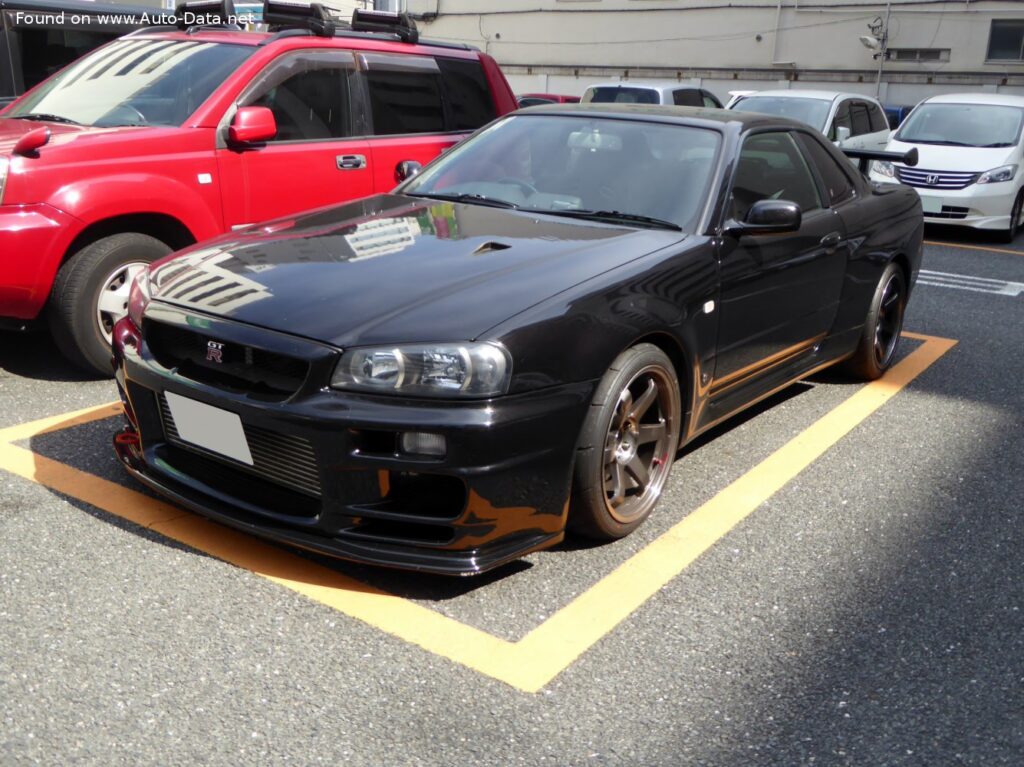
The Nissan Skyline GT-R X (R34) 2.6 i 24V Turbo 4WD (280 Hp), produced from 1999 to 2002, stands as one of the most revered and iconic Japanese performance vehicles of all time. Representing the tenth generation of the legendary Skyline GT-R lineage, the R34 series further cemented its reputation as a technological tour de force and a dominant force in both street and motorsport arenas. While never officially sold in the United States, its global fame, fueled by media appearances and racing success, transcended geographical boundaries, making it a highly sought-after machine for enthusiasts worldwide. This particular variant, powered by the fabled RB26DETT engine, embodies the pinnacle of Nissan’s engineering prowess during the late 20th century, combining sophisticated all-wheel-drive technology with a potent twin-turbocharged inline-six powerplant within a distinctive and aggressive coupe body.
The R34 generation was designed to be more compact and offer improved aerodynamics compared to its R33 predecessor, returning to a more aggressive, sharper aesthetic that resonated deeply with performance car aficionados. Its market segment was fiercely competitive, primarily in Japan, where it battled other high-performance coupes and sedans. However, its advanced technology and exceptional performance metrics allowed it to punch above its weight, often being compared favorably to much more expensive European sports cars of its era. The R34 GT-R is not merely a car; it’s a cultural phenomenon, an engineering marvel, and a testament to Japan’s automotive innovation.
Engine & Performance: The Heart of the Nissan Skyline GT-R X (R34)
At the core of the Nissan Skyline GT-R X (R34) lies the legendary RB26DETT engine, a 2.6-liter (2568 cm3 or 156.71 cu. in.) inline-six, twenty-four-valve unit featuring a DOHC (Double Overhead Camshaft) valvetrain. This powerhouse is longitudinally mounted at the front of the vehicle, contributing to a balanced chassis. The engine’s aspiration is handled by a sophisticated twin-turbocharger system, complemented by an intercooler to optimize air density, ensuring maximum power delivery. With a compression ratio of 9:1 and a multi-port manifold injection system, the RB26DETT was engineered for high performance and durability.
Officially, this variant produced 280 horsepower at 6800 rpm, a figure that was famously constrained by Japan’s “gentlemen’s agreement” among manufacturers to limit advertised output. However, it is widely acknowledged that the engine’s true potential was significantly higher, often exceeding 300 horsepower in stock form. Torque output was a robust 289.12 lb.-ft. (392 Nm) delivered at 4400 rpm, providing a strong mid-range pull. This formidable powertrain, combined with a kerb weight ranging from 3395.12 to 3439.21 lbs., resulted in an impressive weight-to-power ratio of 5.5 kg/Hp (approximately 181.8 Hp/tonne) and a weight-to-torque ratio of 3.9 kg/Nm (254.5 Nm/tonne).
Power is transmitted to all four wheels via a precise 6-speed manual transmission, offering an engaging driving experience. The R34 GT-R’s advanced drivetrain architecture, specifically the ATTESA E-TS Pro all-wheel-drive system, dynamically distributes torque between the front and rear axles, optimizing traction and handling in various conditions. This sophisticated system, combined with independent multi-link suspension at both the front and rear, and stabilizer bars, provided exceptional grip and cornering capabilities. The vehicle’s top speed was electronically limited to 155.34 mph (250 km/h), a common practice for Japanese domestic market vehicles of that era. Despite its performance focus, the R34 GT-R also demonstrated reasonable fuel economy for its class, with an extra-urban consumption of approximately 26.1 US mpg.
Design & Features of the Nissan Skyline GT-R X (R34)
The Nissan Skyline GT-R X (R34) is instantly recognizable by its aggressive and purposeful design. As a two-door coupe, it boasts a muscular stance, characterized by sharp lines, flared wheel arches, and a prominent rear wing (though variations existed). Its dimensions – 181.1 inches in length, 70.28 inches in width, and 53.54 inches in height – contribute to a compact yet formidable presence. The 104.92-inch wheelbase and relatively wide tracks (58.27 inches front, 58.66 inches rear) ensure stability and athletic handling. The ride height, ranging from 5.12 to 5.71 inches, underscores its performance orientation, maintaining a low center of gravity.
Beyond its striking aesthetics, the R34 GT-R was a technological marvel for its time. It featured a sophisticated chassis incorporating independent multi-link suspension with transverse stabilizers at the front and independent multi-link spring suspension with stabilizers at the rear. Braking performance was ensured by ventilated discs at the front and disc brakes at the rear, supported by an Anti-lock Braking System (ABS). A key technological highlight was the HICAS (High Capacity Actively Controlled Steering) 4-wheel steering system, which, in conjunction with the hydraulic rack and pinion power steering, enhanced agility and high-speed stability. The car rode on substantial 245/40 R18 tires, providing ample grip.
The interior of the R34 GT-R was driver-focused, with supportive seating for five (though the rear seats were notably cramped for adults). A standout feature was the multi-function display (MFD) on the dashboard, which provided a wealth of real-time performance data, including turbo boost pressure, oil and water temperatures, G-force readings, and even lap times. This level of integrated telemetry was groundbreaking for a production car of its era, reinforcing its image as a sophisticated performance machine. Despite its raw performance capabilities, the R34 also offered a degree of practicality, with a minimum trunk space of 6.36 cu. ft. and a 17.17 US gallon fuel tank, making it suitable for spirited daily driving or track days.
Technical Specifications: Nissan Skyline GT-R X (R34) 2.6 i 24V Turbo 4WD (280 Hp)
| Category | Specification |
| Brand | Nissan |
| Model | Skyline GT-R |
| Generation | Skyline GT-R X (R34) |
| Type (Engine) | 2.6 i 24V Turbo 4WD (280 Hp) |
| Start of Production | 1999 year |
| End of Production | 2002 year |
| Powertrain Architecture | Internal Combustion engine |
| Body Type | Coupe |
| Seats | 5 |
| Doors | 2 |
| Performance Specs | |
| Fuel Consumption (Economy) – Urban | 14.7 US mpg (16 l/100 km) |
| Fuel Consumption (Economy) – Extra Urban | 26.1 US mpg (9 l/100 km) |
| Fuel Type | Petrol (Gasoline) |
| Maximum Speed | 155.34 mph (250 km/h) |
| Weight-to-Power Ratio | 5.5 kg/Hp, 181.8 Hp/tonne |
| Weight-to-Torque Ratio | 3.9 kg/Nm, 254.5 Nm/tonne |
| Engine Specs | |
| Power | 280 Hp @ 6800 rpm |
| Power per Liter | 109 Hp/l |
| Torque | 289.12 lb.-ft. @ 4400 rpm (392 Nm @ 4400 rpm) |
| Engine Layout | Front, Longitudinal |
| Engine Model/Code | RB26DETT |
| Engine Displacement | 2.6 liters (2568 cm3 / 156.71 cu. in.) |
| Number of Cylinders | 6 |
| Engine Configuration | Inline |
| Cylinder Bore | 3.39 in. (86 mm) |
| Piston Stroke | 2.9 in. (73.7 mm) |
| Compression Ratio | 9:1 |
| Number of Valves per Cylinder | 4 |
| Fuel Injection System | Multi-port manifold injection |
| Engine Aspiration | Turbocharger, Intercooler |
| Valvetrain | DOHC |
| Engine Oil Capacity | 5.07 US qt (4.8 l) |
| Coolant Capacity | 9.72 US qt (9.2 l) |
| Space, Volume and Weights | |
| Kerb Weight | 3395.12 – 3439.21 lbs. (1540-1560 kg) |
| Max. Weight | 3924.23 lbs. (1780 kg) |
| Max Load | 485.02 – 529.11 lbs. (220-240 kg) |
| Trunk (Boot) Space – Minimum | 6.36 cu. ft. (180 l) |
| Fuel Tank Capacity | 17.17 US gal (65 l) |
| Dimensions | |
| Length | 181.1 in. (4600 mm) |
| Width | 70.28 in. (1785 mm) |
| Height | 53.54 in. (1360 mm) |
| Wheelbase | 104.92 in. (2665 mm) |
| Front Track | 58.27 in. (1480 mm) |
| Rear (Back) Track | 58.66 in. (1490 mm) |
| Ride Height (Ground Clearance) | 5.12 – 5.71 in. (130-145 mm) |
| Minimum Turning Circle (Turning Diameter) | 33.46 ft. (10.2 m) |
| Drivetrain, Brakes and Suspension Specs | |
| Drivetrain Architecture | The Internal combustion engine (ICE) drives permanently the four wheels of the vehicle. |
| Drive Wheel | All-wheel drive (4×4) |
| Number of Gears and Type of Gearbox | 6 gears, manual transmission |
| Front Suspension | Independent multi-link suspension, Transverse stabilizer |
| Rear Suspension | Independent multi-link spring suspension with stabilizer |
| Front Brakes | Ventilated discs |
| Rear Brakes | Disc |
| Assisting Systems | ABS (Anti-lock braking system), 4-wheel steering (4WS, active rear steering) |
| Steering Type | Steering rack and pinion |
| Power Steering | Hydraulic Steering |
| Tires Size | 245/40 R18 |
Legacy & Market Impact of the Nissan Skyline GT-R X (R34)
The Nissan Skyline GT-R X (R34) holds an indelible place in automotive history, particularly within the realm of Japanese performance cars. Its legacy is one of groundbreaking technology, formidable performance, and an enduring cult status that has only grown stronger over time. While primarily a Japanese Domestic Market (JDM) vehicle, with limited official exports to other right-hand-drive markets like the UK and Australia, its influence spread globally, largely through video games, cinema, and the burgeoning tuner culture. The R34 became synonymous with high-performance modification, its robust RB26DETT engine proving capable of handling immense power increases, making it a favorite among tuners aiming for hundreds, if not thousands, of horsepower.
In its home market, the R34 GT-R faced stiff competition from other Japanese legends such as the Toyota Supra, Mitsubishi Lancer Evolution, and Subaru Impreza WRX STI. However, the GT-R occupied a slightly different niche, often seen as the more sophisticated and technologically advanced option, particularly with its ATTESA E-TS Pro AWD and HICAS 4WS systems. These technologies allowed it to compete with, and often outperform, European rivals like the Porsche 911 (996 generation) or BMW M3 (E46 generation) in terms of raw acceleration and all-weather capability, despite being a more budget-friendly proposition.
The R34’s reputation was further solidified through its success in various motorsport disciplines, including the Super Taikyu series and the Nürburgring 24 Hours. Its distinctive appearance and incredible capabilities also made it a star in popular culture, most notably in the “Fast and Furious” film franchise, which introduced the car to a massive global audience and cemented its status as an aspirational dream car for a generation of enthusiasts.
Today, the Nissan Skyline GT-R X (R34) is considered a highly collectible modern classic. Its value has soared, particularly in anticipation of its eligibility for legal import into the United States under the “25-year rule.” This rule allows vehicles not originally certified for sale in the US to be imported once they are 25 years old or older, making the earliest R34 models from 1999 now legally importable. This has only intensified demand and solidified its position as one of the most significant and influential Japanese performance cars ever built, a true icon that continues to captivate and inspire automotive enthusiasts around the world.