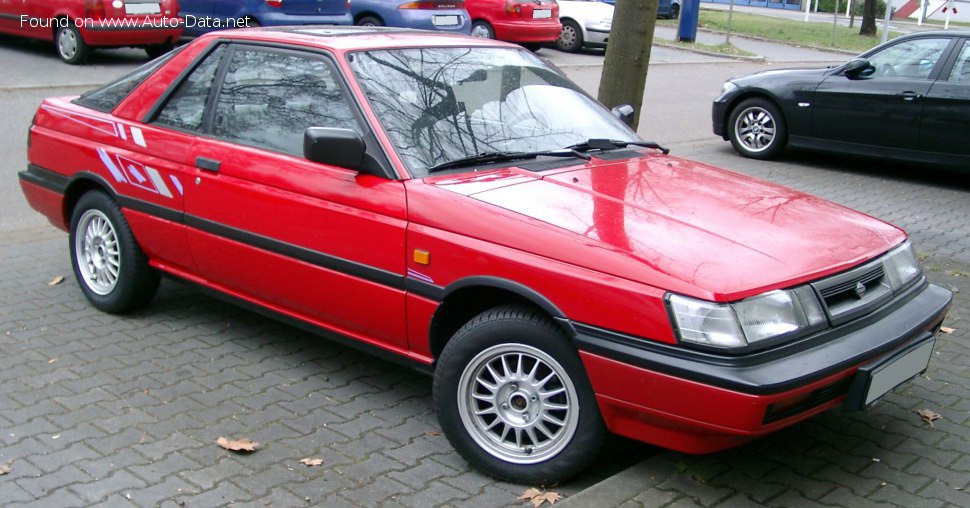
The Nissan Sunny II Coupe (B12) represents a significant chapter in Nissan’s long-standing history of producing reliable and affordable compact cars. Launched in 1986, the B12 generation of the Sunny, known as the Sentra in the North American market, continued the lineage of a globally successful nameplate. The “Sunny” badge itself has an illustrious history dating back to the 1960s, establishing Nissan as a formidable player in the economy car segment. The II Coupe (B12) variant, specifically with the 1.5-liter, 71 horsepower engine, was positioned as a practical yet somewhat sportier alternative to its sedan and hatchback siblings, targeting buyers seeking a blend of everyday usability, fuel efficiency, and a touch of youthful appeal in the mid-to-late 1980s.
This particular model, produced from 1986 to 1988, exemplified the automotive trends of its era: a focus on compact dimensions, front-wheel-drive efficiency, and a no-nonsense approach to design and engineering. While not a performance powerhouse, the Nissan Sunny II Coupe (B12) carved out its niche by offering dependable transportation at a competitive price point, solidifying Nissan’s reputation for building durable vehicles that could withstand the rigors of daily commuting across various international markets. Its role in markets outside the USA, particularly in Europe and Asia, was often as a primary family vehicle or a reliable first car, embodying the spirit of accessible personal mobility.
Engine & Performance: The Heart of the Nissan Sunny II Coupe (B12)
Powering the Nissan Sunny II Coupe (B12) 1.5 (71 Hp) was a naturally aspirated 1.5-liter gasoline engine, delivering a modest but adequate 71 horsepower. This powertrain architecture was typical of compact cars during the 1980s, prioritizing fuel economy and robust reliability over outright speed. The engine, likely a variant of Nissan’s E-series, was engineered for simplicity and longevity, crucial factors for its target demographic.
The 71 horsepower output, while seemingly low by modern standards, was respectable for a compact car of its vintage. It provided sufficient power for urban driving and highway cruising, especially when paired with a manual transmission, allowing drivers to maximize the engine’s power band. The naturally aspirated design meant predictable power delivery without the added complexity or cost of turbocharging, contributing to the car’s overall affordability and ease of maintenance. This engine was a workhorse, designed to start reliably in various climates and to run for many thousands of miles with basic upkeep. Its efficiency was a strong selling point, making the Sunny II Coupe an economical choice for budget-conscious consumers.
Design & Features: Form Follows Function in the B12 Coupe
The design of the Nissan Sunny II Coupe (B12) reflected the prevailing automotive aesthetics of the mid-1980s. It featured a clean, somewhat angular silhouette, moving away from the more overtly boxy designs of the early 80s towards a slightly more aerodynamic profile, though still distinctly a product of its time. The coupe body type, with its two doors and sloping roofline, offered a sportier visual appeal compared to the more utilitarian sedan and hatchback variants. Despite its compact footprint, Nissan engineers worked to maximize interior space, a common challenge for coupe designs.
Inside, the B12 Coupe was characterized by a functional and user-friendly cabin. The dashboard layout was straightforward, with easily accessible controls and clear instrumentation. Materials were chosen for durability and practicality, designed to withstand years of use. While luxury features were sparse in this segment, standard amenities typically included a heater, ventilation system, and a basic AM/FM radio. Depending on the market and trim level, features like power windows, power steering, and air conditioning might have been available as optional extras, though they were not universal for a 71 Hp base model. Safety features, by 1980s standards, included three-point seatbelts for front occupants and basic crash protection inherent in the body structure. The focus was on providing reliable, no-frills transportation that was easy to operate and maintain, appealing to a broad segment of buyers globally.
A Global Perspective on the B12
The Sunny II Coupe (B12) wasn’t a major seller in the United States, where Nissan focused more on the sedan and hatchback versions marketed as the Sentra. However, in Europe and Asia, the coupe held more appeal, particularly in markets where smaller, fuel-efficient cars were highly valued. It served as a popular entry-level vehicle for young drivers and a practical choice for families seeking affordable transportation. The B12’s reputation for reliability and low running costs made it a particularly attractive option in regions with less developed automotive infrastructure.
Technical Specifications: Nissan Sunny II Coupe (B12) 1.5 (71 Hp)
| Category | Specification |
| Brand | Nissan |
| Model | Sunny |
| Generation | Sunny II Coupe (B12) |
| Type (Engine) | 1.5 (71 Hp) |
| Start of Production | 1986 |
| End of Production | 1988 |
| Powertrain Architecture | Internal Combustion engine |
| Body type | Coupe |
| Fuel Type | Petrol (Gasoline) |
| Power | 71 Hp |
| Engine aspiration | Naturally aspirated engine |
Legacy and Market Impact of the Nissan Sunny II Coupe (B12)
The Nissan Sunny II Coupe (B12) 1.5 (71 Hp), alongside its sedan and hatchback counterparts, played a crucial role in cementing Nissan’s reputation for building reliable, economical, and practical vehicles worldwide. In markets like Japan, Europe, and various developing nations, the Sunny was a ubiquitous sight, serving as dependable transportation for millions. Its robust engineering and straightforward mechanics meant lower ownership costs and a long service life, characteristics highly valued by consumers.
In the fiercely competitive compact car segment of the 1980s, the Sunny B12 faced formidable rivals. Key competitors included the Honda Civic Coupe, Toyota Corolla Coupe, and the Mazda 323 Coupe, all of which offered similar propositions of efficiency and reliability. The Sunny distinguished itself through its competitive pricing, solid build quality, and Nissan’s expanding global dealer network. While the coupe variant might not have been the volume seller compared to the four-door sedan, it offered a distinct style for buyers who wanted something a little different without sacrificing practicality.
The historical significance of the B12 generation, and specifically the Sunny II Coupe, lies in its contribution to the evolution of the compact car. It represented a period when Japanese automakers were perfecting the art of mass-producing durable, fuel-efficient vehicles that could compete effectively with established European and American brands. For many, a Sunny or Sentra of this era was their first new car, providing an introduction to dependable personal mobility. Today, these cars are increasingly recognized as affordable classics, sought after by enthusiasts for their mechanical simplicity, ease of maintenance, and nostalgic appeal. They stand as a testament to an era when automotive design prioritized function and durability, creating vehicles that, against all odds, continue to serve their owners decades after rolling off the assembly line.
The enduring legacy of the Nissan Sunny II Coupe (B12) is one of understated excellence. It was a car that didn’t shout for attention but quietly delivered on its promises, earning a place in the hearts of its owners and contributing significantly to Nissan’s global success story. It remains a symbol of accessible motoring, a reliable companion that helped shape the automotive landscape of the late 20th century.