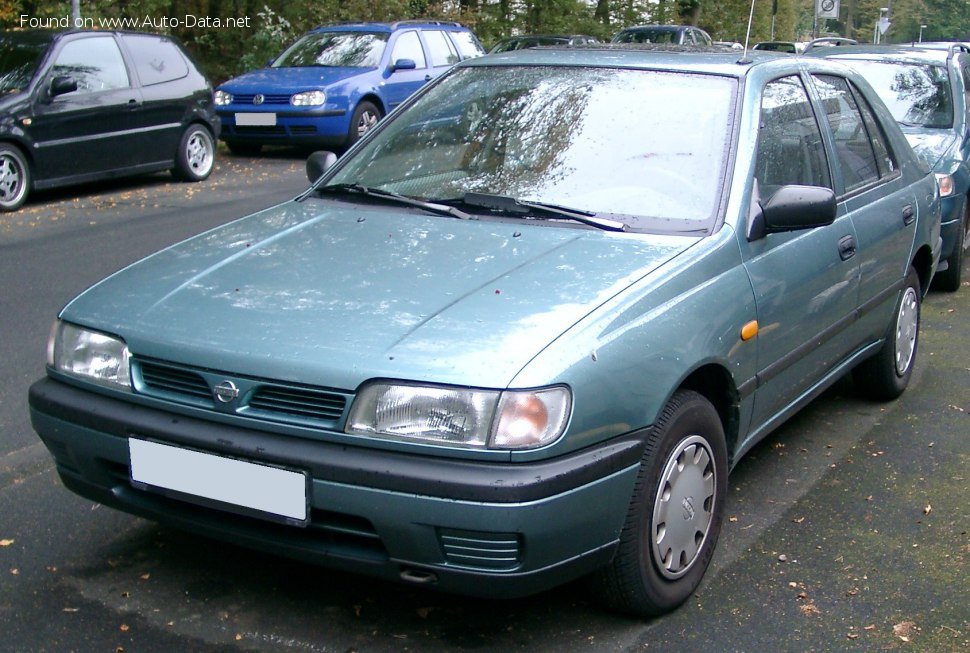
The Nissan Sunny, a nameplate synonymous with reliability and practicality across numerous global markets, saw its third generation, internally designated N14, introduced in 1990. This particular variant, the Nissan Sunny III Hatch (N14) 5 doors 1.6 16V (90 Hp), represented a core offering in Nissan’s compact car lineup for markets primarily outside North America, such as Europe and Asia. While the Sunny name was largely supplanted by the Sentra in the United States, the N14 generation, in its various body styles, served as a global workhorse, embodying Nissan’s commitment to accessible and durable transportation. The 5-door hatchback configuration, in particular, catered to a demographic seeking versatility and a compact footprint without sacrificing passenger or cargo capacity. Produced from 1990 to 1992, this specific model year range highlights a period of significant advancements in automotive engineering, even for economy-focused vehicles, incorporating features that would become standard in later decades.
Engineering for the Masses: The Nissan Sunny III Hatch (N14) 5 doors 1.6 16V (90 Hp)
Engine & Performance
At the heart of the Nissan Sunny III Hatch (N14) 5 doors 1.6 16V (90 Hp) lay the venerable GA16DE engine, a 1.6-liter (1597 cm3 or 97.45 cu. in.) inline four-cylinder powertrain. This naturally aspirated unit was a testament to Nissan’s engineering prowess, featuring a Double Overhead Camshaft (DOHC) valvetrain with 16 valves (four per cylinder), which was a significant upgrade over older single overhead cam designs, contributing to improved breathing and efficiency. Fuel delivery was handled by a multi-port manifold injection system, ensuring precise fuel metering and better performance compared to carbureted setups.
The GA16DE engine generated a respectable 90 horsepower (Hp) at 6000 rpm, translating to a power-per-liter output of 56.4 Hp/l. Torque figures stood at 136 Nm (100.31 lb.-ft.) delivered at 4000 rpm, providing adequate pulling power for city driving and highway cruising. Mated to a 5-speed manual transmission, the powertrain architecture was front-engine, transverse-mounted, driving the front wheels. This front-wheel-drive (FWD) layout was typical for compact cars of the era, offering efficient packaging, improved traction in adverse conditions, and cost-effectiveness. The vehicle’s kerb weight of 2072.35 lbs (940 kg) resulted in a weight-to-power ratio of 10.4 kg/Hp, or 95.7 Hp/tonne, indicating a lively yet economical performance for its class. The focus for this powertrain was not on outright speed, but rather on providing a reliable, fuel-efficient, and durable means of transportation, characteristics for which the Sunny nameplate was well-regarded.
Design & Features
The Nissan Sunny III Hatch (N14) 5 doors adopted a contemporary design for the early 1990s, characterized by smooth, rounded lines that were a departure from the boxier aesthetics of the 1980s. Its hatchback body type offered a practical solution for urban dwellers and small families, blending the maneuverability of a compact car with the utility of a larger cargo area. Measuring 163.19 inches (4145 mm) in length, 66.54 inches (1690 mm) in width, and 54.92 inches (1395 mm) in height, with a wheelbase of 95.67 inches (2430 mm), the N14 Sunny was designed for easy parking and navigating crowded city streets.
The 5-door configuration provided easy access for all five occupants, and the interior was designed with functionality in mind. The standard seating capacity for five passengers ensured versatility for various uses. One of its standout practical features was its impressive cargo capacity; the trunk offered a minimum of 15.22 cu. ft. (431 liters) of space, which could expand significantly to a maximum of 45.56 cu. ft. (1290 liters) with the rear seats folded down, making it highly adaptable for carrying luggage, groceries, or larger items.
In terms of chassis and assisting systems, the N14 Sunny featured a wishbone front suspension and a spring strut rear suspension, providing a comfortable ride and predictable handling. Stopping power was managed by ventilated disc brakes at the front and drum brakes at the rear. For enhanced safety, the vehicle was equipped with an Anti-lock Braking System (ABS), a significant safety feature for its time, especially in a compact segment car. Steering was a hydraulic rack and pinion system, offering direct feel and ease of maneuverability. The car rode on 175/65 R14 tires, balancing grip and ride comfort. The overall design philosophy emphasized practicality, safety, and driver comfort, making it a competitive offering in its market segment.
Technical Specifications: Nissan Sunny III Hatch (N14) 5 doors 1.6 16V (90 Hp)
| Category | Specification |
|---|---|
| Brand | Nissan |
| Model | Sunny |
| Generation | Sunny III Hatch (N14) 5 doors |
| Type (Engine) | 1.6 16V (90 Hp) |
| Start of Production | 1990 year |
| End of Production | 1992 year |
| Powertrain Architecture | Internal Combustion engine |
| Body type | Hatchback |
| Seats | 5 |
| Doors | 5 |
| Performance Specs | |
| Fuel Type | Petrol (Gasoline) |
| Weight-to-power ratio | 10.4 kg/Hp, 95.7 Hp/tonne |
| Weight-to-torque ratio | 6.9 kg/Nm, 144.7 Nm/tonne |
| Engine Specs | |
| Power | 90 Hp @ 6000 rpm. |
| Power per liter | 56.4 Hp/l |
| Torque | 136 Nm @ 4000 rpm. |
| Engine layout | Front, Transverse |
| Engine Model/Code | GA16DE |
| Engine displacement | 1597 cm3 |
| Number of cylinders | 4 |
| Engine configuration | Inline |
| Cylinder Bore | 76 mm |
| Piston Stroke | 88 mm |
| Compression ratio | 9.8:1 |
| Number of valves per cylinder | 4 |
| Fuel injection system | Multi-port manifold injection |
| Engine aspiration | Naturally aspirated engine |
| Valvetrain | DOHC |
| Engine oil capacity | 3.2 l |
| Coolant capacity | 5.7 l |
| Space, Volume and Weights | |
| Kerb Weight | 940 kg |
| Max. weight | 1505 kg |
| Max load | 565 kg |
| Trunk (boot) space – minimum | 431 l |
| Trunk (boot) space – maximum | 1290 l |
| Fuel tank capacity | 50 l |
| Dimensions | |
| Length | 4145 mm |
| Width | 1690 mm |
| Height | 1395 mm |
| Wheelbase | 2430 mm |
| Front track | 1445 mm |
| Rear (Back) track | 1430 mm |
| Drivetrain, Brakes and Suspension Specs | |
| Drivetrain Architecture | The Internal combustion engine (ICE) drives the front wheels of the vehicle. |
| Drive wheel | Front wheel drive |
| Number of gears and type of gearbox | 5 gears, manual transmission |
| Front suspension | Wishbone |
| Rear suspension | Spring Strut |
| Front brakes | Ventilated discs |
| Rear brakes | Drum |
| Assisting systems | ABS (Anti-lock braking system) |
| Steering type | Steering rack and pinion |
| Power steering | Hydraulic Steering |
| Tires size | 175/65 R14 |
Legacy and Market Impact
The Nissan Sunny III Hatch (N14) 5 doors 1.6 16V (90 Hp), along with its sedan and wagon siblings, played a crucial role in Nissan’s global strategy during the early 1990s. While the “Sunny” badge had a limited presence in the United States, where the Sentra nameplate dominated the compact segment, the N14 generation was a cornerstone in markets like Europe, Asia, Australia, and parts of Africa and Latin America. In these regions, the Sunny was revered for its robust build quality, exceptional reliability, and affordable running costs. Its straightforward mechanicals and well-proven GA16DE engine contributed to its reputation as a dependable daily driver, capable of enduring years of service with minimal fuss.
Competitors in its primary markets included other popular compacts such as the Toyota Corolla, Honda Civic, Opel Astra (Vauxhall Astra in the UK), Ford Escort, and Mazda 323. Against these rivals, the Sunny often differentiated itself through a strong value proposition and a reputation for longevity that sometimes surpassed its peers. Its practical hatchback design, offering a flexible cargo area, made it particularly appealing to families and individuals who needed more utility than a traditional sedan could provide.
The N14 Sunny’s mechanical impact was significant. It showcased Nissan’s ability to produce globally competitive compact cars that combined modern engineering – such as DOHC engines and multi-port injection – with traditional Nissan virtues of durability and ease of maintenance. The inclusion of features like ABS, even if optional on some trims, demonstrated a forward-thinking approach to safety in the mass-market segment. This generation helped solidify Nissan’s standing as a manufacturer of practical, well-engineered vehicles that catered to a wide range of consumer needs outside the performance or luxury niches. Today, the N14 Sunny is remembered as a reliable classic, a testament to the era’s focus on functional design and mechanical integrity, and a car that faithfully served millions of drivers worldwide.