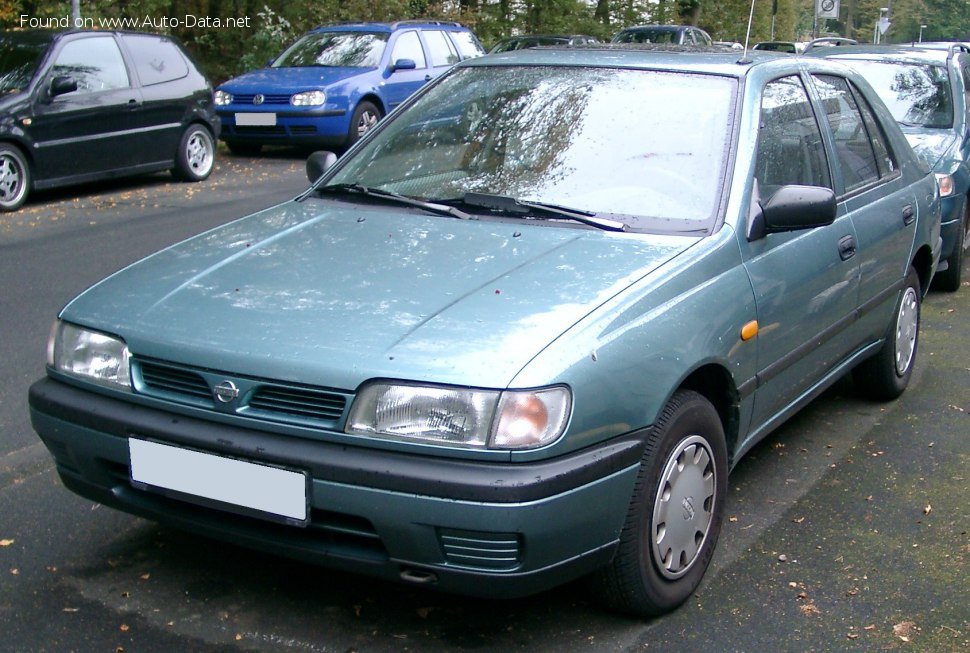
The Nissan Sunny III Hatch, internally designated as the N14 series, represented the seventh generation of Nissan’s long-running Sunny compact car line. Produced from 1990 to 1995, this particular iteration – the 5-door hatchback powered by a 2.0 D (75 HP) engine – was a prime example of a practical, fuel-efficient vehicle designed primarily for European and other international markets where diesel power was highly valued. While the Sunny nameplate has a history of reaching North American shores as the Sentra, this specific diesel hatchback variant was never officially offered in the United States. Instead, it established a niche in regions demanding economy, reliability, and robust performance from a compact family car. The N14 series built upon the Sunny’s reputation for dependable transportation, offering a blend of contemporary design for its era, functional utility, and a powertrain focused on longevity and low running costs.
Nissan Sunny III Hatch (N14): A Global Compact
Positioned in the highly competitive C-segment, or compact car class, the Nissan Sunny III Hatch (N14) aimed to appeal to a broad demographic, from young families to commuters seeking an economical daily driver. Its 5-door hatchback configuration provided excellent versatility, a characteristic highly prized in its target markets. The N14 generation featured a more rounded, aerodynamic styling compared to its predecessors, reflecting the evolving automotive design trends of the early 1990s. This particular diesel model underscored Nissan’s commitment to offering diverse powertrain options to cater to specific regional demands, prioritizing fuel efficiency and durability for markets where diesel fuel was readily available and often more affordable than gasoline.
Engine & Performance
At the heart of this Nissan Sunny III Hatch (N14) was the CD20 engine, a naturally aspirated 2.0-liter (1974 cm³ or 120.46 cu. in.) inline four-cylinder diesel unit. This engine was engineered for endurance and fuel economy, delivering a modest but adequate 75 horsepower at 4800 rpm. Torque output stood at 132 Nm (97.36 lb.-ft.) at a relatively low 2800 rpm, characteristic of naturally aspirated diesels of the period, providing a solid, usable pull from lower engine speeds. This power delivery made the Sunny 2.0 D a competent performer in urban environments and on longer journeys, where its strong low-end torque was beneficial for carrying loads or maintaining cruising speeds without excessive downshifting.
The powertrain architecture was a conventional front-engine, front-wheel-drive setup, paired exclusively with a 5-speed manual transmission for this diesel variant. This combination emphasized driver engagement and optimized fuel efficiency. Performance figures, while not impressive by modern standards, were respectable for its class and intended purpose. The Sunny 2.0 D could accelerate from 0 to 60 mph in an estimated 14.7 seconds, reaching a top speed of 99.42 mph (160 km/h). These numbers reflected its design philosophy: a reliable, economical commuter rather than a performance-oriented hot hatch.
Fuel economy was a major selling point for the 2.0 D engine. With a combined fuel consumption rating of 38.6 US mpg (6.1 l/100 km), it offered excellent running costs, a crucial factor for European drivers. The engine featured a precombustion chamber injection system, a common technology for diesel engines of the early 90s, known for its robustness and ability to handle varying fuel qualities. With a high compression ratio of 22.2:1 and an OHC (Overhead Camshaft) valvetrain with two valves per cylinder, the CD20 engine was a testament to straightforward, durable engineering designed for a long service life.
Design & Features
The Nissan Sunny III Hatch (N14) 5-door adopted a design language characteristic of early 1990s compact cars: slightly rounded edges, a relatively low beltline for good visibility, and a focus on aerodynamic efficiency to improve fuel economy and reduce wind noise. Measuring 163.19 inches (4145 mm) in length, 66.54 inches (1690 mm) in width, and 54.92 inches (1395 mm) in height, the N14 was a compact vehicle easy to maneuver in congested city traffic and park in tight spaces. Its 95.67-inch (2430 mm) wheelbase contributed to a stable ride quality for its class.
The 5-door hatchback body style was a practical choice, offering easy access to both the front and rear seats, as well as a versatile cargo area. The Sunny N14 provided a minimum trunk space of 15.22 cu. ft. (431 liters), which could be expanded significantly to an impressive 45.56 cu. ft. (1290 liters) by folding down the rear seats. This made it highly adaptable for carrying groceries, luggage, or larger items, reinforcing its role as a functional family car.
Inside, the N14 Sunny was characterized by a straightforward and ergonomic cabin layout. While not luxurious, the interior was built to be durable and user-friendly, with controls placed intuitively. For safety, the inclusion of ABS (Anti-lock Braking System) was a notable feature for a compact car of its time, providing enhanced stopping power and control under hard braking conditions. The braking system consisted of ventilated discs at the front and drum brakes at the rear, a common and effective setup for vehicles in this segment. The suspension system, featuring a wishbone setup at the front and spring struts at the rear, provided a comfortable ride while maintaining predictable handling characteristics. Power steering, specifically a hydraulic rack-and-pinion system, ensured effortless maneuvering at low speeds and a reassuring feel at higher velocities. The vehicle rode on 175/70 R13 tires, a standard size for economical compacts of the era.
Technical Specifications
| Category | Specification |
| General Information | |
| Brand | Nissan |
| Model | Sunny III Hatch (N14) 5 doors 2.0 D (75 Hp) |
| Generation | Sunny III Hatch (N14) 5 doors |
| Production Start | 1990 year |
| Production End | 1995 year |
| Body type | Hatchback |
| Seats | 5 |
| Doors | 5 |
| Performance Specs | |
| Fuel consumption (combined) | 6.1 l/100 km |
| Fuel Type | Diesel |
| Acceleration 0 – 60 mph | 14.7 sec |
| Maximum speed | 160 km/h |
| Weight-to-power ratio | 14.9 kg/Hp |
| Weight-to-torque ratio | 8.5 kg/Nm |
| Engine Specs | |
| Power | 75 Hp @ 4800 rpm |
| Power per liter | 38 Hp/l |
| Torque | 132 Nm @ 2800 rpm |
| Engine layout | Front, Transverse |
| Engine Model/Code | CD20 |
| Engine displacement | 1974 cm3 |
| Number of cylinders | 4 |
| Engine configuration | Inline |
| Cylinder Bore | 84.5 mm |
| Piston Stroke | 88 mm |
| Compression ratio | 22.2:1 |
| Valves per cylinder | 2 |
| Fuel injection system | Precombustion chamber injection |
| Engine aspiration | Naturally aspirated engine |
| Valvetrain | OHC |
| Space, Volume and Weights | |
| Kerb Weight | 1120 kg |
| Max. weight | 1545 kg |
| Max load | 425 kg |
| Trunk (boot) space – minimum | 431 l |
| Trunk (boot) space – maximum | 1290 l |
| Fuel tank capacity | 50 l |
| Dimensions | |
| Length | 4145 mm |
| Width | 1690 mm |
| Height | 1395 mm |
| Wheelbase | 2430 mm |
| Drivetrain, Brakes and Suspension Specs | |
| Drivetrain Architecture | Front-wheel drive, Internal Combustion engine |
| Gearbox | 5 gears, manual transmission |
The Nissan Sunny III Hatch (N14) 2.0 D played a significant role in Nissan’s global strategy during the early to mid-1990s, particularly in markets outside of North America. It competed against European models like the Volkswagen Golf, Ford Escort, Opel Astra, and Peugeot 306, as well as Japanese rivals like the Toyota Corolla and Honda Civic. In these markets, the Sunny N14 was renowned for its robust build quality, exceptional reliability, and the cost-effectiveness of its diesel powertrain.
While it may not have garnered the same level of enthusiast appeal as some of its competitors, the Nissan Sunny III Hatch (N14) earned a reputation as a no-nonsense, dependable vehicle. Its naturally aspirated diesel engine, while not powerful, was celebrated for its longevity and excellent fuel efficiency, making it a popular choice for fleet operators, taxi services, and private owners who prioritized low running costs and minimal downtime. The N14’s mechanical simplicity and robust engineering contributed to lower maintenance costs and a higher degree of owner satisfaction over the long term, traits that are highly valued in European and Asian markets. The N14 generation marked a period of refinement for the Sunny line, evolving its design and enhancing its features to keep pace with contemporary automotive trends. Although it has since been succeeded by numerous generations of Nissan compacts, the Sunny N14 remains a testament to Nissan’s engineering prowess in producing durable, economical, and practical vehicles for a global audience. Its legacy is one of quiet competence, serving millions of drivers faithfully and contributing to Nissan’s image as a manufacturer of reliable and accessible automobiles. For many, the Sunny N14 was simply a car that worked, day in and day out, embodying the essence of dependable transportation.