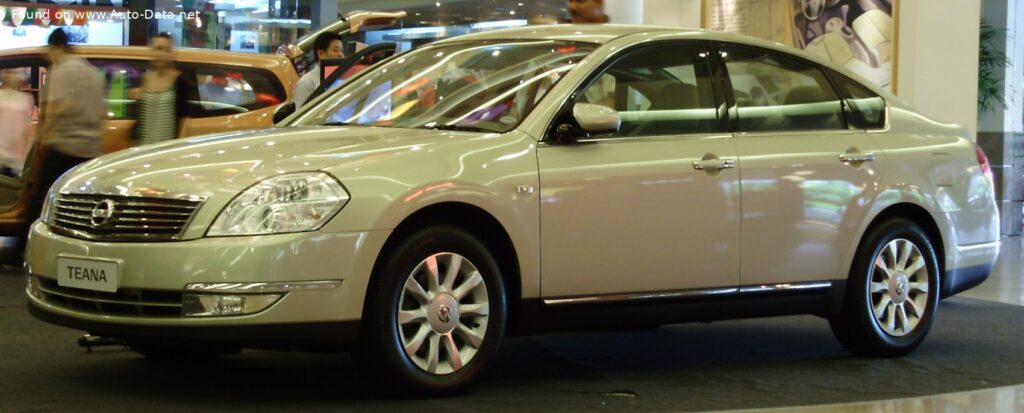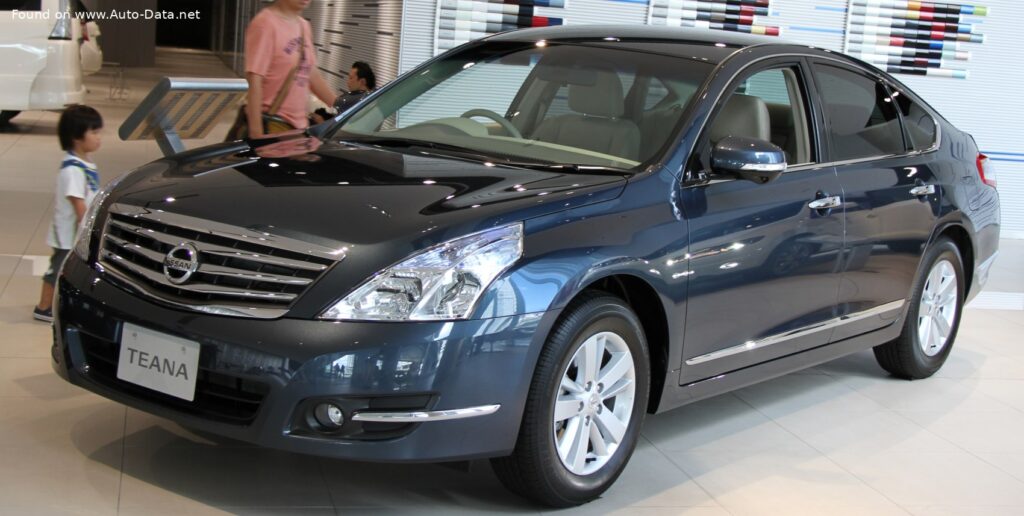
The Nissan Teana, specifically its second generation, the Nissan Teana II, marked Nissan’s significant foray into the executive mid-size sedan segment for markets outside of North America. Produced from 2008 to 2013, this iteration, and particularly the potent Nissan Teana II 3.5i V6 24V (249 Hp) variant, aimed to deliver a blend of luxury, comfort, and performance. While not offered for sale in the United States, the Teana achieved considerable success in Asian markets, Russia, and other regions, often serving as a more premium alternative to the Nissan Altima or Maxima, which were designed for the North American consumer. It was recognized for its sophisticated styling, spacious interior, and, in this specific configuration, its robust V6 engine.
Nissan Teana II 3.5i V6 24V (249 Hp): An Overview
The Teana II generation (codenamed J32) represented an evolution from its predecessor, focusing on enhanced refinement and a more contemporary aesthetic. It was designed to directly compete with established rivals like the Toyota Camry and Honda Accord in its target markets, offering a distinctly Nissan approach to comfort and driving dynamics. The 3.5i V6 model, with its powerful powertrain, was positioned as the flagship performance variant, appealing to buyers seeking a more engaging driving experience without compromising the plush ride expected of a car in this class.
Engine & Performance: The Heart of the Teana II
The core of the Nissan Teana II’s most performance-oriented variant was the acclaimed VQ35DE engine, a 3.5-liter V6 unit celebrated throughout Nissan’s lineup for its smooth power delivery and reliability. This specific iteration of the VQ engine, tuned for the Nissan Teana II 3.5i V6 24V (249 Hp), generated a healthy 249 horsepower at 6000 rpm and a substantial 240.45 lb.-ft. (326 Nm) of torque peaking at 4400 rpm. This naturally aspirated, multi-port injected engine featured a DOHC (Double Overhead Camshaft) valvetrain with four valves per cylinder, ensuring efficient breathing and a broad power band.
The VQ35DE engine, with its V-engine configuration and a compression ratio of 10.3:1, was known for its responsive throttle and refined operation. Paired with a continuously variable transmission (CVT), common for Nissan models of this era, the powertrain delivered power seamlessly to the front wheels. Despite the CVT, which can sometimes diminish performance feel, the V6 Teana was capable of impressive acceleration, achieving an estimated 6.8 seconds for a 0-60 mph sprint and 7.2 seconds for 0-100 km/h. Its top speed was electronically limited to 130.49 mph (210 km/h), making it a capable cruiser on highways.
Fuel economy for this powerful sedan was rated at a combined 23.1 US mpg (10.2 l/100 km), with urban consumption at 17 US mpg (13.8 l/100 km) and extra-urban at 28.7 US mpg (8.2 l/100 km). While not class-leading by today’s standards, these figures were respectable for a large V6-powered sedan of its time. The engine met Euro 3 emission standards, reflecting the regulations of its primary markets.
Design & Features: Executive Comfort and Style
The Nissan Teana II adopted a more mature and executive design language compared to its predecessor. As a traditional four-door, five-seat sedan, its dimensions were generous, contributing to a commanding road presence and a spacious interior. The exterior featured smooth lines, a prominent grille, and elegant headlamp designs that conveyed sophistication rather than aggressive sportiness. Its overall aesthetic was aimed at appealing to a slightly older, more discerning clientele who valued comfort and prestige.
Inside, the Teana II was celebrated for its “Modern Living” concept, emphasizing a premium, tranquil cabin environment. High-quality materials, soft-touch surfaces, and thoughtful ergonomics were hallmarks of its interior design. The 3.5i V6 model typically included standard features such as automatic climate control, a premium audio system, leather upholstery, power-adjustable seats, and keyless entry with push-button start. Safety features for the era included ABS (Anti-lock Braking System) as standard, with more advanced systems like traction control and stability control often available depending on the specific market and trim level.
The car’s independent McPherson strut front suspension and independent multi-link rear suspension, coupled with a front-wheel-drive architecture, were engineered to provide a comfortable and stable ride. This setup effectively absorbed road imperfections, making the Teana a pleasant vehicle for long journeys. Steering was managed by a rack and pinion system, offering predictable handling. The vehicle rode on 215/55 R17 tires, mounted on 7J x 16-inch wheels, providing a good balance of grip and ride comfort.
Technical Specifications
| Category | Specification |
| Brand | Nissan |
| Model | Teana |
| Generation | Teana II |
| Type (Engine) | 3.5i V6 24V (249 Hp) |
| Start of production | 2008 year |
| End of production | 2013 year |
| Powertrain Architecture | Internal Combustion engine |
| Body type | Sedan (4 Doors, 5 Seats) |
| Fuel consumption (economy) – urban | 13.8 l/100 km (17 US mpg) |
| Fuel consumption (economy) – extra urban | 8.2 l/100 km (28.7 US mpg) |
| Fuel consumption (economy) – combined | 10.2 l/100 km (23.1 US mpg) |
| Fuel Type | Petrol (Gasoline) |
| Acceleration 0 – 60 mph | 6.8 sec |
| Acceleration 0 – 100 km/h | 7.2 sec |
| Maximum speed | 210 km/h (130.49 mph) |
| Emission standard | Euro 3 |
| Weight-to-power ratio | 6.3 kg/Hp (157.5 Hp/tonne) |
| Weight-to-torque ratio | 4.8 kg/Nm (206.2 Nm/tonne) |
| Power | 249 Hp @ 6000 rpm |
| Power per litre | 71.2 Hp/l |
| Torque | 326 Nm @ 4400 rpm (240.45 lb.-ft. @ 4400 rpm) |
| Engine layout | Front, Transverse |
| Engine Model/Code | VQ35DE |
| Engine displacement | 3498 cm3 (3.5 liters / 213.46 cu. in.) |
| Number of cylinders | 6 (V-engine configuration) |
| Cylinder Bore | 95.5 mm (3.76 in.) |
| Piston Stroke | 81.4 mm (3.2 in.) |
| Compression ratio | 10.3:1 |
| Number of valves per cylinder | 4 |
| Fuel injection system | Multi-port manifold injection |
| Engine aspiration | Naturally aspirated engine |
| Valvetrain | DOHC |
| Engine oil capacity | 4.6 l (4.86 US qt) |
| Kerb Weight | 1581 kg (3485.51 lbs.) |
| Max. weight | 2060 kg (4541.52 lbs.) |
| Max load | 479 kg (1056.01 lbs.) |
| Trunk (boot) space – minimum | 488 l (17.23 cu. ft.) |
| Fuel tank capacity | 70 l (18.49 US gal) |
| Length | 4850 mm (190.94 in.) |
| Width | 1800 mm (70.87 in.) |
| Height | 1480 mm (58.27 in.) |
| Wheelbase | 2775 mm (109.25 in.) |
| Front track | 1550 mm (61.02 in.) |
| Rear (Back) track | 1550 mm (61.02 in.) |
| Minimum turning circle (turning diameter) | 10.6 m (34.78 ft.) |
| Drivetrain Architecture | Internal combustion engine (ICE) drives the front wheels. (Front wheel drive) |
| Front suspension | Independent, type McPherson with coil spring and anti-roll bar |
| Rear suspension | Independent multi-link spring suspension with stabilizer |
| Front brakes | Ventilated discs |
| Rear brakes | Disc |
| Assisting systems | ABS (Anti-lock braking system) |
| Steering type | Steering rack and pinion |
| Tires size | 215/55 R17 |
| Wheel rims size | 7J x 16 |
Legacy and Market Impact
The Nissan Teana II, and particularly its 3.5i V6 variant, established a significant presence in its target markets. It was often viewed as a more luxurious and comfortable alternative to the popular Toyota Camry and Honda Accord, which also competed strongly in the Asian and Russian mid-size sedan segments. While the Camry prioritized reliability and the Accord emphasized sportiness, the Teana positioned itself with a focus on interior comfort, refinement, and a plush ride.
Its powerful VQ35DE engine provided a performance advantage over many rivals’ non-premium V6 options, making it an appealing choice for those seeking executive comfort with ample power for effortless highway cruising and confident overtaking. In markets like Russia, where road conditions could be challenging and distances long, the Teana’s robust construction, comfortable suspension, and powerful engine made it a popular selection.
The Teana II’s legacy is that of a competent and sophisticated executive sedan that successfully catered to specific global markets with tailored features and performance. Its absence from the North American market demonstrates Nissan’s strategy of offering different models to suit regional preferences, with the Teana serving as an example of Nissan’s ability to produce compelling vehicles for diverse international audiences. Though it has been superseded by newer generations, the Nissan Teana II 3.5i V6 24V (249 Hp) remains a notable example of Nissan’s engineering capabilities and commitment to luxury in its class during its production years.