
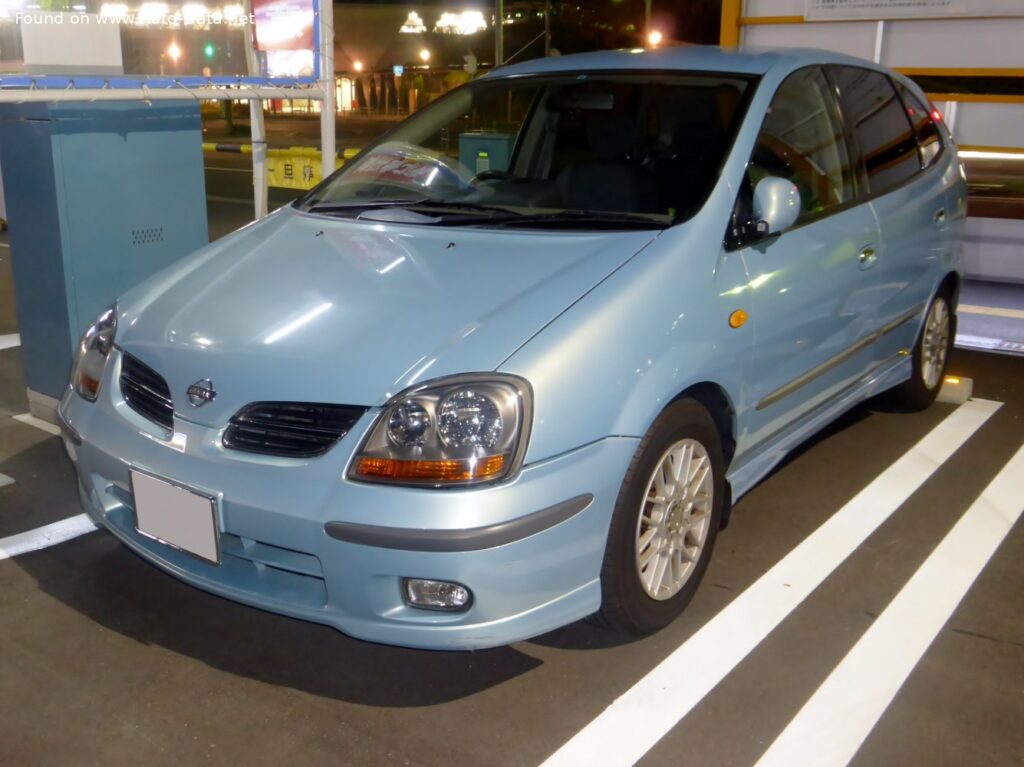
The Nissan Tino (V10), produced between 1999 and 2002, was a compact minivan primarily aimed at the European market. While not officially sold in the United States, it represents Nissan’s entry into the increasingly popular multi-purpose vehicle (MPV) segment during that period. Positioned as a practical and family-oriented vehicle, the Tino offered a blend of affordability, space, and Nissan’s reputation for reliability. It served as a competitor to vehicles like the Renault Scenic and Citroën Xsara Picasso, offering a similar level of functionality and versatility. The 1.5 i 16V variant, equipped with a 105 horsepower engine and automatic transmission, was a common configuration, designed for ease of use and fuel efficiency.
Nissan Tino (V10) 1.5 i 16V: An Overview
The Tino (V10) was a five-door, five-seater minivan built on Nissan’s compact platform. It was designed to provide a comfortable and spacious interior within a relatively small footprint, making it well-suited for urban environments and family use. The vehicle’s design prioritized practicality, with a focus on maximizing interior space and offering flexible seating arrangements. The 1.5-liter engine, while not exceptionally powerful, provided adequate performance for everyday driving, and the availability of an automatic transmission further enhanced its appeal to a broad range of drivers.
Engine & Performance
The Nissan Tino 1.5 i 16V is powered by a 1.5-liter inline four-cylinder gasoline engine. This naturally aspirated engine produces 105 horsepower at 6000 rpm and 135 Nm (99.57 lb-ft) of torque at 4400 rpm. The engine features a multi-port fuel injection system and a double overhead camshaft (DOHC) valvetrain, contributing to its relatively efficient operation. Power delivery is managed through a four-speed automatic transmission, directing power to the front wheels. The weight-to-power ratio of 15.3 kg/Hp and a weight-to-torque ratio of 11.9 kg/Nm indicate a focus on usability rather than outright performance. The engine’s 9.9:1 compression ratio is typical for engines of this era, balancing efficiency and durability. With a power output of 70.1 Hp per liter, the engine demonstrates a reasonable level of specific output for a naturally aspirated 1.5-liter unit.
Design & Features
The Nissan Tino (V10) features a conventional minivan silhouette, characterized by a tall roofline and a relatively short hood. The design is functional rather than overtly stylish, prioritizing interior space and practicality. The vehicle’s five-door configuration provides easy access for passengers and cargo. Inside, the Tino offers a comfortable and spacious cabin, with seating for five adults. While not lavishly equipped, the Tino included standard features such as power steering, front disc brakes, and an anti-lock braking system (ABS) for enhanced safety. The trunk offers a minimum of 440 liters (15.54 cu. ft.) of cargo space, which can be expanded to 1030 liters (36.37 cu. ft.) by folding down the rear seats. The vehicle’s dimensions – 4270 mm (168.11 in) in length, 1760 mm (69.29 in) in width, and 1610 mm (63.39 in) in height – place it firmly within the compact minivan segment.
Technical Specifications
| Brand | Nissan |
| Model | Tino |
| Generation | Tino (V10) |
| Type (Engine) | 1.5 i 16V (105 Hp) Automatic |
| Start of production | 1999 |
| End of production | 2002 |
| Powertrain Architecture | Internal Combustion engine |
| Body type | Minivan |
| Seats | 5 |
| Doors | 5 |
| Fuel Type | Petrol (Gasoline) |
| Weight-to-power ratio | 15.3 kg/Hp |
| Weight-to-torque ratio | 11.9 kg/Nm |
| Power | 105 Hp @ 6000 rpm |
| Power per litre | 70.1 Hp/l |
| Torque | 135 Nm @ 4400 rpm / 99.57 lb.-ft. @ 4400 rpm |
| Engine layout | Front, Transverse |
| Engine displacement | 1497 cm3 / 91.35 cu. in. |
| Number of cylinders | 4 |
| Engine configuration | Inline |
| Cylinder Bore | 73.6 mm / 2.9 in. |
| Piston Stroke | 88 mm / 3.46 in. |
| Compression ratio | 9.9:1 |
| Number of valves per cylinder | 4 |
| Fuel injection system | Multi-port manifold injection |
| Engine aspiration | Naturally aspirated engine |
| Valvetrain | DOHC |
| Kerb Weight | 1610 kg / 3549.44 lbs |
| Max. weight | 1880 kg / 4144.69 lbs |
| Max load | 270 kg / 595.25 lbs |
| Trunk (boot) space – minimum | 440 l / 15.54 cu. ft. |
| Trunk (boot) space – maximum | 1030 l / 36.37 cu. ft. |
| Fuel tank capacity | 50 l / 13.21 US gal | 11 UK gal |
| Length | 4270 mm / 168.11 in. |
| Width | 1760 mm / 69.29 in. |
| Height | 1610 mm / 63.39 in. |
| Wheelbase | 2535 mm / 99.8 in. |
| Front track | 1535 mm / 60.43 in. |
| Rear (Back) track | 1510 mm / 59.45 in. |
| Minimum turning circle (turning diameter) | 9.8 m / 32.15 ft. |
| Drivetrain Architecture | The Internal combustion engine (ICE) drives the front wheels of the vehicle. |
| Drive wheel | Front wheel drive |
| Number of gears and type of gearbox | 4 gears, automatic transmission |
| Front suspension | Coil spring |
| Rear suspension | Coil spring |
| Front brakes | Disc |
| Rear brakes | Disc |
| Assisting systems | ABS (Anti-lock braking system) |
| Steering type | Steering rack and pinion |
| Power steering | Hydraulic Steering |
| Tires size | 175/70 R13 |
| Wheel rims size | 13 |
The Nissan Tino (V10) 1.5 i 16V, while not a groundbreaking vehicle, represented a solid offering in the compact minivan segment. Its practicality, affordability, and Nissan’s reputation for reliability made it a popular choice for families in Europe. Although never sold in the US market, it provides a glimpse into Nissan’s global product strategy during the late 1990s and early 2000s.
