
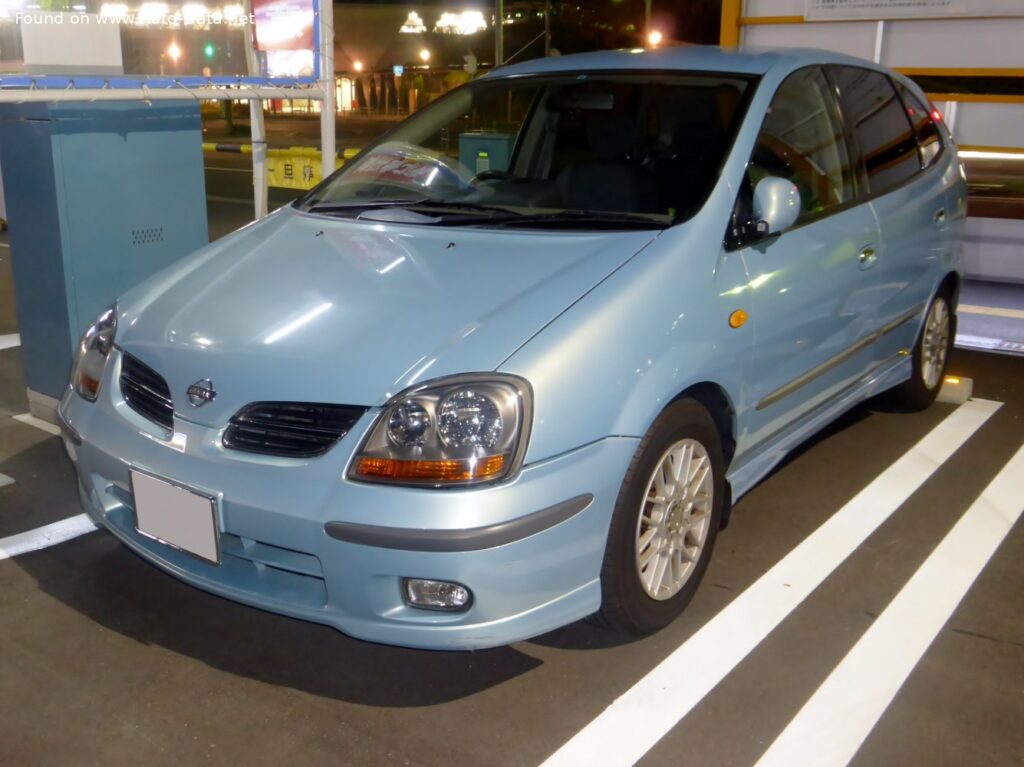
The Nissan Tino (V10), produced between 1999 and 2002, was a compact minivan primarily aimed at the European market. While not officially sold in the United States, it represented Nissan’s entry into the increasingly popular leisure activity vehicle (LAV) segment, offering a practical and versatile alternative to larger, more traditional minivans. The Tino distinguished itself with a focus on a comfortable ride, user-friendly interior, and a relatively compact footprint, making it well-suited for navigating tighter European city streets. It served as a competitor to models like the Renault Scenic and Citroën Xsara Picasso, offering a blend of practicality and affordability.
Nissan Tino (V10): An Overview
The V10 generation Tino was based on the Nissan Sunny (Sentra in North America) platform, sharing many of its mechanical components. It was positioned as a five-seater, five-door vehicle designed for families and individuals seeking a flexible and efficient mode of transport. The Tino’s design prioritized interior space and functionality over sporty aesthetics, reflecting its intended role as a practical family vehicle. The 2.0i 16V variant, equipped with a 135 horsepower engine, was a popular choice, offering a balance between performance and fuel economy.
Engine & Performance
The Nissan Tino 2.0i 16V was powered by a 1.998-liter inline-four cylinder gasoline engine. This naturally aspirated engine produced 135 horsepower at 5600 rpm and 178 Nm (131.29 lb.-ft.) of torque at 4800 rpm. The engine featured a multi-port fuel injection system and a double overhead camshaft (DOHC) valvetrain, contributing to its relatively efficient operation. Power delivery was smooth and predictable, making it suitable for everyday driving. The engine’s power-to-weight ratio of 10.3 kg/Hp (97.1 Hp/tonne) provided adequate acceleration, while the torque-to-weight ratio of 7.8 kg/Nm (128.1 Nm/tonne) ensured reasonable responsiveness. The engine was coupled with a four-speed automatic transmission, delivering power to the front wheels. Fuel economy figures were respectable for its class, achieving approximately 8.6 l/100 km (27.4 US mpg) in urban conditions and 5.52 l/100 km (42.6 US mpg) on the open road.
Design & Features
The Nissan Tino V10 adopted a conventional minivan silhouette, characterized by a tall roofline and a relatively boxy shape to maximize interior space. The exterior design was understated and functional, prioritizing practicality over stylistic flair. The vehicle’s five-door configuration provided easy access for passengers and cargo. Inside, the Tino offered a comfortable and spacious cabin for five occupants. The rear seats could be folded down to increase cargo capacity, providing flexibility for carrying larger items. The trunk offered a minimum capacity of 440 liters (15.54 cu. ft.), expanding to 1030 liters (36.37 cu. ft.) with the rear seats folded. Standard features included power steering, disc brakes on all four wheels, and an Anti-lock Braking System (ABS) for enhanced safety. The Tino’s suspension utilized coil springs on both the front and rear axles, providing a comfortable ride quality. The vehicle’s turning circle of 9.2 meters (30.18 ft) made it relatively maneuverable in urban environments.
Technical Specifications
| Brand | Nissan |
| Model | Tino |
| Generation | Tino (V10) |
| Type (Engine) | 2.0 i 16V (135 Hp) |
| Start of production | 1999 |
| End of production | 2002 |
| Powertrain Architecture | Internal Combustion engine |
| Body type | Minivan |
| Seats | 5 |
| Doors | 5 |
| Fuel consumption (urban) | 8.6 l/100 km (27.4 US mpg) |
| Fuel consumption (extra urban) | 5.52 l/100 km (42.6 US mpg) |
| Fuel Type | Petrol (Gasoline) |
| Weight-to-power ratio | 10.3 kg/Hp |
| Weight-to-torque ratio | 7.8 kg/Nm |
| Power | 135 Hp @ 5600 rpm |
| Power per litre | 67.6 Hp/l |
| Torque | 178 Nm @ 4800 rpm (131.29 lb.-ft. @ 4800 rpm) |
| Engine layout | Front, Transverse |
| Engine displacement | 1998 cm3 (121.93 cu. in.) |
| Number of cylinders | 4 |
| Engine configuration | Inline |
| Cylinder Bore | 86 mm (3.39 in.) |
| Piston Stroke | 86 mm (3.39 in.) |
| Compression ratio | 9.5:1 |
| Number of valves per cylinder | 4 |
| Fuel injection system | Multi-port manifold injection |
| Engine aspiration | Naturally aspirated |
| Valvetrain | DOHC |
| Kerb Weight | 1390 kg (3064.43 lbs.) |
| Max. weight | 1880 kg (4144.69 lbs.) |
| Max load | 490 kg (1080.27 lbs.) |
| Trunk (boot) space – minimum | 440 l (15.54 cu. ft.) |
| Trunk (boot) space – maximum | 1030 l (36.37 cu. ft.) |
| Fuel tank capacity | 50 l (13.21 US gal | 11 UK gal) |
| Length | 4270 mm (168.11 in.) |
| Width | 1760 mm (69.29 in.) |
| Height | 1610 mm (63.39 in.) |
| Wheelbase | 2535 mm (99.8 in.) |
| Front track | 1535 mm (60.43 in.) |
| Rear track | 1510 mm (59.45 in.) |
| Minimum turning circle | 9.2 m (30.18 ft.) |
| Drivetrain Architecture | Front wheel drive |
| Number of gears | 4 |
| Gearbox type | Automatic transmission |
| Front suspension | Coil spring |
| Rear suspension | Coil spring |
| Front brakes | Disc |
| Rear brakes | Disc |
| Assisting systems | ABS (Anti-lock braking system) |
| Steering type | Steering rack and pinion |
| Power steering | Hydraulic |
| Tires size | 205/55 R16 |
The Nissan Tino (V10) 2.0i 16V, while not a groundbreaking vehicle, offered a practical and reliable transportation solution for European families. Its blend of affordability, functionality, and reasonable fuel economy contributed to its moderate success in a competitive market segment. Though largely unknown in the United States, it represents a significant part of Nissan’s global product strategy during the late 1990s and early 2000s.
