The Nissan Titan II Crew Cab, particularly the 2020 facelift model, represents Nissan’s full-size pickup truck offering for the North American market. Introduced as a complete redesign for the 2016 model year, the Titan aimed to provide a more competitive alternative to established American brands like Ford, Chevrolet, and Ram. The 2020 refresh brought updated styling, enhanced technology, and a continued focus on delivering a robust and capable truck. Positioned within the highly competitive full-size pickup segment, the Titan II Crew Cab caters to buyers seeking a blend of work capability, passenger comfort, and towing capacity. This version, equipped with a 5.6-liter V8 engine and four-wheel drive, is a key configuration within the Titan lineup.
Nissan Titan II Crew Cab: A Detailed Overview
The Titan II generation marked a significant shift for Nissan in the pickup truck arena. Prior to this, Nissan’s full-size offerings hadn’t consistently resonated with American truck buyers. The second generation sought to address this by offering a more distinctly American-designed and engineered vehicle. The 2020 facelift further refined this approach, focusing on improving the overall ownership experience through enhanced features and a more modern aesthetic. The Crew Cab configuration, with its spacious four-door layout, prioritizes passenger comfort, making it suitable for both work and family use.
Engine & Performance
At the heart of the 2020 Nissan Titan II Crew Cab is the VK56VD 5.6-liter V8 engine. This naturally aspirated powerplant delivers 400 horsepower at 5800 rpm and 560 Nm (413.03 lb.-ft.) of torque at 4000 rpm. The engine utilizes direct fuel injection and a variable valve timing system (VVWL, CVTS) to optimize performance and efficiency. Power is delivered through a smooth and responsive 9-speed automatic transmission, which contributes to improved fuel economy and drivability. The engine’s longitudinal mounting and the truck’s all-wheel-drive (4×4) system provide robust traction and capability in various driving conditions. The weight-to-power ratio of 6.7 kg/Hp and a weight-to-torque ratio of 4.8 kg/Nm demonstrate a respectable balance between power and mass. Fuel economy figures are rated at 13.1 l/100 km (18 US mpg) combined, with 15.7 l/100 km (15 US mpg) in urban settings and 11.2 l/100 km (21 US mpg) on the highway.
Design & Features
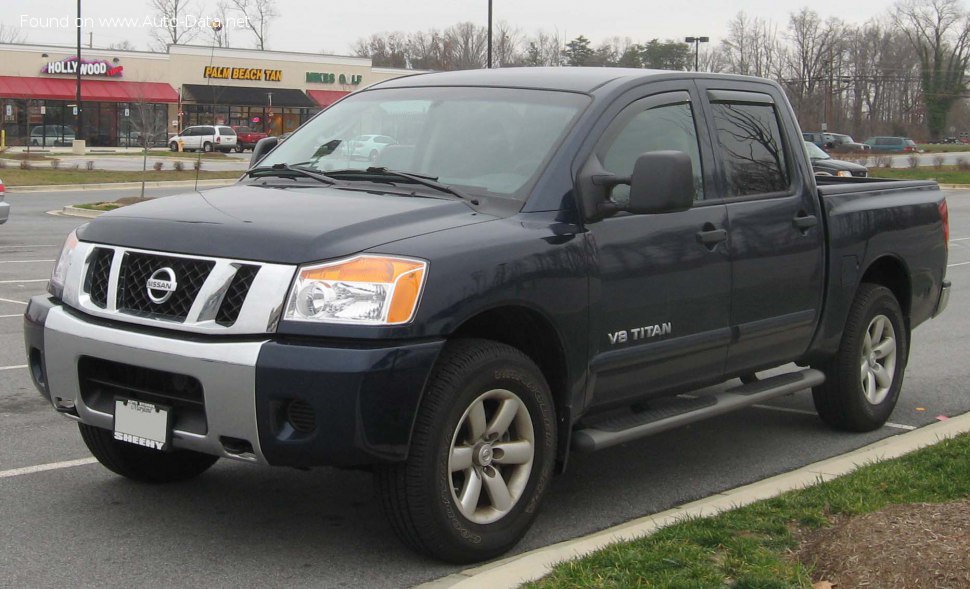
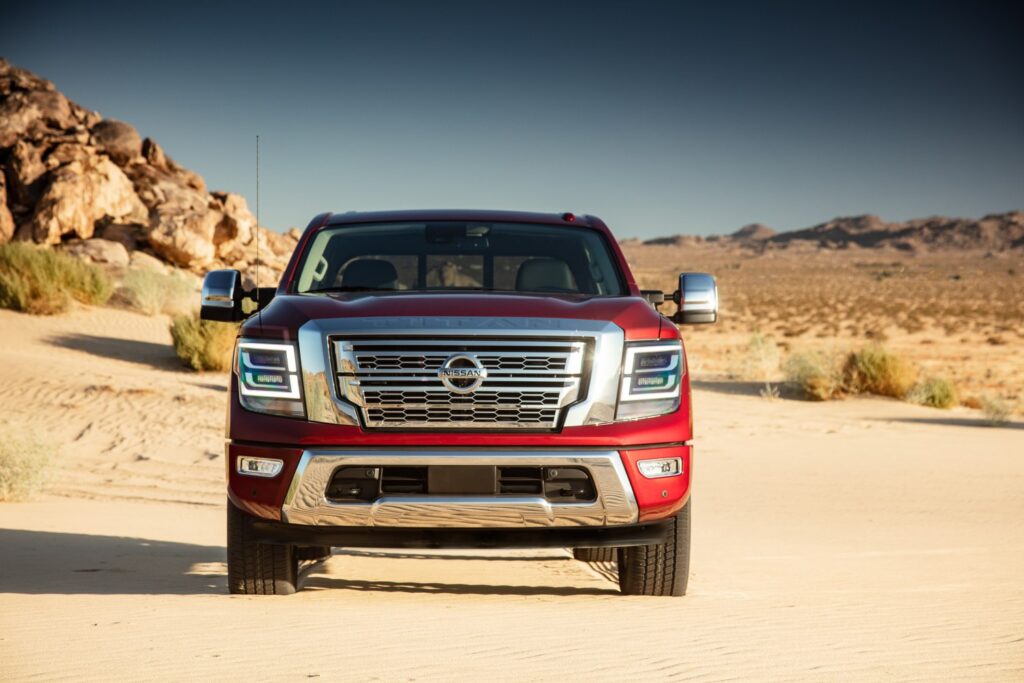
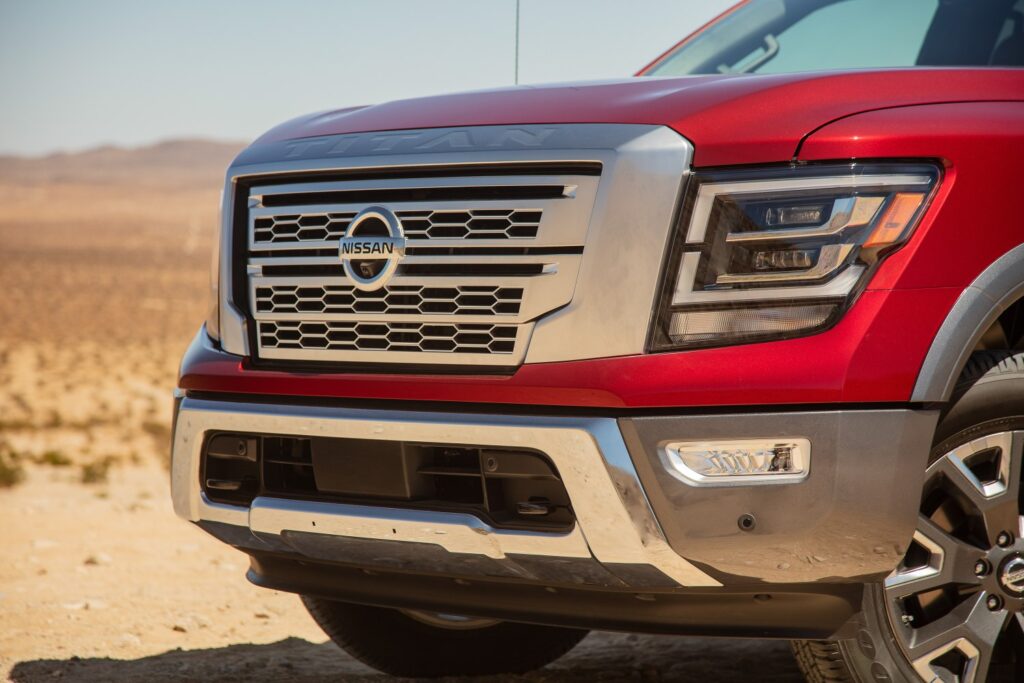
The 2020 Nissan Titan II Crew Cab maintains the robust and imposing design language established with the second generation. The exterior features a bold front grille, prominent headlights, and a muscular profile. The Crew Cab body style offers ample space for five passengers, with comfortable seating and a well-appointed interior. Key features include a standard 8-inch touchscreen infotainment system, Apple CarPlay and Android Auto compatibility, and a suite of advanced driver-assistance systems (ADAS) such as Automatic Emergency Braking and Blind Spot Monitoring. The truck’s bed provides a practical cargo area for hauling, and its maximum payload capacity ranges from 626 to 636 kg (1380.09 – 1402.14 lbs.). The Titan II Crew Cab is designed to be a versatile vehicle, capable of handling both demanding work tasks and everyday transportation needs. Ground clearance is a substantial 257 mm (10.12 in), enhancing its off-road capability. The permitted trailer load with brakes is an impressive 4178 kg (9210.91 lbs).
Technical Specifications
| Brand | Nissan |
| Model | Titan |
| Generation | Titan II Crew Cab (facelift 2020) |
| Type | 5.6 V8 (400 Hp) 4WD Automatic 5 seats |
| Start of production | 2020 |
| Powertrain Architecture | Internal Combustion engine |
| Body type | Pick-up |
| Seats | 5 |
| Doors | 4 |
| Fuel consumption (urban) | 15.7 l/100 km (15 US mpg, 18 UK mpg) |
| Fuel consumption (extra urban) | 11.2 l/100 km (21 US mpg, 25.2 UK mpg) |
| Fuel consumption (combined) | 13.1 l/100 km (18 US mpg, 21.6 UK mpg) |
| Fuel Type | Petrol (Gasoline) |
| Emission standard | LEV3-ULEV200 |
| Weight-to-power ratio | 6.7 kg/Hp |
| Weight-to-torque ratio | 4.8 kg/Nm |
| Power | 400 Hp @ 5800 rpm |
| Power per litre | 72 Hp/l |
| Torque | 560 Nm @ 4000 rpm (413.03 lb.-ft. @ 4000 rpm) |
| Maximum engine speed | 6000 rpm |
| Engine layout | Front, Longitudinal |
| Engine Model/Code | VK56VD |
| Engine displacement | 5552 cm3 (338.8 cu. in.) |
| Number of cylinders | 8 |
| Engine configuration | V-engine |
| Cylinder Bore | 98 mm (3.86 in.) |
| Piston Stroke | 92 mm (3.62 in.) |
| Compression ratio | 11.2:1 |
| Number of valves per cylinder | 4 |
| Fuel injection system | Direct injection |
| Engine aspiration | Naturally aspirated engine |
| Valvetrain | VVWL, CVTS |
| Engine oil capacity | 6.5 l (6.87 US qt | 5.72 UK qt) |
| Coolant capacity | 13.4 l (14.16 US qt | 11.79 UK qt) |
| Kerb Weight | 2675-2685 kg (5897.37 – 5919.41 lbs.) |
| Max. weight | 3311 kg (7299.51 lbs.) |
| Max load | 626-636 kg (1380.09 – 1402.14 lbs.) |
| Fuel tank capacity | 98 l (25.89 US gal | 21.56 UK gal) |
| Permitted trailer load with brakes (12%) | 4178 kg (9210.91 lbs.) |
| Length | 5796 mm (228.19 in.) |
| Width | 2019 mm (79.49 in.) |
| Height | 1961 mm (77.2 in.) |
| Wheelbase | 3551 mm (139.8 in.) |
| Front track | 1730 mm (68.11 in.) |
| Rear track | 1730 mm (68.11 in.) |
| Ride height (ground clearance) | 257 mm (10.12 in.) |
| Minimum turning circle | 14.6 m (47.9 ft.) |
| Approach angle | 20° |
| Departure angle | 22.9° |
| Ramp-over angle | 21.7° |
| Drivetrain Architecture | All wheel drive (4×4). ICE drives rear wheels, front wheels engaged via clutch. |
| Number of gears | 9 |
| Gearbox type | Automatic transmission |
| Front suspension | Double wishbone |
| Rear suspension | Leaf spring |
| Front brakes | Ventilated discs, 350 mm |
| Rear brakes | Ventilated discs, 345 mm |
| Assisting systems | ABS (Anti-lock braking system) |
| Steering type | Steering rack and pinion |
| Tires size | 275/60 R20 |
| Wheel rims size | 8J x 20 |