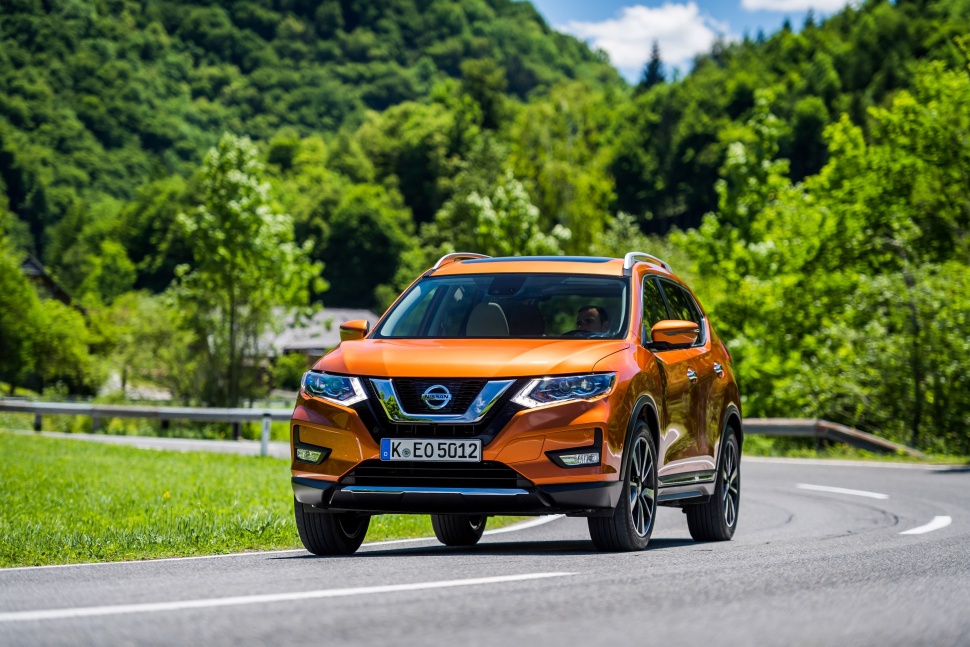
The Nissan X-Trail III (T32), particularly the facelifted version introduced in 2017, represents a significant iteration of Nissan’s popular compact SUV. Sold extensively in Europe and other international markets, the X-Trail occupies a crucial position in Nissan’s lineup, offering a blend of practicality, fuel efficiency, and available all-wheel drive. The 1.6 dCi variant, producing 130 horsepower, was a key offering, catering to markets prioritizing diesel economy and lower emissions. This version, often configured with seven seats, aimed to provide family-friendly versatility within a competitive segment.
Nissan X-Trail III (T32, facelift 2017) 1.6 dCi: Overview
The T32 generation X-Trail, launched initially in 2014, received a substantial facelift in 2017, bringing revised styling, updated technology, and refined engine options. The 1.6 dCi model, equipped with a Renault-sourced diesel engine, was specifically designed to meet stringent European emission standards while delivering acceptable performance. The availability of a seven-seat configuration further broadened its appeal to larger families. While not officially sold in the United States, the X-Trail is comparable to vehicles like the Honda CR-V or Toyota RAV4 in terms of size and functionality.
Engine & Performance
The heart of the 2017 Nissan X-Trail 1.6 dCi is a 1.6-liter inline-four cylinder diesel engine, designated the R9M. This engine produces 130 horsepower at 4000 rpm and a respectable 320 Nm (236 lb-ft) of torque at 1750 rpm. The engine utilizes a turbocharger with an intercooler to enhance power output and efficiency. Power is delivered to the front wheels via a six-speed manual transmission. Acceleration from 0 to 100 km/h (0-62 mph) takes approximately 10.5 seconds, with a top speed of 188 km/h (116.82 mph). Fuel economy is a strong point, with combined cycle figures ranging from 4.9 to 5.1 liters per 100 kilometers (48-46.1 US mpg). The engine meets Euro 6b emission standards, incorporating a particulate filter to reduce harmful emissions.
Design & Features
The 2017 X-Trail facelift features a more prominent V-motion grille, redesigned headlights, and updated bumpers, giving it a more modern and assertive appearance. The body style is a classic five-door SUV, with the option of a seven-seat configuration. The interior focuses on practicality and comfort, with a user-friendly dashboard layout and ample storage space. Key features include air conditioning, power windows, and a basic audio system. Higher trim levels offered features like navigation, a rearview camera, and parking sensors. Safety features, crucial for family vehicles, include ABS (Anti-lock Braking System), and multiple airbags. The seven-seat option provides flexibility for families, although the third-row seats are best suited for children or shorter journeys. Trunk space varies significantly depending on whether the third-row seats are in use, ranging from 135 liters (4.77 cu ft) with all seats up to 1877 liters (66.29 cu ft) with the rear seats folded down.
Technical Specifications
| Brand | Nissan |
| Model | X-Trail |
| Generation | X-Trail III (T32, facelift 2017) |
| Type (Engine) | 1.6 dCi (130 Hp) 7 Seat |
| Start of production | 2017 |
| End of production | August, 2018 |
| Powertrain Architecture | Internal Combustion engine |
| Body type | SUV |
| Seats | 7 |
| Doors | 5 |
| Fuel consumption (urban) | 5.7-5.8 l/100 km (41.3 – 40.6 US mpg) |
| Fuel consumption (extra urban) | 4.5-4.6 l/100 km (52.3 – 51.1 US mpg) |
| Fuel consumption (combined) | 4.9-5.1 l/100 km (48 – 46.1 US mpg) |
| CO2 emissions | 129-133 g/km |
| Fuel Type | Diesel |
| Acceleration 0 – 100 km/h | 10.5 sec |
| Acceleration 0 – 62 mph | 10.5 sec |
| Acceleration 0 – 60 mph | 10 sec |
| Maximum speed | 188 km/h (116.82 mph) |
| Emission standard | Euro 6 b |
| Weight-to-power ratio | 11.9 kg/Hp |
| Weight-to-torque ratio | 4.8 kg/Nm |
| Power | 130 Hp @ 4000 rpm |
| Torque | 320 Nm @ 1750 rpm (236.02 lb.-ft. @ 1750 rpm) |
| Engine layout | Front, Transverse |
| Engine Model/Code | R9M |
| Engine displacement | 1598 cm3 (97.52 cu. in.) |
| Number of cylinders | 4 |
| Engine configuration | Inline |
| Cylinder Bore | 80 mm (3.15 in.) |
| Piston Stroke | 79.5 mm (3.13 in.) |
| Number of valves per cylinder | 4 |
| Fuel injection system | Diesel Commonrail |
| Engine aspiration | Turbocharger, Intercooler |
| Engine oil capacity | 5.5 l (5.81 US qt | 4.84 UK qt) |
| Coolant | 7.9 l (8.35 US qt | 6.95 UK qt) |
| Kerb Weight | 1550-1703 kg (3417.17 – 3754.47 lbs.) |
| Max. weight | 2310 kg (5092.68 lbs.) |
| Max load | 607-760 kg (1338.21 – 1675.51 lbs.) |
| Trunk (boot) space – minimum | 135 l (4.77 cu. ft.) |
| Trunk (boot) space – maximum | 1877 l (66.29 cu. ft.) |
| Fuel tank capacity | 60 l (15.85 US gal | 13.2 UK gal) |
| Max. roof load | 100 kg (220.46 lbs.) |
| Permitted trailer load with brakes (12%) | 2000 kg (4409.25 lbs.) |
| Permitted trailer load without brakes | 750 kg (1653.47 lbs.) |
| Permitted towbar download | 100 kg (220.46 lbs.) |
| Length | 4690 mm (184.65 in.) |
| Width | 1820-1830 mm (71.65 – 72.05 in.) |
| Height | 1700-1730 mm (66.93 – 68.11 in.) |
| Wheelbase | 2705 mm (106.5 in.) |
| Front track | 1575-1585 mm (62.01 – 62.4 in.) |
| Rear (Back) track | 1575-1585 mm (62.01 – 62.4 in.) |
| Ride height (ground clearance) | 210 mm (8.27 in.) |
| Minimum turning circle (turning diameter) | 11.2 m (36.75 ft.) |
| Drivetrain Architecture | Front wheel drive |
| Number of gears and type of gearbox | 6 gears, manual transmission |
| Front suspension | Independent, type McPherson with coil spring and anti-roll bar |
| Rear suspension | Independent multi-link suspension |
| Front brakes | Ventilated discs |
| Rear brakes | Ventilated discs |
| Tires size | 225/65 R17; 225/60 R18; 225/55 R19 |
| Wheel rims size | 17; 18; 19 |